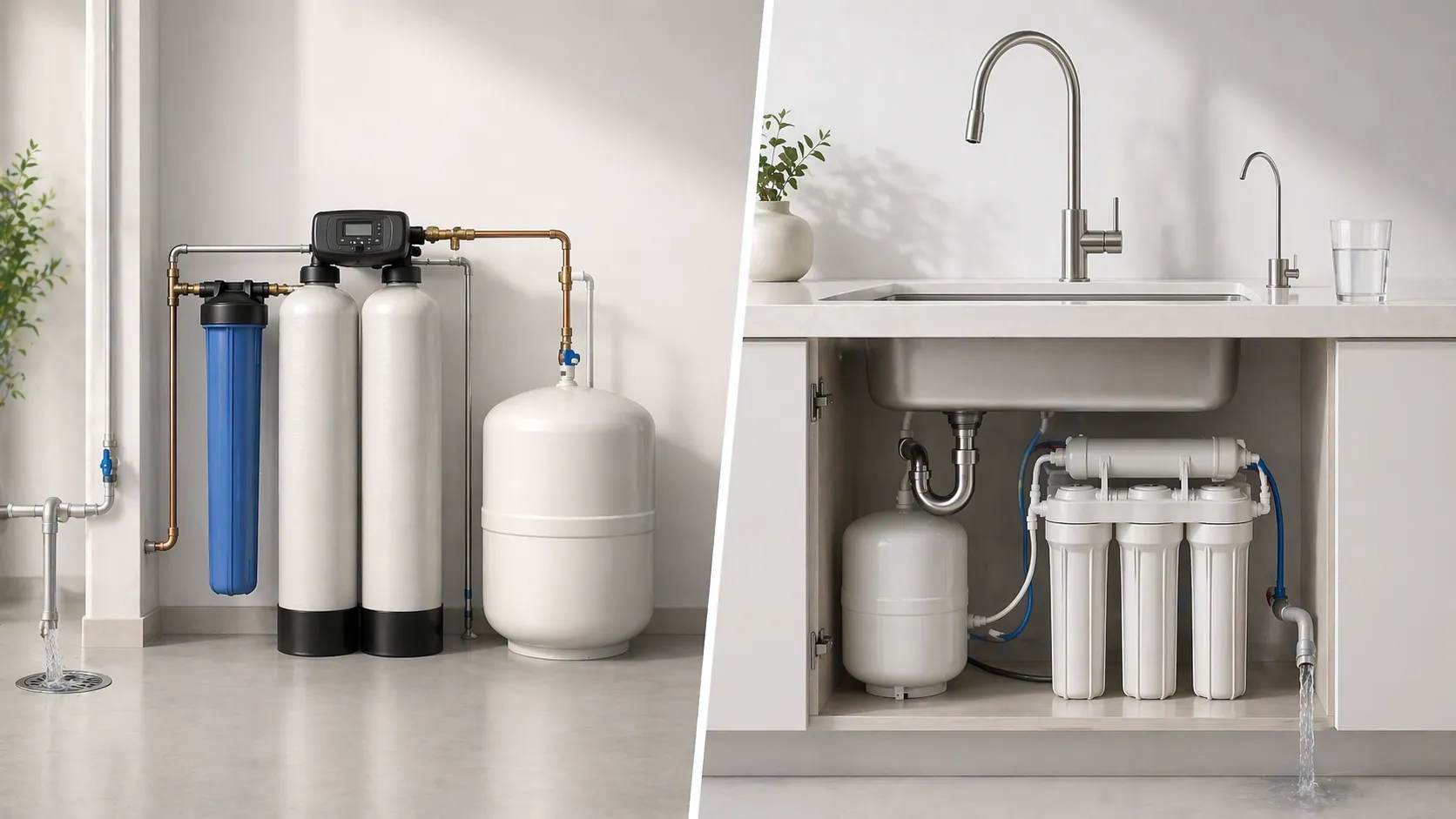
We get this question a lot from readers who want the cleanest possible water but do not want to overbuild the system. That is exactly the right instinct. Reverse osmosis can be a very smart upgrade, but the best setup is not always the biggest one. In many homes, the real decision is not whether RO works; it is whether you need deep filtration at every tap, or only where you actually drink and cook. That difference changes everything, including cost, complexity, wastewater, maintenance, and long-term sustainability. If you are weighing a whole-house setup, this guide to the best whole-house reverse osmosis systems walks through when a full-home RO system makes sense and when a point-of-use approach is the better fit.
Quick Answer
For most homes, point-of-use RO makes more sense than whole-house RO.
If your main goal is cleaner drinking and cooking water, an under-sink or other point-of-use RO system usually gives you the best balance of performance, cost, and practicality. Whole-house RO can be the right choice when the entire home has serious dissolved contaminant problems, very high dissolved solids, brackish water, or a well-water profile that truly justifies deep treatment everywhere.
If you do not have a whole-home water problem, whole-house RO is often more system, more wastewater, and more expense than you actually need.
At a Glance: Whole-House RO vs Point-of-Use RO
| Category | Whole-House RO | Point-of-Use RO |
| Best for | Serious whole-home dissolved contaminant issues | Drinking and cooking water at one or a few taps |
| Upfront cost | High | Much lower |
| Installation complexity | High | Usually moderate |
| Maintenance burden | Higher | Easier to manage |
| Wastewater impact | Higher overall | Lower overall |
| Sustainability logic | Only makes sense when the full house truly needs it | Better fit for most homes |
| Space required | Much more | Much less |
| Material burden | Larger system, more fittings, tanks, and components | Smaller and simpler setup |
What Is the Real Difference?
Both systems use reverse osmosis technology, but they solve different problems.
A whole-house RO system treats water before it moves through the rest of the home. That means showers, laundry, bathroom sinks, kitchen taps, and appliances all receive RO-treated water.
A point-of-use RO system treats water only where you install it, most commonly under the kitchen sink. That means you reserve the deepest filtration for the water you actually drink and cook with.
That distinction matters because not all water use deserves the same level of treatment.
Using highly filtered RO water to fill a pot, make coffee, or mix baby formula can make obvious sense.
Using that same level of treatment for toilet flushing or general cleaning water is a very different value equation.
Point-of-use efficiency wins for most: best under sink water filter, pure drinking water, zero house-wide waste.
Cost: Upfront and Ongoing
This is usually the first major dividing line, and it runs through the entire ownership period, not just the purchase.
Whole-house RO is a much bigger project. You are paying for larger system design, more plumbing integration, more components, often more storage capacity, and usually more labor. Everything around it tends to be larger too: more maintenance, more pretreatment responsibility, and higher service cost if something goes wrong.
Point-of-use RO is much easier to justify financially. The maintenance is more contained, the component count is lower, and the financial risk of ownership is simply more reasonable. If a cartridge needs replacement or the membrane ages out, the scale of the problem stays manageable.
For most households, that difference matters more than marketing language about ultimate purity.
Whole-house RO reality check: best whole house reverse osmosis systems—when the 4:1 wastewater ratio actually pays off
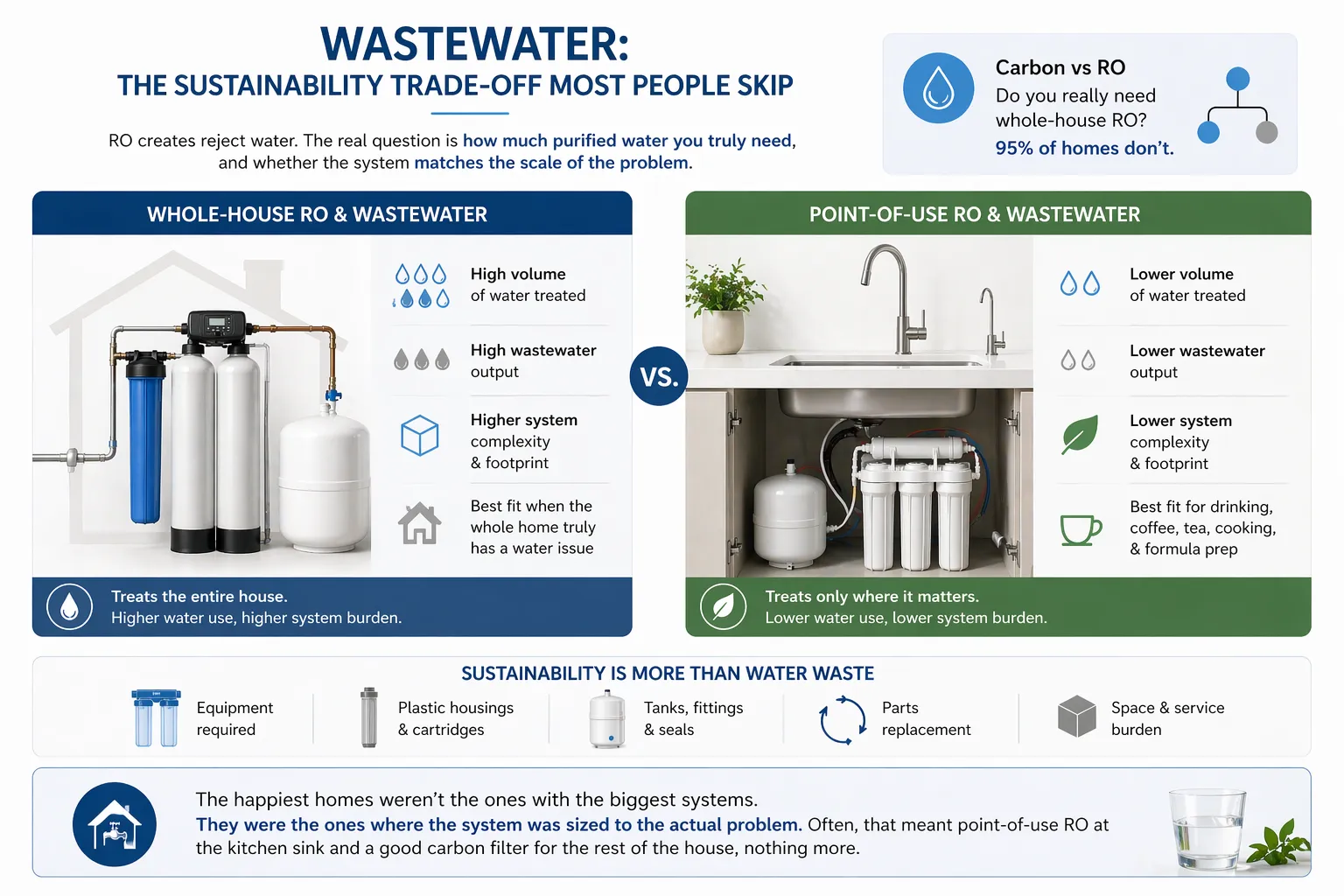
Wastewater: The Sustainability Trade-Off Most People Skip
This is one of the most important parts of the decision.
Reverse osmosis works by separating purified water from rejected water. That means wastewater is part of the process. The key question is not whether RO creates reject water. It does. The real question is how much purified water you truly need, and whether the scale of the system matches the scale of the problem.
Whole-house RO and wastewater
Whole-house RO applies deep filtration to the entire house. That means the total volume moving through the system is dramatically larger.
If the water issue truly affects the whole home, that can still make sense.
But if your real concern is only what you drink, then using whole-house RO means you are paying the wastewater and system-burden logic of full-home treatment for a problem that may only exist at one sink.
That is where the sustainability case starts to weaken.
Carbon vs RO decision tree: do you really need whole-house RO, 95% of homes don’t.
Point-of-use RO and wastewater
Point-of-use RO still creates reject water, but the total treated volume is much smaller because it is focused where it matters most.
That makes it easier to defend from both a practical and sustainability perspective.
If you only need RO for drinking, coffee, tea, cooking, or formula prep, point-of-use RO usually creates a more proportional system. It keeps deep treatment where the highest-value uses actually happen.
Wastewater fix for any RO: remineralizing RO water protects teeth after filtration.
Sustainability Is Not Just Water Waste
This is where HH should stay more thoughtful than a generic filter site.
Sustainability is not only about reject water. It is also about the total system footprint.
That includes:
- how much equipment is required
- how many plastic housings and cartridges are involved
- how many tanks, fittings, and seals are added
- how often parts are replaced
- how much space and service burden the setup creates
A whole-house RO system may be justified in a hard case, but it is not automatically the more responsible or more advanced choice. In many ordinary homes, it is the less proportional one.
A smaller point-of-use system can actually be the more sustainable option because it delivers deep filtration only where the return is highest.
We reviewed a number of whole-house RO installations for this article and one pattern stood out consistently: the homes that were happiest with their setup were not the ones with the biggest systems. They were the ones where the system was sized to the actual problem. In several cases, that meant point-of-use RO at the kitchen sink and a good carbon filter for the rest of the house, nothing more.
RO purity myths decoded: is reverse osmosis water too pure, science says remineralize.
Why Larger Whole-House RO Gets More Complex Faster
This is one of the least discussed trade-offs.
In larger whole-house RO setups, the system often does not stop at the membrane itself. Extra storage, added pressure management, and more downstream components can increase both cost and maintenance. In some designs, that can also mean more attention to hygiene, stabilization, and material quality than homeowners expect at first.
If treated water sits in larger storage components before distribution, the system design has to stay much tighter. In some setups, additional post-treatment or extra hygiene safeguards may be considered. That does not make whole-house RO wrong. It simply makes it more complex than many homeowners realize when they first compare it to a kitchen-sink RO unit.
That added complexity is exactly why whole-house RO should solve a real whole-home problem, not just satisfy the feeling that bigger must be better.
Material Burden and Zero Toxic Load Logic
This is where the HH lens matters.
If you build a large filtration system, you are not only choosing a technology. You are choosing an ecosystem of materials.
Whole-house RO often means more:
- housings
- fittings
- seals
- tubing
- storage components
- maintenance touchpoints
That makes material quality even more important.
From a Zero Toxic Load perspective, the best system is not the most dramatic one. It is the one that solves the real problem with the cleanest overall material logic.
If deep filtration is only needed at one tap, then a smaller high-quality point-of-use setup is often the better decision than a much larger system built around more plastic, more complexity, and more long-term upkeep.
There is also a plumbing logic to remember. Very low-mineral water can be more aggressive in some distribution setups if it is not properly stabilized before moving through the home. That is another reason whole-house RO deserves more design caution than most sales pages admit.
Balanced approach beats extremes: layered filtration, whole-house carbon + targeted RO
When Whole-House RO Actually Makes Sense
Whole-house RO can be the right answer, but the reasons should be strong.
It makes more sense when:
- your water has serious dissolved contaminant issues across the entire home
- you have very high dissolved solids or brackish water that affect all uses
- your private well profile justifies broader treatment
- point-of-use treatment alone would leave major whole-home problems unresolved
- the system is being designed properly, not added impulsively
This is not the category most standard city-water households fall into.
When Point-of-Use RO Is the Smarter Choice
For many homes, point-of-use RO is the better long-term decision.
It makes more sense when:
- your main concern is drinking and cooking water
- the rest of the home does not need deep mineral stripping
- you want better cost control
- you want lower overall system complexity
- you want the cleanest sustainability argument for using RO at all
This is especially true in homes where chlorine, odor, or general city-water cleanup can be handled with carbon or layered filtration, while RO is reserved only for the kitchen sink.
That kind of setup often gives the best of both worlds.
Affordable entry point: best whole house water filter system skips RO expense.
The Best Middle Ground for Most Homes
For most HH readers, the smartest setup is not an all-or-nothing choice.
It is usually one of these:
Option 1: Whole-house carbon plus point-of-use RO
This is one of the strongest setups for city-water homes.
You get:
- better shower and household water
- reduced chlorine and taste issues across the home
- deep filtration only where you drink and cook
This is often the best balance of comfort, health logic, cost, and sustainability.
Option 2: Softener plus point-of-use RO
If hard water is the main full-home problem, and drinking water quality is the kitchen priority, this setup often makes more sense than whole-house RO.
Option 3: Whole-house RO only when testing clearly justifies it
If the water problem is truly broad, then whole-house RO may be appropriate. But it should be the result of testing and design, not the result of assuming bigger always means better.
Installation sticker shock: whole house water filter installation cost $2K vs $300 reality.
My Honest Take
For most homes, point-of-use RO is the better answer.
It is cheaper, simpler, easier to maintain, and easier to defend from a sustainability perspective. Most importantly, it applies deep filtration where it matters most instead of turning the whole house into a high-complexity treatment project.
Whole-house RO can absolutely be the right call in the right conditions. But in many homes, it is a premium-scale response to a kitchen-scale problem.
From an HH perspective, that matters.
If your real concern is what goes into your coffee, food, drinking glasses, and baby formula, then build for that. Do not automatically purify toilet water, shower water, and general utility water to the same level unless your testing gives you a real reason.
The goal is not maximum filtration at any cost.
The goal is proportionate filtration with the least unnecessary waste, the least unnecessary material burden, and the smartest health logic.
FAQ
Is whole-house RO better than under-sink RO?
Not automatically. It is broader, not always smarter. Whole-house RO treats the entire home, while under-sink RO focuses on drinking and cooking water. For many households, under-sink RO is the better fit.
Does whole-house RO waste more water?
In overall household terms, usually yes, because it is treating much larger total volumes. The issue is not just system type, but how much water you are pushing through deep filtration in the first place.
Is point-of-use RO more sustainable?
Often yes, because it limits deep filtration to the highest-value uses and avoids scaling that process across the entire home unless there is a true whole-home need.
When is whole-house RO worth it?
When water testing shows a serious whole-home dissolved contaminant issue, very high dissolved solids, brackish water, or a well-water situation where deeper treatment is justified beyond one tap.
What is the best setup for most city-water homes?
Usually a layered setup, often whole-house carbon or another general cleanup strategy paired with point-of-use RO at the kitchen sink.
Conclusion
Whole-house RO vs point-of-use RO is not just a filtration question.
It is a cost question, a wastewater question, and a sustainability question.
If the whole home genuinely needs deep treatment, whole-house RO may be the right move. But if your main concern is drinking and cooking water, point-of-use RO is usually the more rational system.
That is the key trade-off.
Whole-house RO gives broader treatment, but with more cost, more material burden, more maintenance, and more wastewater across the full house.
Point-of-use RO keeps the deepest filtration focused where it matters most, which is exactly why it is often the smarter long-term choice.