If you are trying to choose between under-sink, countertop, and faucet filters, the best option depends less on marketing and more on how you actually live. A renter usually needs flexibility, easy setup, and easy removal. A homeowner can often think more long term and choose a system that looks cleaner, works harder, and feels like part of the kitchen.
That is why the under-sink vs countertop vs faucet filters question matters. These filter types do not solve the same problem in the same way. Some are better for convenience. Some are better for stronger filtration. Some are better if you want the easiest upgrade possible without turning your kitchen into a project. If you already suspect an under-sink setup might be your end goal, this guide to the best under-sink water filters walks through specific systems, certifications, and real-world pros and cons.
For most renters, a countertop filter is often the smartest middle ground. For most homeowners, an under-sink filter usually makes more sense if they want a cleaner setup and better long term value. Faucet filters can still work, but they are usually the most basic option in both filtration power and durability.
Quick Answer
If you rent, a countertop filter is usually the best balance of filtration, flexibility, and easy removal. A faucet filter can still make sense if you want the cheapest and simplest setup. If you own your home, an under-sink filter is often the better long term choice because it keeps the counters clear, feels more integrated, and usually gives you better daily convenience.
Also in this article
- What makes each filter type different
- Which option is best for renters
- Which option is best for homeowners
- Which filter type usually filters more
- Which one is easiest to install and maintain
- What to know about healthier, lower-tox materials
What makes these filter types different?
When people compare under-sink vs countertop vs faucet filters, they often focus only on price. That is too narrow. A better comparison looks at five things at once: installation, kitchen space, filtration strength, long term convenience, and how permanent you want the setup to be.
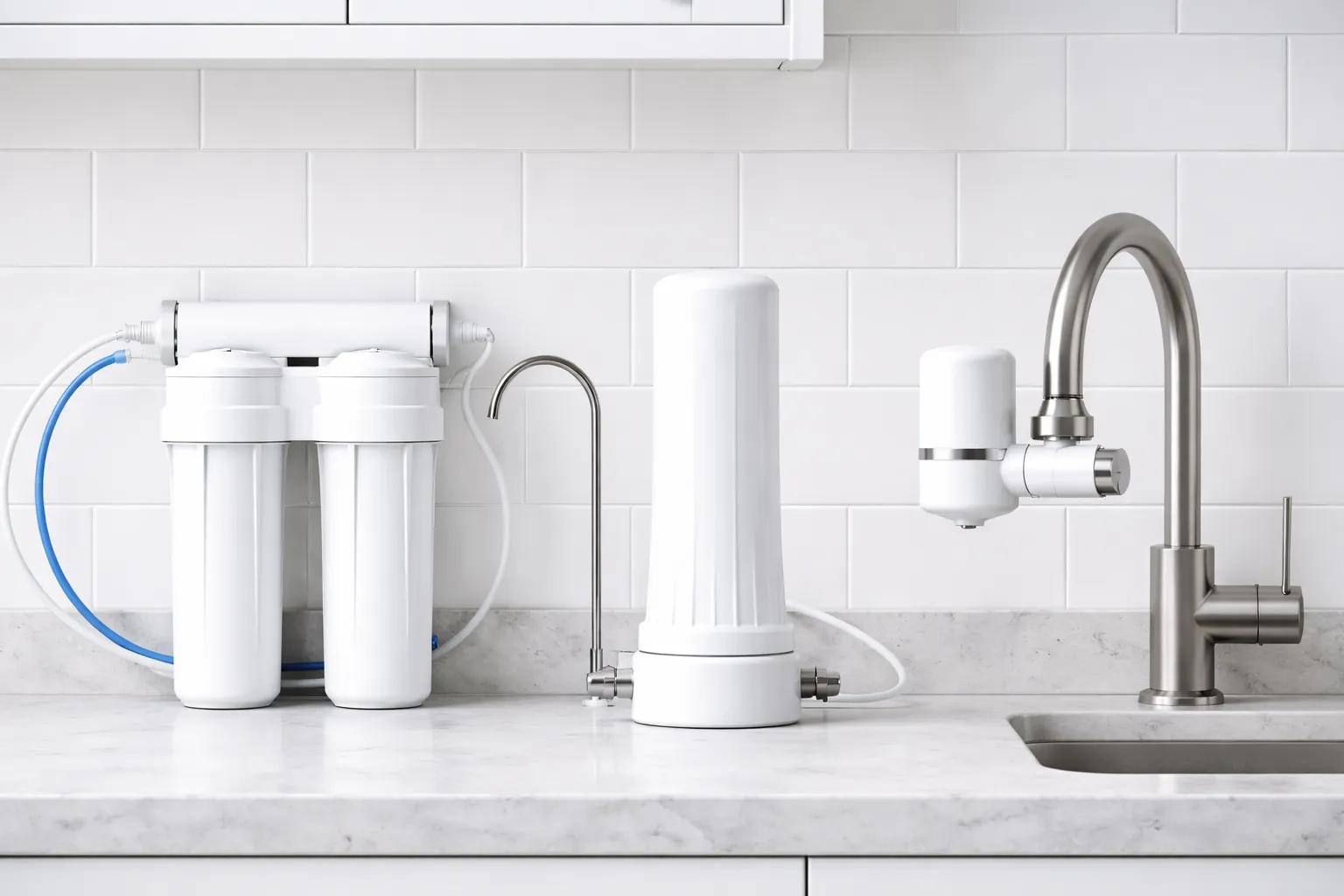
An under-sink filter is hidden below the sink and connects to your plumbing. A countertop filter sits visibly on the counter or next to the sink and is easier to remove later. A faucet filter attaches directly to the faucet and is usually the smallest and simplest option of the three.
So before choosing a brand, it makes sense to choose the category that actually fits your home.
Under-sink filters
Under-sink filters are usually the most polished option. They stay out of sight, free up your counter, and can feel like the most natural part of a well-designed kitchen. That alone makes them attractive for homeowners who want a cleaner look and less clutter.
They also tend to be the category with the most serious filtration options. That does not mean every under-sink model is automatically better, but it does mean this category often gives you more choices if you want something more robust than a quick entry-level fix.
The downside is installation. Even simpler systems still ask for a level of commitment that not every renter wants to deal with. They also take up cabinet space, which matters more than many people expect.
Under-sink filters can be an excellent long term solution, but the details matter. Since these systems often use tubing and fittings hidden below the sink, it makes sense to pay attention to build quality, replacement schedules, and whether the brand clearly explains the materials used in water-contact parts. Better transparency here usually signals a more trustworthy system overall.
Under-sink filters usually make the most sense if you own the home, want a long term solution, and are tired of counter clutter.
Homeowners’ powerhouse choice: best under sink water filter – maximum filtration, minimal space.
Countertop filters
Countertop filters are often the best compromise for real life. They give you more flexibility than an under-sink system while still feeling more serious than a basic faucet filter. That is why they are often the strongest category for renters who want meaningful filtration without permanent installation.
They are easier to install, easier to remove, and usually easier to take with you if you move. For someone renting an apartment or house, that flexibility matters a lot.
The biggest trade-off is visual. They take up space and can make a kitchen feel busier. In a very small kitchen, that can get annoying quickly. But for many people, that is still a better compromise than dealing with plumbing or relying on a weaker faucet-mounted option.
Countertop filters are often the sweet spot for renters because they offer better balance between ease and performance.
Whole-home protection for owners: best whole house water filter system.
Faucet filters
Faucet filters are the easiest entry point. They are small, relatively cheap, and simple to install. If you just want something fast and inexpensive, they can make sense.
The problem is that they are usually the most limited category. They often have shorter filter life, more modest filtration, and a less robust build than stronger countertop or under-sink systems. They can also slow water flow, which becomes annoying when you use the sink constantly for cooking, rinsing produce, or filling pots.
That does not make them useless. It just means they are usually the lightest answer, not the strongest one.
Faucet filters work best for people who want a very simple improvement over plain tap water and do not want to spend much upfront.
Renters’ countertop king: Berkey water filter review – zero install, total portability.
Which is best for renters?
For most renters, the winner is usually countertop first, faucet second, under-sink last.
A countertop filter is usually the best choice because it can give you stronger everyday usefulness without asking for permanent changes to the kitchen. If you move, you can take it with you. If your landlord does not like plumbing changes, you avoid the whole issue. And if you want to upgrade your drinking water without turning the sink cabinet into a project, a countertop unit is often the easiest practical win.
A faucet filter can still be the right choice if your budget is tight, your kitchen is very small, or you want something temporary. It is not usually the strongest solution, but it is the quickest and cheapest.
An under-sink filter can work in a rental if the setup is reversible and your landlord allows it. But in most cases, it is not the first thing to recommend because it asks for more commitment, more installation effort, and more confidence that it is worth it for a home you do not own.
For renters, the simple rule is this: choose countertop if you want the best balance, choose faucet if you want the easiest low-cost option.
Which is best for homeowners?
For most homeowners, under-sink filters usually win.
Once you own the space, the decision changes. You no longer need to optimize around easy removal. You can think about long term convenience, aesthetics, and how the kitchen functions every day.
An under-sink filter usually fits that better. It keeps the surface cleaner, feels more integrated, and often gives a more satisfying day to day experience if you use filtered water constantly. If you are cooking often, filling bottles, making tea or coffee, or washing produce in filtered water, that convenience adds up quickly.
That said, homeowners do not automatically need an under-sink filter. Some still prefer countertop systems because they do not want plumbing work or because they want something easier to monitor and replace. But if the goal is a cleaner, more permanent setup, under-sink is often the strongest fit.
For homeowners, the usual order is under-sink first, countertop second, faucet third.
Which type usually filters more?
This depends on the specific system, but in broad practical terms, under-sink and countertop filters usually give you access to stronger filtration than faucet filters.
Faucet filters are often built for convenience. That can be perfectly fine, but it usually means less capacity and fewer serious filtration options. Countertop filters, especially larger or more robust systems, can do much better. Under-sink filters often sit in the strongest overall category for people who want a more committed long term solution.
That said, the category alone is not enough. What really matters is what the filter is certified to reduce, how transparent the brand is, and what materials the water comes into contact with.
So if you are comparing under-sink vs countertop vs faucet filters, do not assume under-sink always wins by default. The actual system still matters.
Which is easiest to install and maintain?
Faucet filters are usually the easiest to install.
Countertop filters are usually next. Some connect to the faucet, while others simply sit on the counter and require very little setup.
Under-sink filters usually take the most effort upfront. Some are manageable for a confident DIYer, but they still feel more permanent and more involved.
Maintenance follows a similar pattern. Faucet filters are simple but often need more frequent changes. Countertop filters are straightforward and usually easy to access. Under-sink systems can be very convenient once installed, but the first setup is the bigger step.
If you hate installation stress, countertop and faucet filters are easier choices.
What about cost and long term value?
Faucet filters usually win on lowest upfront cost.
Countertop filters often sit in the middle. They cost more, but they can feel like a much smarter purchase if you want something stronger and more useful than the most basic setup.
Under-sink filters often cost more upfront, but they can offer better long term value if you stay in the home and use filtered water every day. A lot of people buy the cheapest option first, then replace it because it is not enough. That can actually cost more over time.
So the cheapest option is not always the best value. The better question is how long you will use it and whether it actually fits your lifestyle.
Non-toxic materials and what to avoid
At Healthy Home Upgrade, this matters.
A water filter is supposed to improve what you drink, so it makes sense to care about what touches the water. Many systems still use plastic parts somewhere in the design. That does not automatically make them bad, but vague material claims should make you cautious.
One point many people overlook is contact time and material transparency. If water sits in a system for longer periods, especially in lower-quality plastic components, that is one more reason to prefer brands that are clear about certifications, housing materials, and replacement guidance. For under-sink systems, tubing quality and maintenance also matter, since any water filtration setup is only as good as the materials used and how well it is maintained over time.
When comparing filter types, it makes sense to give more attention to brands that are transparent about materials, certifications, housing quality, and long term durability. Better design, clearer build details, and more honest product descriptions matter.
At minimum, it is wise to look for systems with stronger build quality, less vague plastic language, and clearer safety information. A healthier kitchen is not just about removing contaminants from water. It is also about reducing unnecessary daily exposure where you reasonably can.
That is one reason why the under-sink vs countertop vs faucet filters question is not just about convenience. It is also about standards.
So which one should you choose?
- Choose an under-sink filter if you own your home, want a cleaner setup, and prefer a more permanent solution.
- Choose a countertop filter if you rent, want strong flexibility, and still want something more substantial than a faucet filter.
- Choose a faucet filter if you want the simplest and cheapest starting point and your needs are more basic.
That is the clearest real-world answer.
Final verdict
If you are a renter, a countertop filter is often the smartest overall choice because it gives you flexibility without forcing you into a permanent installation. A faucet filter can still work if you want the fastest and cheapest route.
If you are a homeowner, an under-sink filter is usually the better long term investment because it keeps the kitchen cleaner, feels more integrated, and often delivers a more satisfying daily experience.
So if you are still deciding between under-sink vs countertop vs faucet filters, think about your home first, not just the product category. The best filter is the one that fits your space, your standards, your budget, and how long you plan to stay there.
ABOUT THE AUTHOR

Anita is the founder and writer behind Healthy Home Upgrade, where she shares her passion for transforming living spaces into foundations for smart health and wellness. Driven by her personal health journey, her goal is to provide valuable, practical articles that empower readers to use technology and design to improve their quality of life.