Last Updated: September 2026
Best Water Filter for Lead Removal 2026 — Certified Protection for Every Home
There is a quiet comfort in knowing that the water in your glass is not just clear, but free from lead—a contaminant for which health agencies agree there is no safe level. In 2026, the best water filter for lead removal is no longer a bulky under‑sink box; it is a compact, certified system that slots into modern kitchens and delivers lab‑verified protection for families, renters and homeowners alike.
The leading options this year—Aquasana Claryum Max Flow, Clearly Filtered Under‑Sink, and Waterdrop G3P800 Smart RO—all have test data or certifications to NSF/ANSI 53 and/or 58 for lead, and many also tackle PFAS, fluoride and emerging contaminants. This guide explains how they work, how to match them to your home, and how to avoid risky materials like untested coatings, low‑grade plastics, EPP and EVA in the products you rely on for clean water.
My Honest Take as the Founder of Healthy Home Upgrade
Lead in drinking water became something I took seriously when I read about what it can actually do to the body. Even small amounts over time can affect brain function, energy levels, blood pressure and the immune system. There is no safe level according to the WHO and EPA, and that alone was enough for me to start paying attention.
What surprised me most was how close to home the risk sits. Even in Denmark, where water regulations are among the strictest in Europe, the certified municipal water can still pick up lead on its way through older pipes and fittings inside the building itself. That last stretch from the street to your tap is where the problem often hides, and it is your responsibility to deal with it, not the water company.
I have researched this category carefully and what I keep coming back to is that the certification is everything. NSF 53 for lead is the number that actually means something. Marketing language about “clean water” and “advanced filtration” means nothing without it.
If you have never had your tap water tested, and especially if you live in a home built before the 1990s, that is the place to start. Knowing what is actually in your water makes the choice of filter much easier and much more precise.
Best Water Filter for Lead Removal
- Best under‑sink lead filter for most homes: Aquasana Claryum 3‑Stage Max Flow — a compact, fast‑flow system certified to NSF/ANSI 42, 53 and 401 that cuts lead, chlorine and VOCs while using recyclable “eco” cartridges, ideal if you want strong protection without RO tanks or wastewater.
- Best high‑coverage lead + PFAS filter: Clearly Filtered Under‑Sink System — an easy‑install unit independently tested to NSF/ANSI 42, 53 and 401 with lab‑verified 99.9% lead reduction and broad coverage of hundreds of contaminants, perfect for older homes or historic pipes where you want maximum contaminant removal without adding a drain line.
- Best smart RO for lead + PFAS + fluoride: Waterdrop G3P800 Smart RO — a tankless RO system certified to NSF/ANSI 42, 53, 58 and 372 for performance and lead‑free materials that combines membrane filtration, carbon and UV to tackle lead, PFAS, fluoride and high TDS in one high‑flow package, ideal for family kitchens with more complex water profiles.
At a Glance / Editor’s Picks
| Model | Best for | Lead & PFAS performance | Key certifications | Materials & safety notes | Typical price* |
| Aquasana Claryum 3‑Stage Max Flow | Apartments & rentals | Certified lead reduction, strong chlorine and VOC cut; good for city water. | NSF/ANSI 53 for lead and other health contaminants; aesthetic performance via 42 on components. | Uses plastic housings and cartridges tested for material safety; avoid off‑brand housings made from unknown EVA/EPP. | ≈ 289 € / 299 $ |
| Frizzlife SK99-NEW | Best budget non-RO under-sink filter | Designed to reduce lead and other contaminants using 0.5-micron, 3-stage carbon-block filtration. PFAS reduction is not a clearly certified claim for this model, so I would not position it as a PFAS-first choice.. | NSF/ANSI 42 & 53, tested/certified through IAPMO | Mineral-retaining filtration; no electricity or wastewater; replaceable filter cores reduce plastic waste | ~$100–$125 |
| Waterdrop G3P600 | Best tankless RO option for lead + broader contaminant reduction | RO filtration designed to reduce lead, PFOA/PFOS, TDS, chlorine, fluoride, arsenic and other contaminants | NSF/ANSI 42, 58 & 372 | BPA-free system housing; NSF/ANSI 372 addresses lead-free material requirements; tankless design helps avoid stored-water stagnation | ~$429–$539 |
*Prices and certification details change; always confirm on the manufacturer website or NSF/WQA/IAPMO database before buying.
Why lead still matters in 2026
Old pipes and aging fittings still hide traces of lead in cities from Paris to Chicago to Sydney. Heat, acidity, and corrosion release tiny particles that invisibly enter our homes — especially after water sits overnight.
Health agencies like the EPA and WHO agree: there is no safe level of lead exposure. Even small doses can affect a child’s brain development or an adult’s energy and blood pressure.
That’s why filters with NSF 53 certification are the gold standard for removing lead and heavy metals. When you install one, you’re not adding a gadget — you’re eliminating a silent toxin and making a statement about care.
You might find this helpful: Best Whole House Water Filter Systems 2026 (Expert Picks)
Materials & safety – EPP, EVA, PFAS, coatings and medical‑grade silicone
You asked specifically about common risk materials. With lead filters, two things matter: what the filter removes and what the filter itself is made from.
PFAS and internal coatings
Some plumbing products and housings use PFAS‑based coatings or fluoropolymer linings for durability or “non‑stick” benefits.
- PFAS (including PFOA and PFOS) are persistent chemicals linked at higher exposures to immune and hormonal effects.
- For lead‑removal filters, you want media that can reduce PFAS (like certain RO membranes or specialty carbon) but no unnecessary PFAS‑based coatings inside wetted housings.
What to favor:
- Systems like Waterdrop G3P800 that have been tested to remove PFOS/PFOA while also holding NSF 372/58 certifications for low leaching and lead‑free materials.
- Under‑sink units with documented PFAS performance or where the manufacturer publishes third‑party PFAS test reports in addition to lead data.
EPP (expanded polypropylene) and EVA (ethylene‑vinyl acetate)
EPP and EVA are lightweight plastics often used for:
- Packaging, insulation sleeves and sometimes external parts.
- In some lower‑cost cartridges or housings, as structural foams.
Issues:
- They are petroleum‑derived plastics that can contain additives, colorants and stabilizers.
- When not part of an NSF/ANSI 61‑ or 372‑certified wetted component, there is no guarantee about migration of small organic compounds into water.
What to favor:
- Filters where any plastic parts in contact with water (cartridge shells, housings, manifolds) are certified under NSF/ANSI 61 or 372, not generic EVA/EPP with unknown formulation.
- Avoid ultra‑cheap, no‑name housings or replacement cartridges that do not list materials or certifications.
Medical‑grade silicone and seals
Most modern lead filters rely on:
- Medical‑ or food‑grade silicone O‑rings.
- EPDM or similar elastomers that are approved for drinking water.
Benefits:
- Silicone is generally more inert than many plastics, with fewer plasticizers required.
- When part of a certified system, its formulation is checked so it does not leach excessive volatiles or impart taste.
What to favor:
- Original manufacturer replacement parts (tubing, O‑rings) that maintain the system’s NSF/ANSI 53 or 58 certification and drinking‑water approvals.
In short, pick filters whose media is proven against lead and PFAS, and whose housings and seals are part of an NSF/ANSI‑certified package instead of unknown EVA/EPP or coated plastics.
Global Water Safety — A 2026 Perspective
Lead contamination isn’t just a problem of the past — it’s a quiet global issue still hiding in pipes and solder joints across every continent. In Europe, the EU Drinking Water Directive sets a maximum of 10 µg/L, already stricter than the U.S. EPA limit of 15 ppb, and new revisions are expected to tighten both by 2026.
In older neighborhoods from London and Paris to Chicago and Sydney, temperature shifts and corrosion can still release lead particles overnight. That’s why global agencies — WHO, EPA, and the European Commission — all emphasize home filtration as the most reliable final defense. Even when municipal water meets standards, a short run through a certified filter can turn “technically safe” into truly pure — water you can taste, trust, and share confidently with your family, pets, and plants.
From Tap to Life — How Clean Water Shows Up Every Day
The difference is often felt before it’s seen.
Morning coffee tastes less bitter and smells richer when lead and chlorine are gone.
Children’s skin and scalps react less after baths in filtered water.
Plants and pets thrive on balanced minerals instead of chemical residue.
Even a simple glass of water feels “lighter,” the way spring water tastes on a mountain trail.
Clean water doesn’t just prevent harm — it brings vitality back to the routine moments that shape our days.
Read more about: Best Under-Sink Water Filter 2025–2026
Certified technology – how the best lead‑removal filters work
Lead is challenging to remove because it can be present as dissolved ions and as tiny particles.
High‑performing systems combine several layers:
- Activated carbon – removes chlorine, some organics, and improves taste and odor.
- Ion‑exchange resins – swap lead and other heavy metal ions for calcium or sodium ions, capturing lead inside the resin.
- Sub‑micron mechanical filtration – blocks particulate lead down to about 0.5 microns.
- Reverse osmosis membranes (RO) – in systems like Waterdrop G3P800, thin‑film composite membranes operate under NSF/ANSI 58 to greatly reduce dissolved lead, PFAS, arsenic, fluoride and other dissolved solids.
Certification snapshot
| Certification | What it ensures | Typical relevance to lead removal |
| NSF/ANSI 42 | Aesthetic impurities (chlorine taste/odor, particulates). | Not sufficient alone for lead. |
| NSF/ANSI 53 | Health‑related contaminants like lead, mercury and some VOCs. | Core standard for lead‑reduction filters. |
| NSF/ANSI 58 | RO system performance (TDS plus listed contaminants). | Used for RO units that include lead and PFAS in their claims. |
| NSF/ANSI 401 | Emerging contaminants (pharmaceuticals, some PFAS, etc.). | Useful add‑on for complex water profiles. |
| NSF/ANSI 372 | Lead‑free content in wetted parts. | Ensures the system itself is not adding lead. |
| CE / RoHS | EU electrical and hazardous substance rules. | Important for smart/UV units’ electronics and materials. |
Choosing a filter with NSF 53 for lead or NSF 58 where lead is listed is the key difference between better‑tasting water and truly safer water.
Product highlights – real‑world performance
Aquasana Claryum 3‑Stage Max Flow
Check GFrizzlife SK99-NEW price on Amazon
Aquasana’s Claryum Max Flow is a compact, under‑sink system that balances flow rate, eco‑friendly cartridges and strong lead performance.
- Lead removal: Tested and certified under NSF/ANSI 53 specifically for lead, plus other heavy metals and cysts.
- Flow: Around 2 L/min, enough for typical kitchen tasks without feeling sluggish.
- Sustainability: “Eco” cartridges reduce plastic compared with full‑housing replacements and last roughly 6 months, depending on usage.
- Best for: Renters and small households who want lead protection without electricity, tanks or wastewater.
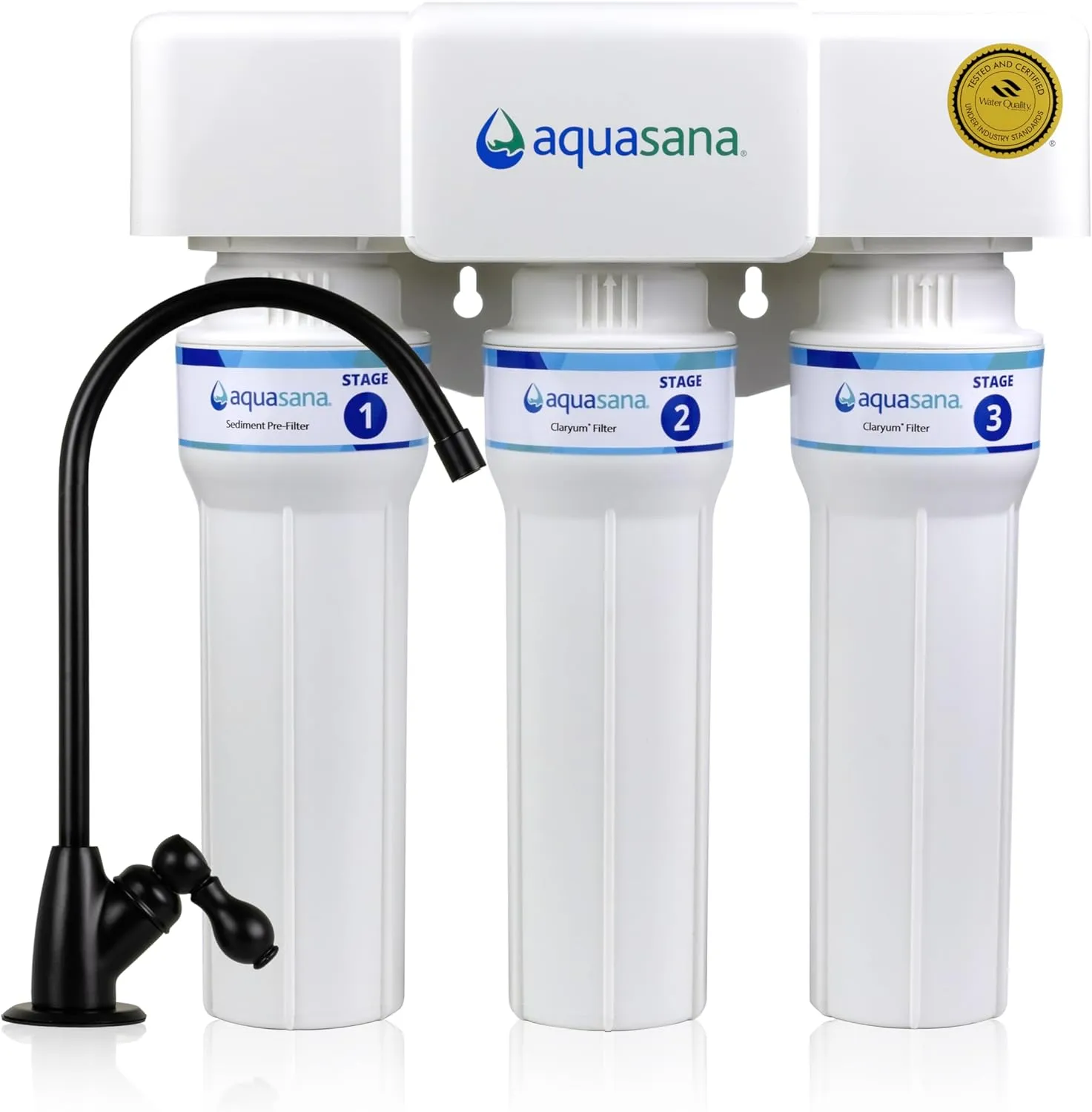
Healthy Home Upgrade Review:
A reliable, certified solution for reducing lead and common contaminants, ideal for everyday use without switching to full reverse osmosis.
Why it’s a good choice
The Aquasana Claryum 3-Stage Max Flow is NSF-certified to reduce lead, chlorine, and other harmful contaminants while maintaining good water flow. It’s a great choice for households that want safer drinking water without the complexity or water waste of RO systems. The design keeps beneficial minerals intact, making it a balanced, health-conscious option.
Pros
- NSF-certified for lead reduction
- Maintains strong water flow (Max Flow design)
- Retains beneficial minerals
- Easy under-sink installation
- No electricity required
Cons
- Not as comprehensive as reverse osmosis
- Filters require periodic replacement
- Limited to drinking and cooking water (point-of-use)
Frizzlife SK99-NEW
Check Frizzlife SK99-NEW price on Amazon
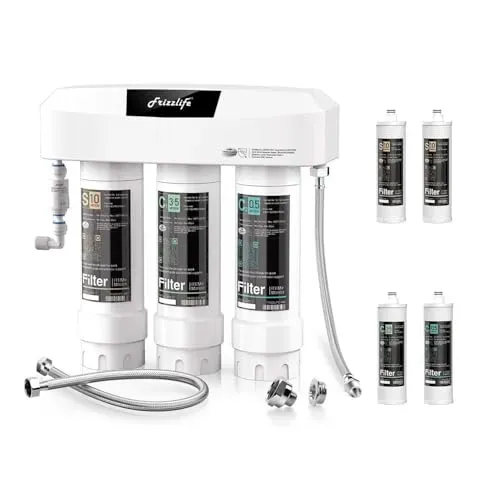
The Frizzlife SK99-NEW is a compact under-sink water filtration system designed for households that want effective lead and everyday contaminant reduction without switching to reverse osmosis. Its three-stage filtration system uses high-precision filtration and carbon-block media to target contaminants while allowing beneficial minerals to remain in the water.
Healthy Home Upgrade Review:
The SK99-NEW stands out as a practical option if lead reduction is your main concern but you don’t necessarily need a full reverse-osmosis system. We like that it installs under the sink, provides filtered water on demand, and does not require electricity or produce RO wastewater.
It is also a good middle ground for homeowners who want stronger filtration than a basic pitcher or faucet filter while keeping installation and ongoing maintenance relatively simple.
One important distinction is PFAS. We would choose a properly certified RO system instead if PFAS reduction is a top priority, since we would not rely on the SK99-NEW as a PFAS-first recommendation without model-specific certification supporting that claim.
Why it’s a good choice
The Frizzlife SK99-NEW combines lead-focused filtration, straightforward under-sink installation, and a mineral-retaining design at a relatively accessible price. Because it is not an RO system, there is no storage tank, electricity requirement, or wastewater stream.
The replaceable filter-core design is another plus. Instead of replacing the entire housing each time, you replace the internal cartridges, which can reduce unnecessary plastic waste and ongoing costs.
Pros
- Designed to reduce lead and common drinking-water contaminants
- Three-stage under-sink filtration
- Retains naturally occurring beneficial minerals
- No electricity required
- No RO wastewater
- Fast, on-demand filtered-water flow
- Replaceable filter cores help reduce plastic waste
- More affordable than many tankless RO systems
- Compact design fits beneath most kitchen sinks
Cons
- Not a reverse-osmosis system
- Not our first choice when PFAS removal is the primary goal
- Does not reduce dissolved solids as comprehensively as RO
- Requires periodic cartridge replacements
- Takes up some under-sink cabinet space
Waterdrop G3P600
Check Waterdrop G3P600 price on Amazon
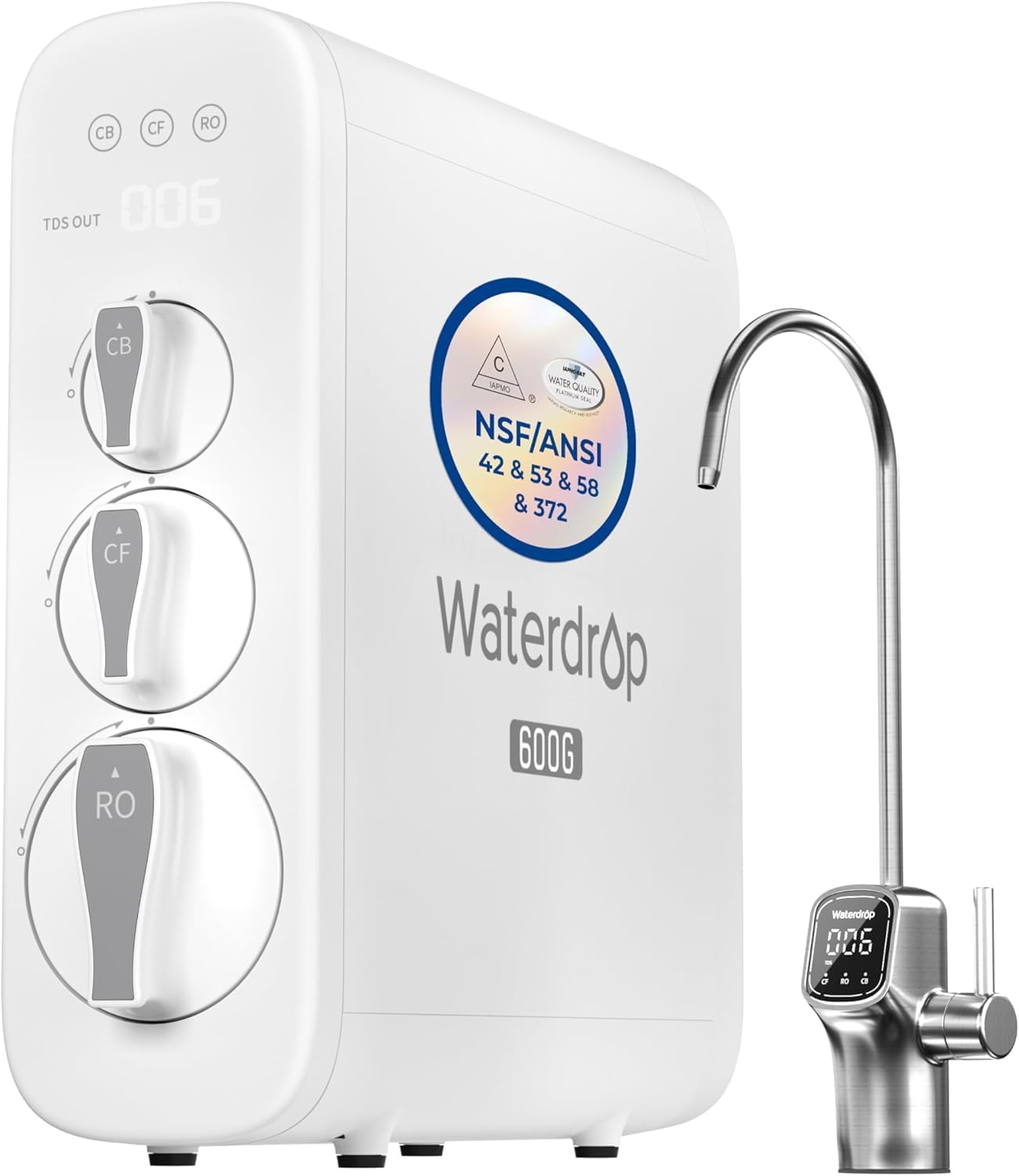
The Waterdrop G3P600 is a high-capacity tankless reverse osmosis system designed for households that want more comprehensive filtration than a standard under-sink carbon filter. Its multi-stage RO filtration targets a wide range of contaminants, including lead, chlorine, fluoride, arsenic, dissolved solids, and PFOA/PFOS, while delivering up to 600 gallons of filtered water per day.
Healthy Home Upgrade Review:
For homes where lead is a concern alongside other contaminants, the Waterdrop G3P600 is our stronger all-around filtration pick. Unlike a conventional carbon-based under-sink filter, its reverse-osmosis membrane provides a much broader level of filtration and is particularly useful when you want to reduce dissolved contaminants as well.
We also like the tankless design. It eliminates the bulky storage tank found with traditional RO systems, saves valuable cabinet space, and filters water as you need it. The integrated smart faucet also provides a convenient way to monitor filter status.
For households concerned about both lead and PFOA/PFOS, the G3P600 offers a more comprehensive approach than a basic under-sink filter.
Why it’s a good choice
The G3P600 combines reverse-osmosis filtration with a space-saving tankless design and high daily output. It is a particularly good fit for families that use a significant amount of filtered water but do not want a large RO storage tank underneath the kitchen sink.
Its RO system also goes beyond lead-focused filtration by addressing a wider range of contaminants, making it a strong choice when overall drinking-water quality is the priority.
Pros
- Reverse-osmosis filtration for comprehensive contaminant reduction
- Designed to reduce lead, PFOA/PFOS, fluoride, arsenic and other contaminants
- Reduces TDS and many dissolved impurities
- High 600 GPD filtration capacity
- Tankless design saves under-sink space
- Smart faucet provides filter-life information
- Fast filtered-water flow compared with many traditional RO systems
- NSF/ANSI certifications provide additional third-party assurance
- Lead-free materials requirements covered by NSF/ANSI 372 certification
Cons
- More expensive than non-RO under-sink filters
- Requires electricity to operate
- RO filtration produces some wastewater
- Replacement filters add to long-term ownership costs
- Removes beneficial minerals along with unwanted dissolved contaminants
- Installation is more involved than a simple faucet or pitcher filter
Choosing the right lead filter for your home
1. Test your water first
Before buying, use a certified lab or services like MyTapScore to identify lead and other contaminants.
- If lead is above detection in cold water at the kitchen tap, prioritize NSF 53 or 58‑certified lead filters.
- If PFAS also show up, choose systems with documented PFAS reduction such as RO units like Waterdrop G3P800 or PFAS‑rated carbon filters.
2. Match filter type to living situation
This logic from your existing tables still works and is aligned with current guidance:
Buyer’s Guide — Matching Filters to Your Everyday Life
| Water Type / Home | Budget Range | Recommended System | Key Benefit | Maintenance Cycle |
| Apartment or Rental | €250 – €450 | Aquasana Claryum 3-Stage / Clearly Filtered | No electricity, easy DIY install | Cartridges 6 months |
| Family Home / Multi-Tap Kitchen | €550 – €700 | Waterdrop G3P800 Smart RO | High flow, fluoride + PFAS removal | RO membrane 2 years |
| Older Pipes / Historic Building | €400 – €500 | Clearly Filtered System | 99.9 % lead reduction | 9–12 months |
| Eco-Focused / Minimalist Home | €280 – €350 | Aquasana Claryum Max Flow | Recyclable cartridges | 6–8 months |
Tip: Pair a whole-house pre-filter with one lead-specific under-sink unit for layered protection.
Lead-Free Living — The Wellness Ripple Effect
Without micro-metal build-up, cells absorb oxygen better, hydration improves, and digestion feels lighter. Pets drink more willingly; plants develop glossier leaves.
Clean water quietly upgrades everything — from morning tea to night-time rest.
Maintenance & Longevity
Most modern filters need little upkeep. Digital alerts signal cartridge replacement every 6–12 months. Flush new cartridges 5 min before use and inspect tubing yearly. A quality system can last 10 years or more.
What Even the Best Lead Water Filters Cannot Do
A certified lead filter is a meaningful upgrade, but it is important to be realistic about what it can and cannot achieve.
No filter lasts forever. Even the best systems require regular cartridge replacements to maintain their certified performance. A filter that is past its service life may provide little or no protection.
A filter cannot repair corroded plumbing or aging pipes inside your home. If the source of lead contamination is severe structural damage to your plumbing, a filter is a temporary solution while you address the root cause.
Extremely contaminated water may require professional assessment and treatment beyond what a standard under-sink system can handle. If your water test shows very high lead levels, consult a water quality professional before relying on a consumer filter alone.
Some filters also reduce beneficial minerals alongside contaminants. Remineralization stages, like those in some RO systems, can help restore minerals that matter for taste and everyday health.
My Final Recommendation
For most households, an NSF 53-certified under-sink filter offers the best balance between lead protection, convenience, and long-term value without the complexity of a full reverse osmosis setup.
If your local water report includes PFAS, fluoride, or high dissolved solids alongside lead concerns, a modern RO system like the Waterdrop G3P800 provides broader protection and stronger overall contaminant reduction.
The most important thing is not chasing the perfect system, but choosing a certified filter you can maintain consistently over time. A well-maintained basic filter beats a premium system with neglected cartridges every time.
FAQs
What is the best water filter for lead removal in 2026?
For most homes, the best water filters for lead removal in 2026 are NSF/ANSI 53 or 58‑certified systems such as Aquasana Claryum Max Flow, Clearly Filtered Under‑Sink, and Waterdrop G3P800 Smart RO, all of which have documented lead reduction and material‑safety certifications.
Do standard pitcher filters remove lead?
Many popular pitchers are certified only to NSF/ANSI 42 for taste and odor; unless the packaging explicitly lists NSF/ANSI 53 for lead, you should assume they do not provide reliable lead removal, and opt for a certified under‑sink or RO system instead.
Can one filter remove both lead and PFAS?
Yes; some reverse osmosis systems and advanced carbon filters are certified or lab‑tested to reduce both lead and PFAS, but you need to check that both contaminants are named in their NSF/ANSI 53 or 58 listings or third‑party test reports.
Which materials should I avoid in lead‑removal filters?
Avoid no‑name housings or cartridges with unknown plastics, unlisted internal coatings, or unverified EVA/EPP foams in contact with water; instead, choose systems whose wetted parts are certified under NSF/ANSI 61 or 372 and use known materials like certified plastics and medical‑grade silicone seals.
Do I still need a whole‑house filter if I have a lead filter at the sink?
Not necessarily; a certified under‑sink or RO system at the main kitchen tap can fully cover drinking and cooking needs, while a whole house filter is useful if you also want to reduce chlorine or contaminants for showers, laundry and other taps.
References & Certifications