
We get a version of this question all the time from readers who install reverse osmosis for the first time. They love the cleaner taste and deeper filtration, but then a second worry shows up almost immediately: if RO removes so much, do you need to put minerals back in? In many homes, the answer is yes—but not for the reasons a lot of brands suggest.
Reverse osmosis can reduce calcium, magnesium, and fluoride, depending on the system and the incoming water. That matters for taste, for how the finished water feels day to day, and for whether you want your drinking water left almost completely stripped. It does not mean remineralized water suddenly becomes your main strategy for strong bones or healthy teeth; food still does most of that work. If you are considering a full-home setup, this guide to the best whole-house reverse osmosis systems explains where RO makes sense and how remineralization fits into the overall design.
Quick Answer
If you use reverse osmosis, remineralizing the water is often worth it for better taste, better daily drinkability, and a more balanced finished water profile. It can also make sense if you do not want your drinking water stripped of nearly all calcium and magnesium.
But for teeth, the bigger question is often fluoride, not just minerals. And for bones, food remains the main source of calcium and magnesium for most people.
What RO Water Removes in the First Place
Reverse osmosis is powerful because it removes a wide range of dissolved substances from water. That is a big part of why RO works so well for deep filtration.
It can also leave the water tasting flatter than many people expect.
Some people love that ultra-clean profile. Others find it tastes flat, hollow, or almost like water with the structure missing. That reaction makes sense. Once you remove much of the mineral content, the water can feel cleaner, but also thinner and less satisfying.
That is where remineralization starts to make practical sense.
Does RO Water Harm Teeth or Bones?
This is where a lot of articles get sloppy.
The better answer is that RO water is not automatically bad for teeth or bones, but there are two separate issues hiding inside that question.
Issue 1: Water is not the main source of bone minerals
Calcium and magnesium matter for bone health. But water is usually not the main source of either one in a healthy diet.
That is an important point because a lot of weak content makes it sound as if remineralized water is the missing key to strong bones. It is not. If your food intake is poor, remineralized water does not fix that. At most, it can help support a better finished water profile.
So yes, some calcium and magnesium in water can be a nice bonus. No, it should not be treated like a substitute for mineral-rich food.
Issue 2: Teeth are often more about fluoride in this context
For teeth, the more overlooked issue is fluoride.
If your incoming tap water is fluoridated and your RO system reduces fluoride at the kitchen sink, then you may be changing one of the protective factors that previously supported enamel and cavity prevention. That is a separate question from calcium and magnesium, and it should stay separate.
That does not mean every household needs to add fluoride back into RO water. It does mean the teeth conversation is incomplete if fluoride is never mentioned.
So What Is Remineralization Really For?
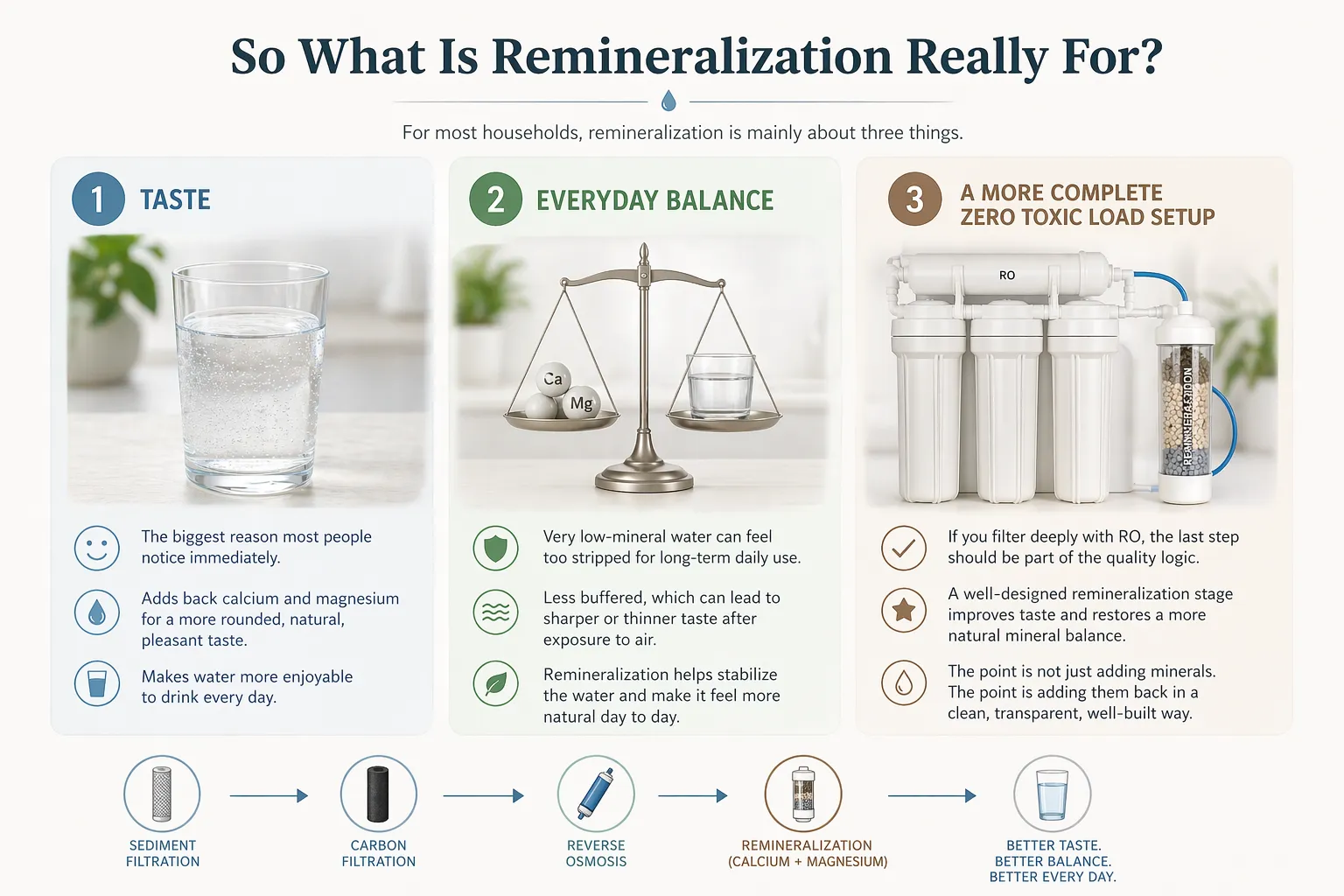
For most households, remineralization is mainly about three things.
1. Taste
This is the biggest reason most people notice immediately.
Plain RO water can taste extremely neutral, but also strangely empty. Some people describe it as clean. Others experience it as flat or unfinished. A little calcium and magnesium can make the water taste more rounded, more natural, and more pleasant to drink every day.
2. Everyday balance
Very low-mineral water can feel a little too stripped for long-term daily use, even if it is technically very clean.
It is also less buffered, which helps explain why untreated RO water can sometimes taste slightly sharper or thinner after exposure to air. Remineralization can help stabilize the finished water profile and make it feel more natural day to day.
That does not mean turning water into a miracle product. It simply means finishing the job more thoughtfully.
3. A more complete Zero Toxic Load setup
This is the HH angle most generic water-filter blogs miss.
If you are already filtering deeply with RO, the last step should not be treated like a gimmick. It should be treated as part of the quality logic of the whole system.
A well-designed remineralization stage can improve taste and restore a more natural mineral balance. A vague post-filter with unclear media, cheap housings, or poor transparency can undermine the elegance of the setup.
The point is not just adding minerals.
The point is adding them back in a clean, transparent, well-built way.
Start with proven RO performance: best under sink water filter sets the purification baseline.
When Remineralizing RO Water Makes the Most Sense
You should think more seriously about remineralization if:
- your RO water tastes too flat for daily drinking
- you want some calcium and magnesium back in the finished water
- you drink a lot of RO water every day
- your diet is already borderline low in mineral-rich foods
- you want the finished water to feel less stripped
You may care less about remineralization if:
- you already like the taste of plain RO water
- you get plenty of calcium and magnesium from food
- you only use RO occasionally
- your main concern is contaminant removal, not taste or water feel
RO’s purity paradox revealed: reverse osmosis water too pure—science says add minerals back.
The Fluoride Question Needs Its Own Decision
This deserves its own section because people often blend it into the mineral conversation, and that creates confusion.
Calcium and magnesium are one discussion. Fluoride is another.
If your household relies on fluoridated community water as part of cavity prevention, and your RO system removes much of that fluoride, that changes the equation. The right follow-up question is not only, “Should I remineralize?”
It is also, “Am I unintentionally removing fluoride from the water I drink every day?”
That does not mean every home should chase fluoride in filtered water. It does mean this topic should be approached consciously, especially for families thinking about enamel protection and children’s daily routines.
Right system, right minerals: which reverse osmosis system fits your home from apartments to wells.
The Best Ways to Remineralize RO Water
1. A built-in remineralization stage
For most people, this is the cleanest and easiest option.
Many under-sink RO systems now include a post-filter that adds back a small amount of calcium and magnesium after the membrane stage. If you choose this route, the important question is not whether the brand says “mineral” or “alkaline.”
The real question is whether the brand clearly explains:
- what media it uses
- what minerals it adds back
- how often the cartridge needs replacement
- whether the materials are clearly disclosed
A good remineralization stage looks boring in the best way. It is transparent, specific, and easy to maintain.
2. A targeted mineral cartridge, not a vague alkaline gimmick
This is where quality starts to separate itself.
A better cartridge usually tells you what it is doing in plain language. It explains the mineral media, gives a realistic replacement schedule, and focuses on taste and balance rather than miracle-style health claims.
A weaker cartridge often hides behind vague phrases like “alkaline stones,” “energy minerals,” or “natural balance technology” without telling you what is actually inside, how much it adds back, or how clean the housing materials are.
That difference matters.
If a system removes a wide range of contaminants with RO, then the final cartridge should not be the least transparent part of the setup.
3. Food first, water second
If your real concern is bones, do not lean on water as the main fix.
Water can support a better daily mineral profile, but it is still a supporting layer. Food matters more. Remineralized RO water should complement a good diet, not pretend to replace one.
Whole-house RO needs mineral rescue too: best whole house reverse osmosis systems
What to Look for in a Good Remineralization Setup
From an HH perspective, this is what matters most.
Clear filtration standards first
Do not get distracted by mineral marketing before the filtration side is right.
Start with the RO system itself and look for relevant reverse osmosis certification logic, especially NSF/ANSI 58. Carbon-based stages and supporting filters may also refer to NSF/ANSI 42 or 53 depending on what they are designed to reduce.
The point is simple: get the filtration right first, then worry about what gets added back.
Over-filtration myth busted: do you really need whole-house RO carbon often suffices.
Transparent post-filter design
Look for brands that explain:
- what minerals are used
- what media are inside the cartridge
- how often the remineralization stage should be replaced
- whether the housing and materials are clearly described
If the company cannot explain what is in the final stage, that is not a reassuring sign.
Clean material logic
This matters more than people think.
Very low-mineral RO water should not pass through a vague final cartridge with poorly documented media and low-transparency materials. If the whole point of RO is cleaner water, the final polishing stage should be just as clean in concept as the membrane itself.
From a Zero Toxic Load perspective, I would rather use plain RO than add minerals back through a cheap, mystery-media cartridge that introduces new uncertainty.
Certification confusion solved: NSF/ANSI labels 42 vs 53 vs 58—know what you’re buying.
Third-party-tested mineral cartridges matter
This is one of the most overlooked parts of the conversation.
Many cheaper brands throw around words like alkaline, coral, mineral stone, or healthy pH without giving much detail about testing or sourcing. If you are removing a wide range of contaminants with RO, you do not want to add uncertainty back through an unclear mineral stage.
Cleaner remineralization matters more than aggressive alkaline marketing.
Smart layering + remineralization: layered water filtration without wasting minerals.
My Honest Take
For most people, remineralizing RO water is worth it, but mainly for taste, drinkability, and finished-water balance, not because it magically turns water into a bone-health supplement.
If you eat well and use a sensible dental routine, the biggest day-to-day benefit of remineralization is usually that the water tastes better and feels less stripped. That matters more than people admit because the best water setup is the one you actually enjoy using every day.
My biggest concern is not whether remineralization is worth it.
It is how it is done.
If a brand removes a wide range of contaminants with RO, then adds minerals back through a vague, low-transparency cartridge, the logic breaks down. From an HH perspective, clean remineralization matters more than flashy marketing around alkaline water.
That is where generic water-filter content usually stops. HH should not.
Deep filtration is great. But finished water should still make sense as daily human water, and the final cartridge should be worthy of the system that came before it.
FAQ
Is remineralized RO water healthier than plain RO water?
Usually it is better to think of it as more balanced rather than automatically healthier. It often tastes better and may restore some calcium and magnesium, but the bigger health picture still depends on diet, dental routine, and overall water quality.
Does remineralizing RO water protect teeth?
Not by itself in the way many brands imply. For teeth, the fluoride question is often more important than the calcium question if your original tap water was fluoridated.
Does remineralized water help bones?
It can support a better mineral profile, but water is usually not the main source of calcium and magnesium. Food still matters more.
Why does RO water sometimes taste flat?
Because RO removes much of the dissolved material that gives water body and taste. Some people like that. Others experience it as hollow, thin, or unfinished.
Is alkaline water the same as remineralized water?
Not necessarily. Some products market alkalinity more than actual mineral quality. A better question is whether the system adds back useful minerals in a transparent, well-built way.
Conclusion
Remineralizing RO water is not just a trendy add-on.
In a good system, it is the final step that makes deep filtration feel complete.
Reverse osmosis can remove a wide range of dissolved substances, including some minerals people are used to tasting in water. That does not automatically make plain RO water bad, but it does mean the finished drinking water deserves more thought than many people give it.
For most homes, remineralization makes the most sense as a way to improve taste, restore a more natural feel, and create a cleaner final water profile after aggressive filtration.
The key is not to ask only, “What does RO remove?”
Also ask, “What kind of drinking water do I want after it removes it?”