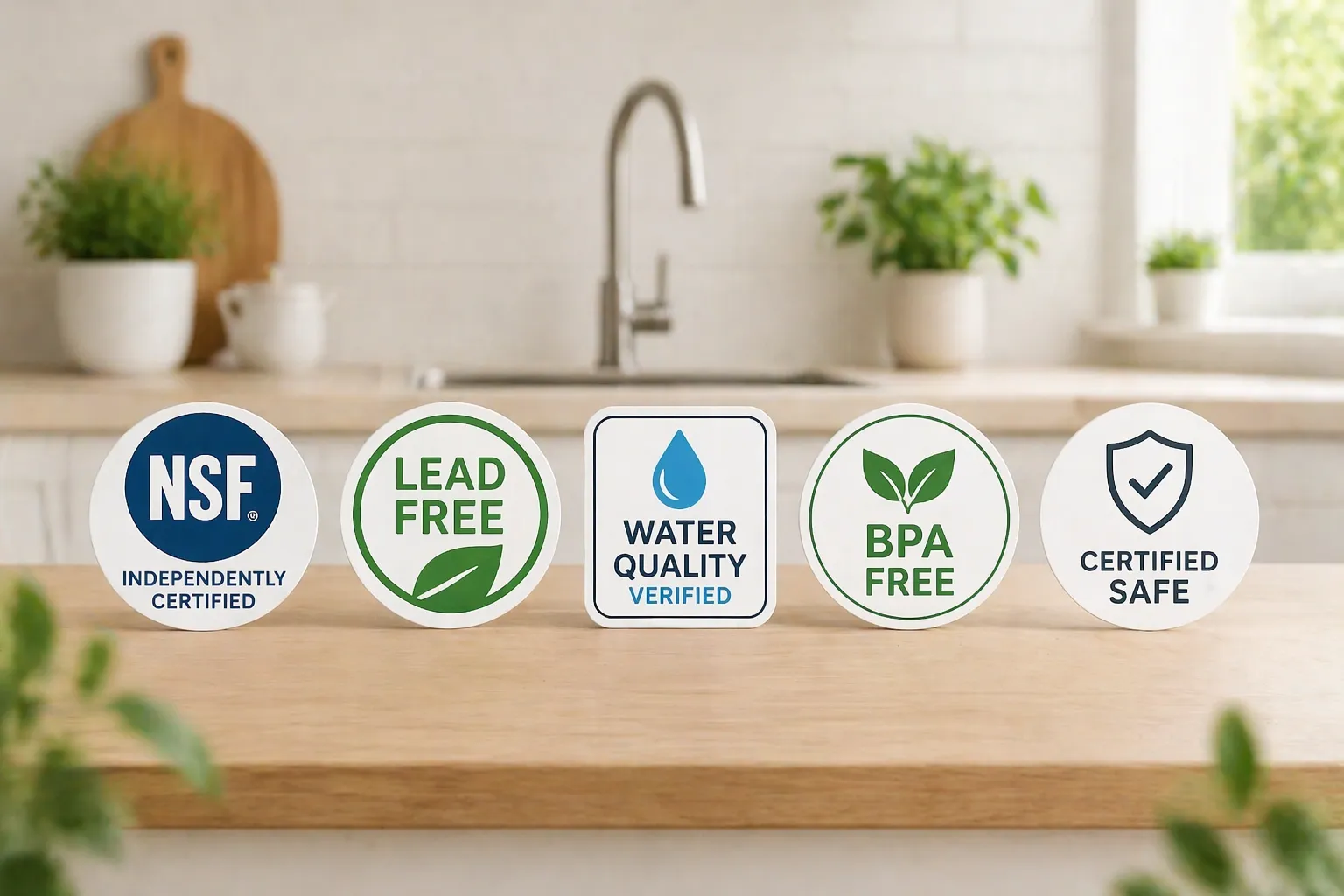
When I started researching filters for my own kitchen, the certification labels were the most confusing part.
If you have ever compared under-sink filters and felt lost in the numbers, you are not alone. A lot of shoppers see NSF/ANSI 42, 53, or 58 on a product page and assume the bigger number means a better filter. That is not how it works.
These labels are useful, but only if you know what they actually mean. In simple terms, NSF/ANSI 42 is usually about aesthetic issues like chlorine taste and odor. NSF/ANSI 53 is for specific health-related contaminant reduction claims. NSF/ANSI 58 is the key standard for reverse osmosis systems. The smartest move is not asking which number is “best” in the abstract; the smarter question is which certification matches the water problem you are actually trying to solve. If you are comparing specific systems side by side, this guide to the best under-sink water filters shows how those certifications play out in real products and everyday use.
Quick Answer
If you want better taste and odor, NSF/ANSI 42 may be enough. If you care about a health-related contaminant such as lead, you usually want an NSF/ANSI 53 claim for that specific contaminant. If you are looking at reverse osmosis, NSF/ANSI 58 is the standard to pay attention to. The number alone is not enough. You also need to check the exact contaminant reduction claims listed for that product.
Also in this article
At-a-Glance: NSF/ANSI Labels in Simple Terms
| Standard | Main Focus | Typical Examples | HH Take |
| NSF/ANSI 42 | Aesthetic effects | Chlorine taste, odor, some particles | Good when the main issue is taste or smell, but not enough if you are targeting a specific health-related contaminant. |
| NSF/ANSI 53 | Health-related reduction claims | Lead, cysts, VOCs, other specific claims | Usually the most important label for buyers who care about health-focused filtration. Always check the exact contaminant claim. |
| NSF/ANSI 58 | Reverse osmosis systems | TDS reduction, RO-specific performance | The key standard for under-sink RO systems. Still check the exact reduction claims and practical trade-offs. |
Why this matters when buying an under-sink filter
This is one of the easiest places for brands to sound more impressive than they really are. A product may mention NSF somewhere on the page, but that does not automatically mean it is certified for the contaminant you care about.
For example, one under-sink filter may be certified to NSF/ANSI 42 for chlorine taste and odor, while another may be certified to NSF/ANSI 53 for lead reduction. Both can say NSF certified, but they are not making the same promise. That is why reading NSF/ANSI labels properly can save you from buying the wrong system.
NSF 42+53 certified winners: best under-sink water filter, labels decoded.
What does NSF/ANSI 42 mean?
NSF/ANSI 42 is the standard for aesthetic effects. That usually means things that affect how water looks, smells, or tastes rather than a defined health-related contaminant claim.
In practice, this often includes chlorine taste and odor reduction. It can also include other aesthetic claims depending on the product. So if your main complaint is that your tap water tastes like chlorine or smells off, a system with NSF/ANSI 42 may be enough.
But if your concern is lead, PFAS, cysts, or another health-related issue, 42 is usually not the label you should stop at.
What does NSF/ANSI 53 mean?
NSF/ANSI 53 is the standard for health effects. This is the one people usually want when they are trying to reduce a specific contaminant with direct health relevance.
This matters because two filters can both carry NSF/ANSI 53 and still not reduce the same things. One may be certified for lead. Another may be certified for a different contaminant. So if you want an under-sink filter for lead, you should not stop at NSF/ANSI 53 alone. You should look for the actual lead reduction claim.
For many buyers, this is the most useful label when comparing standard carbon-based under-sink filters.
If you want to see which systems are actually worth shortlisting, start with our guide to the best under-sink water filters, where we focus on stronger real-world options rather than vague marketing.
What does NSF/ANSI 58 mean?
NSF/ANSI 58 is the reverse osmosis standard.
If you are looking at an RO under-sink system, this is the number that matters most. It applies to point-of-use reverse osmosis systems and covers core RO performance requirements, including TDS reduction. That does not mean every NSF/ANSI 58 system reduces every contaminant you may care about. It means the product is being evaluated as an RO system under that standard.
So if you are shopping for an under-sink RO system, 58 is usually the certification you expect to see. Then you still need to check what else the system specifically claims to reduce.
If reverse osmosis is the direction you are leaning, it makes sense to compare our picks for the best under-sink reverse osmosis systems before you decide.
NSF 58 RO standards explained: best under sink reverse osmosis system.
42 vs 53 vs 58 in simple language
If you want the simplest way to think about it, use this:
NSF/ANSI 42 is usually for taste and odor issues.
NSF/ANSI 53 is usually for specific health-related contaminant claims.
NSF/ANSI 58 is for reverse osmosis systems.
That is the clean version. The more complete version is that none of these labels should be read in isolation. You still have to check the actual contaminant claims attached to that product.
NSF 53-certified winners: best under sink water filter lead, PFAS, chlorine crushed.
Why the number alone is not enough
This is where many people make the wrong decision.
A brand may place NSF/ANSI 53 or NSF/ANSI 58 in the product title and make the filter sound extremely comprehensive. But certification is not a blanket promise that the filter handles every possible concern. It verifies specific claims.
That means a 53-certified filter is not automatically better than a 42-certified one if your only issue is chlorine taste. A 42-certified filter is not enough if you specifically want lead reduction. A 58-certified RO system may be the right category, but you still need to see its exact reduction claims and practical trade-offs.
This is also why product pages that only say NSF certified without detail should make you slow down.
Scale back whole-home contaminants: best whole house water filter system, NSF 42/58 tested.
How to use these labels when choosing an under-sink filter
Start with your actual goal.
If you mostly want better taste and less chlorine, a good under-sink filter with NSF/ANSI 42 may be enough.
If you are shopping because of lead or another specific health-related concern, look for NSF/ANSI 53 with the exact contaminant claim listed.
If you want a reverse osmosis system because you want the broader RO style of treatment and TDS reduction, then you are looking for NSF/ANSI 58 and the extra claims that matter to your situation.
Then check the practical side.
- How hard is installation?
- How often do filters need changing?
- What materials are used in the housing and tubing?
- How much space does it take under the sink?
- How much ongoing cost are you locking yourself into?
That is where a good buying decision actually happens.
No NSF? Here’s the real test data: Berkey water filter review.
A healthier-home angle that often gets missed
At Healthy Home Upgrade, the certification number is only part of the decision.
NSF/ANSI standards include requirements related to material safety and structural integrity, which is important, but that still does not make every certified system equally strong in real-world quality or transparency. A smart buyer should still look closely at the housing, tubing, fittings, replacement schedule, and how clearly the brand explains its water-contact materials.
This is also where vague marketing deserves extra caution. A product may carry the right certification number, but if the materials, maintenance guidance, or replacement details are unclear, that is still a reason to slow down.
And if a product carries a Proposition 65 warning, treat that as a signal to investigate further rather than something to ignore. It does not automatically make a filter a bad choice, but it is a reason to ask more questions before buying.
That is the real HH approach. Look for the right standard, the right contaminant claim, and enough material transparency to feel confident about what touches your water every day.
The most common mistake shoppers make
The biggest mistake is buying based on the standard number alone.
The second biggest mistake is assuming reverse osmosis is automatically the right choice for everyone.
Sometimes a solid under-sink carbon filter with the right NSF/ANSI 53 contaminant claims is the smarter fit. Other times an RO system certified to NSF/ANSI 58 makes more sense. The right answer depends on what you are actually trying to reduce, how much complexity you want, and how permanent a system you are comfortable maintaining.
Final Verdict
If you are choosing an under-sink filter, do not treat NSF/ANSI 42, 53, and 58 like a ranking system. They are different standards for different purposes.
Choose NSF/ANSI 42 when your main goal is better taste and odor.
Choose NSF/ANSI 53 when you need a specific health-related contaminant claim such as lead reduction.
Choose NSF/ANSI 58 when you are evaluating a reverse osmosis under-sink system.
And most importantly, always check the exact contaminant reduction claims, not just the certification number. That is how you read the label like a smart buyer instead of getting pulled in by vague marketing.
Ready to compare specific systems? See our picks for the best under-sink reverse osmosis systems and the best under-sink water filters.

About the Author
Anita
Anita is the founder and writer behind Healthy Home Upgrade, where she shares her passion for transforming living spaces into foundations for smart health and wellness. Driven by her personal health journey, her goal is to provide valuable, practical articles that empower readers to use technology and design to improve their quality of life.