
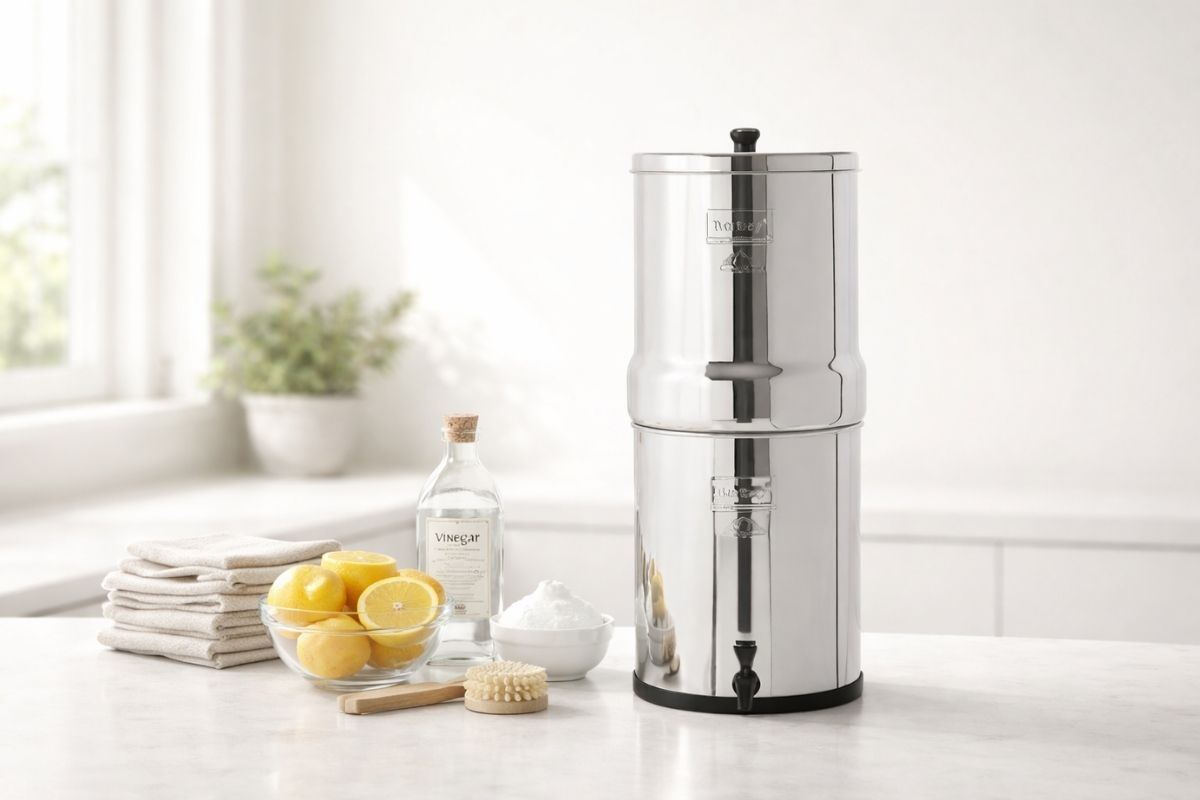
If you own a Berkey, maintenance questions can get confusing fast. Most people are not dealing with one issue, but three separate ones that often get lumped together: slow flow, fluoride add‑ons, and the true end of life for the main elements. When those questions blur, it is easy to overspend on extra parts or replace filters long before you need to.
If you are still deciding whether a Berkey is the right system in the first place, you can start with the full Berkey Water Filter Review for a deeper look at performance, pros, and trade‑offs. For Healthy Home Upgrade readers, a good maintenance routine is not just about keeping water moving; it is about knowing what each filter stage actually does, when a fluoride or extra polishing filter is worth the added cost, and when extra pieces only add complexity without real benefit.
Quick answer
The short version is simple. Black Berkey elements are the main filtration elements. PF-2 fluoride and arsenic reduction elements are optional add-ons that attach to the Black Berkey stems and hang in the lower chamber. They are not a replacement for the main elements. Official Berkey guidance also says slow flow often points to cleaning or re-priming first, not automatic replacement.
The biggest maintenance mistake Berkey owners make
The most common mistake is treating every maintenance issue like proof that the system is worn out.
It usually is not.
A slower system can mean buildup, poor priming, or a basic maintenance issue. Berkey’s support materials say slow or stopped flow most often means the elements need cleaning or proper re-priming, not immediate replacement. Their instructions specifically recommend gently scrubbing Black Berkey elements under cold running water and say not to use soap or other cleaning agents on the elements themselves.
That distinction matters because many owners jump straight to buying new elements before they have ruled out the simple fix.
Myth 1: You need to clean Black Berkey elements on a rigid schedule
Not really.
Berkey does recommend routine system maintenance, but their support guidance does not say the Black Berkey elements need constant cleaning on a fixed panic schedule. Their instructions say maintenance is done as needed, and their FAQs point people toward cleaning and re-priming when flow problems show up.
The more practical rule is this:
- If flow is normal, leave the elements alone.
- If flow slows down significantly, clean first.
- If cleaning and re-priming do not restore performance, then reassess replacement.
That is calmer, cheaper, and usually more accurate.
Skip Berkey cleaning hassles with our best under sink water filter picks, easier maintenance, same purity.
Myth 2: Slow flow means the filters are finished
This is one of the most expensive Berkey myths.
Official support guidance says slow flow is often a maintenance issue, not instant proof that the elements are done. Berkey says that when Black Berkey elements are letting little or no water through, the most likely reason is that they need to be cleaned or primed properly.
So before you buy replacement elements, ask:
- Has the flow actually dropped a lot
- Have the elements been cleaned properly
- Have they been re-primed
- Are you judging performance by real use, or just by frustration
That last one matters more than people think.
Instant filtration without scrubbing: discover the best faucet water filter.
Myth 3: PF-2 fluoride filters are part of the default setup
They should not be treated that way.
PF-2 elements are optional fluoride and arsenic reduction add-ons. Berkey’s own instructions show that they attach to already primed Black Berkey elements and hang into the lower chamber after water passes through the main filters first.
That means PF-2 filters should be a targeted decision, not an automatic purchase.
If fluoride reduction is a real goal for your water source, they may make sense. If you have not even checked your local water report, it makes more sense to do that first than to add another filter stage by default.
For a Healthy Home Upgrade reader, the logic is simple: every extra material in the water path should have a reason to be there.
Pitcher simplicity minus Berkey’s mineral buildup: best water filter pitcher.
Myth 4: PF-2 filters last as long as the main Berkey elements
They do not.
Berkey’s support FAQs say Black Berkey elements are recommended for replacement every 3,000 gallons per element, or 6,000 gallons per set of two, with earlier replacement possible depending on influent water quality. Their PF fluoride and arsenic reduction elements have a much shorter replacement interval, with official guidance pointing to replacement every 1,000 gallons or every six months under normal conditions.
This is one of the easiest maintenance details to get wrong because people assume the whole system runs on one timeline. It does not.
If you use PF add-ons, they need their own replacement rhythm.
Protect skin from chlorine vapors: best shower filter for chlorine.
Myth 5: More cleaning products mean better filter care
No.
Berkey’s official instructions say not to use soap or other cleaning agents on Black Berkey elements. Their warranty information also warns against attempting to clean or restore the elements with chemicals or detergents.
That makes this one simple:
- Do not improvise with detergents, bleach, or random “deep cleaning” hacks from forums.
- Clean the stainless system parts as directed.
- Clean the Black Berkey elements with water and the approved scrubbing method only.
That is the safer, lower-risk approach.
What actually matters when deciding whether to replace elements
Do not replace by panic. Replace by evidence.
A smart replacement decision comes down to:
- total water filtered
- source water difficulty
- whether cleaning and re-priming restore normal performance
- whether you are talking about the main Black Berkey elements or the optional PF add-ons
Berkey’s own guidance supports this logic. Main element lifespan is tied to gallon capacity and source water quality, while PF add-ons have a separate, shorter service life.
The Healthy Home Upgrade take
The biggest Berkey maintenance myth is not that people clean too little. It is that they buy parts too quickly and think “more filtration” is always smarter filtration.
It is not.
- Use the main elements properly.
- Do not assume slow flow equals dead filters.
- Do not buy PF add-ons on autopilot.
- And do not mix up cleaning, fluoride reduction, and replacement timing as if they are the same decision.
That is how you avoid wasted money and unnecessary complexity.
Final thoughts
Berkey maintenance gets much easier once you stop treating the system like one single moving part.
Flow problems are one question.
Fluoride reduction is another.
Real replacement timing is a third.
Separate those three decisions, and the whole system becomes much less confusing.
FAQ
Do PF-2 filters replace the Black Berkey elements?
No. PF-2 elements are optional fluoride and arsenic reduction add-ons that work with the Black Berkey elements, not instead of them.
How do I know when to clean Black Berkey elements?
Official Berkey guidance points to cleaning and re-priming when flow slows significantly or stops.
Can I use soap on Black Berkey elements?
No. Berkey’s instructions say not to use soap or other cleaning agents on the Black Berkey elements.
Do PF fluoride filters need replacement sooner than the main elements?
Yes. Berkey’s official guidance gives PF fluoride and arsenic elements a shorter replacement interval than the Black Berkey elements.
Is slow flow always a sign the filters are finished?
No. Berkey’s support guidance says slow or stopped flow often points to cleaning or re-priming first.

About the Author
Anita
Anita is the founder and writer behind Healthy Home Upgrade, where she shares her passion for transforming living spaces into foundations for smart health and wellness. Driven by her personal health journey, her goal is to provide valuable, practical articles that empower readers to use technology and design to improve their quality of life.