We get this question all the time from readers who are upgrading their water filtration.
And the answer surprises a lot of people.
Most homes do not need whole-house RO. In many cases, a good carbon-based setup does enough of the real work, especially when the goal is better taste, less chlorine, cleaner shower water, and healthier daily use without unnecessary complexity.
That matters, because reverse osmosis is often treated like the premium answer by default. Sometimes it is. But often it is simply more system than the home actually needs.
The smarter question is not, “Is RO the best?”
It is, “What is actually in my water, and do I need deep filtration at every tap?”
Quick Answer
You probably do not need whole-house RO if your main concerns are chlorine taste, odor, general city water cleanup, or improving water for showers and everyday use. In those cases, a quality whole-house carbon filter, or a layered setup with carbon plus a point-of-use filter, is often the more practical choice.
Whole-house RO makes more sense when your water has serious dissolved contaminant issues across the entire home, such as very high TDS, brackish water, nitrate concerns, or testing that shows a broader contamination problem that carbon alone cannot handle.
At a Glance: Which Setup Fits Your Home?
| Situation | Standard Carbon System | Whole-House RO |
| City water with chlorine smell or bad taste | Usually enough | Usually overkill |
| Hard water only | Not enough on its own, pair with softener | Usually not first choice |
| You want better drinking water at one tap | Often pair with under-sink RO | Usually unnecessary |
| Whole-home concern about dissolved solids or salts | Usually not enough | Often more relevant |
| Private well with multiple serious water issues | Sometimes part of the solution | May be worth considering |
| Budget-sensitive setup | Much more practical | Higher install and maintenance cost |
What Whole-House RO Actually Does
Whole-house reverse osmosis is designed to remove a wide range of dissolved substances from water before it reaches your taps, showers, appliances, and kitchen. That includes many minerals, salts, and smaller dissolved contaminants that standard carbon filters are not built to catch well.
That can be useful, but it comes with trade-offs.
Whole-house RO systems are usually:
- more expensive to install
- more expensive to maintain
- more complex to size and service
- more likely to need storage tanks and pumps
- more likely to create wastewater
So while whole-house RO can be the right solution, it is rarely the first solution you should jump to.
When Standard Carbon Systems Are Enough
For many homes, especially homes on treated municipal water, carbon does the job surprisingly well.
1. Your main problem is chlorine, taste, or odor
This is where carbon shines. If your water smells like a pool, tastes flat, or makes showers less pleasant, a standard carbon system is often the most efficient upgrade.
2. You want cleaner water for daily use, not maximum stripping
Some people do not need the most aggressive possible filtration at every tap. They want cleaner, better-smelling, more enjoyable water for bathing, cooking, washing produce, and protecting the overall feel of the home. A good whole-house carbon filter often covers that goal well.
3. Your drinking water needs are more targeted than your whole home
This is where many homes overspend.
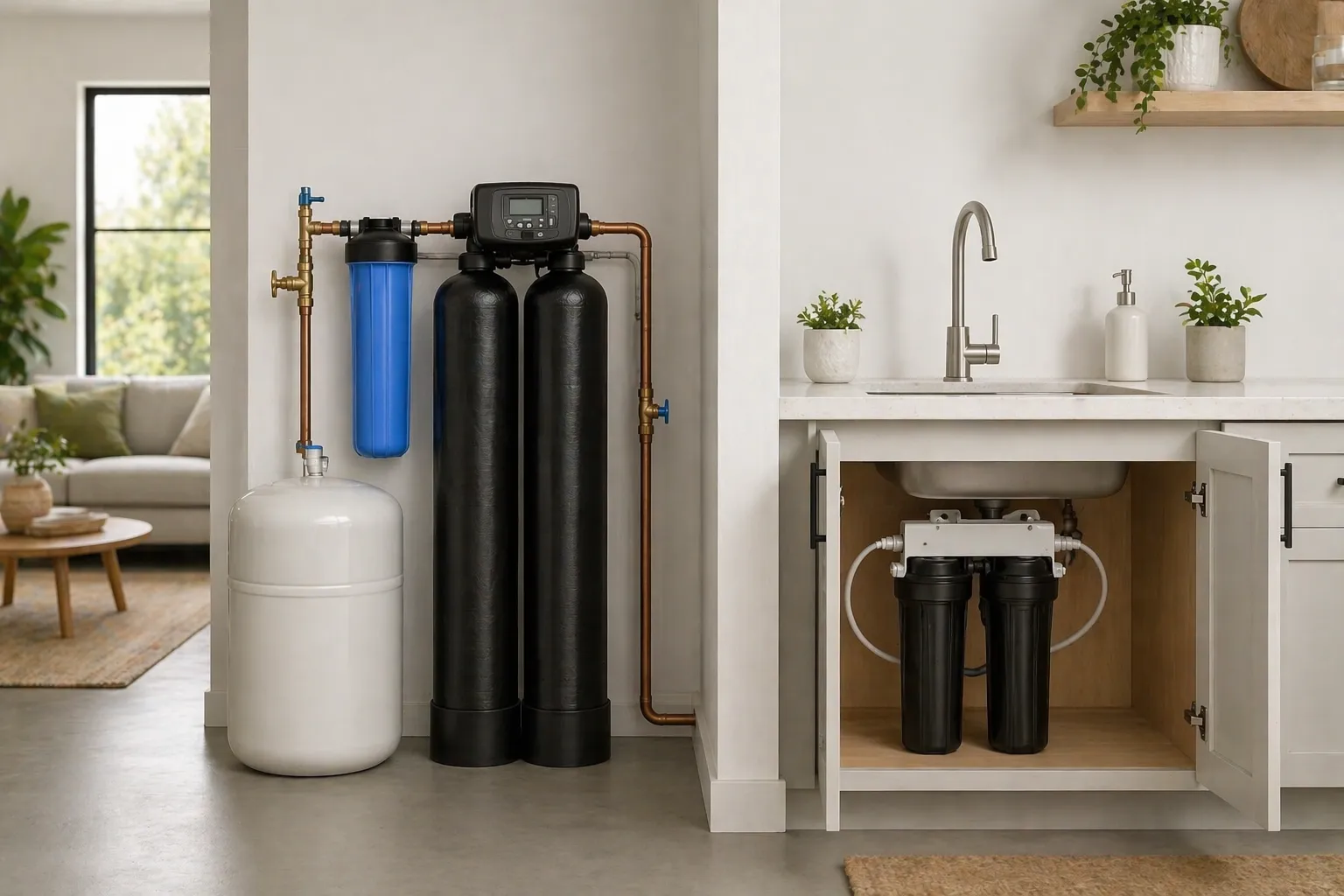
If the real priority is drinking water in the kitchen, not shower water in every bathroom, a layered setup usually makes more sense than whole-house RO. That often means a whole-house sediment or carbon filter for general cleanup, plus an under-sink system where you drink and cook.
4. Your water is hard, but not chemically complex
Hard water is annoying, but hardness alone does not automatically mean you need reverse osmosis. In many cases, a softener plus carbon filtration is the more practical path.
If your biggest issues are limescale, spotting, soap performance, and appliance buildup, start there before jumping to whole-house RO.
When Standard Carbon Systems Are Not Enough
This is where reverse osmosis becomes much more relevant.
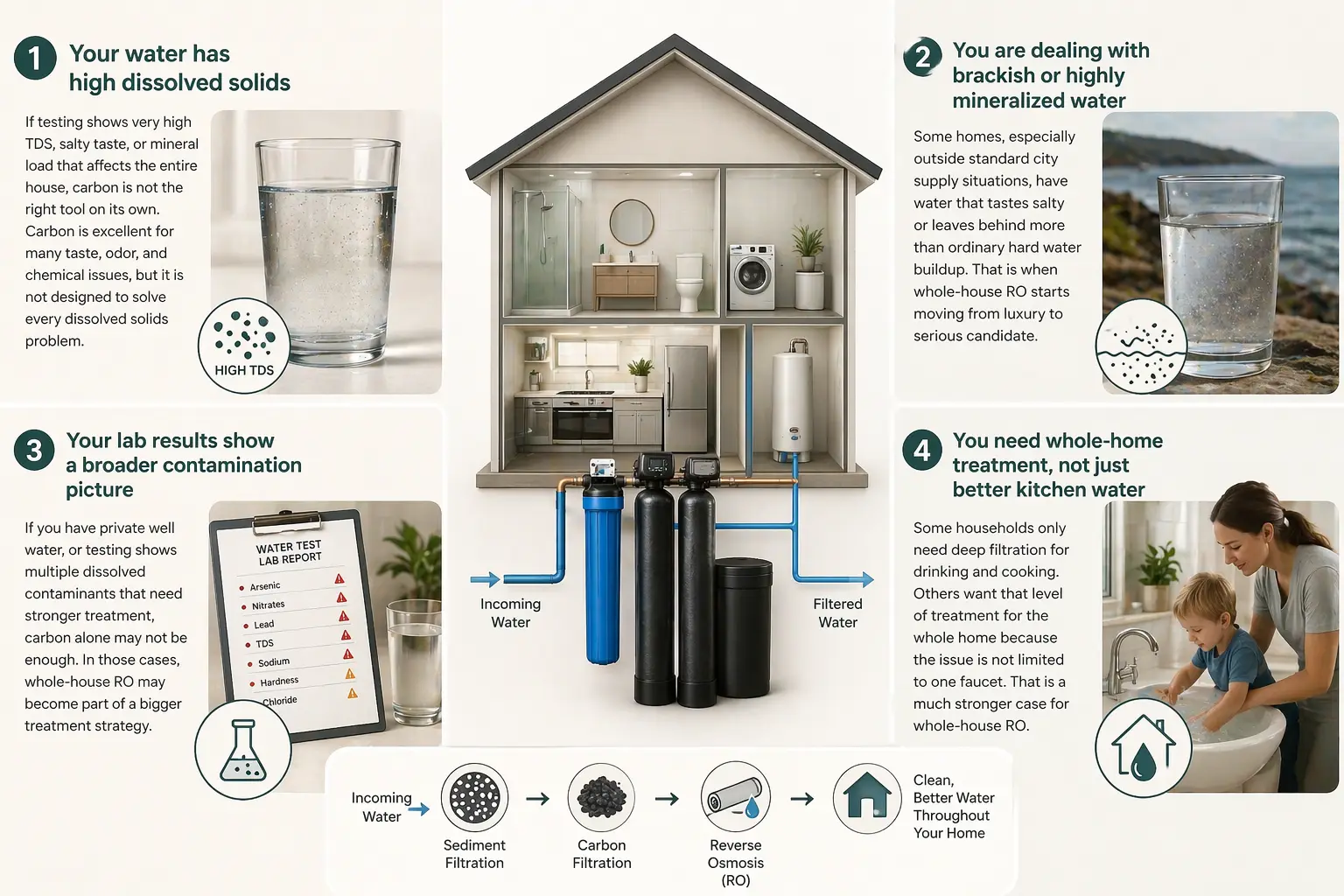
1. Your water has high dissolved solids
If testing shows very high TDS, salty taste, or mineral load that affects the entire house, carbon is not the right tool on its own. Carbon is excellent for many taste, odor, and chemical issues, but it is not designed to solve every dissolved solids problem.
2. You are dealing with brackish or highly mineralized water
Some homes, especially outside standard city supply situations, have water that tastes salty or leaves behind more than ordinary hard water buildup. That is when whole-house RO starts moving from luxury to serious candidate.
3. Your lab results show a broader contamination picture
If you have private well water, or testing shows multiple dissolved contaminants that need stronger treatment, carbon alone may not be enough. In those cases, whole-house RO may become part of a bigger treatment strategy.
4. You need whole-home treatment, not just better kitchen water
Some households only need deep filtration for drinking and cooking. Others want that level of treatment for the whole home because the issue is not limited to one faucet. That is a much stronger case for whole-house RO.
Skip whole-house RO overkill, discover when best whole house water filter systems deliver 95% of benefits at 20% cost
The Middle Ground Most Homes Actually Need
This is the part many homeowners miss.
You do not always have to choose between basic carbon and full-house RO. Often the smartest setup is layered.
Setup 1: Whole-house carbon plus under-sink RO
This is one of the most balanced options for city water homes.
You get:
- cleaner water for showers and general household use
- reduced chlorine and better taste throughout the home
- deeper filtration only where you drink and cook
This setup often gives you most of the benefits people want, without the cost and complexity of whole-house RO.
Whole-house RO sounds thorough, but best whole house reverse osmosis systems reveal when it’s actually necessary.
Setup 2: Whole-house carbon plus softener
This is often the better answer for homes with hard water but no major dissolved contamination problem.
You get:
- chlorine reduction
- better shower water
- scale control
- less strain on appliances and fixtures
Precision beats excess, best under sink water filter targets drinking water perfectly.
Setup 3: Sediment, carbon, UV, and point-of-use filtration
This is common for private well situations, where the answer depends on what testing shows.
The point is simple. Water treatment should be built around the problem, not around the most dramatic filter type on the market.
Smart layering trumps single-system hype: Layered filtration – combining whole-house + under-sink without overkill.
Why Whole-House RO Can Be the Wrong Upgrade
Whole-house RO sounds impressive, but it comes with real downsides.
Cost
It is one of the most expensive residential filtration routes you can take. The install is larger, the hardware is more involved, and ongoing maintenance is higher than standard carbon systems.
Wastewater
RO systems reject water as part of the filtration process. That does not automatically make them a bad choice, but it does make them less appealing if your water issue could be solved more efficiently another way.
Complexity
Whole-house RO is not a simple swap. It often needs more space, more planning, and more follow-up maintenance than homeowners expect.
Materials and plumbing matter more than people think
Whole-house RO is not just a filtration choice. It is also a materials choice.
Because RO water is very low in dissolved minerals, it can be more chemically aggressive in some full-home setups, especially where water sits in storage tanks or moves through older plumbing. That does not make whole-house RO a bad idea by itself, but it does mean tank materials, fittings, seals, and downstream plumbing deserve much closer attention than most homeowners realize.
Large tanks add another layer of maintenance
Many whole-house RO systems rely on larger storage components. That means hygiene and servicing matter more. Poor maintenance can turn tanks and low-flow sections into weak points over time.
This is also where your Zero Toxic Load lens matters. If the system uses lower-quality plastics, questionable liners, or cheap fittings, the setup itself becomes part of the discussion, not just the membrane.
Not always necessary
This is the biggest issue.
Many homes end up paying for whole-house RO when a layered system would have solved the actual problem just as well, or better.
It is not only a question of price. It is also a question of common sense. Running your entire home on highly purified RO water without a clear reason can be like washing your car with bottled spring water. It sounds premium, but in many homes it adds cost and complexity without adding meaningful benefit at the shower, toilet, or laundry sink.
A Quick Note on Standards and Certifications
When comparing systems, look at the filter type and the standard behind it.
In simple terms:
- carbon systems are often associated with NSF/ANSI 42 or 53 claims
- reverse osmosis systems are commonly associated with NSF/ANSI 58
That does not mean every system performs equally well, but it gives you a much better starting point than brand marketing alone.
Construction quality matters too. A stronger carbon system with solid housings, cleaner internal materials, and well-built fittings is often a better real-world choice than a flashy system with weak materials.
Confused by certifications? NSF/ANSI 42 vs 53 vs 58 explained decodes what actually matters.
How to Decide Without Guessing
If you want to choose the right filtration setup, work through this in order.
1. Start with your water report or lab testing
Do not buy based on fear or marketing.
Find out:
- whether you are on municipal water or a private well
- what contaminants are actually present
- whether the issue is mostly aesthetic, chemical, or mineral
2. Separate whole-home problems from drinking-water problems
This one step saves a lot of money.
Ask:
- do I need better shower and laundry water?
- do I need safer cooking and drinking water?
- do I need both?
Those are not always the same system.
3. Match the filter type to the actual contaminant category
Carbon, softening, RO, UV, and sediment filtration all solve different problems. The goal is not to buy the most aggressive system. The goal is to buy the correct one.
4. Think about maintenance before you buy
A great system on paper becomes a bad system fast if it is too expensive, too bulky, or too annoying to maintain.
5. Use certifications and performance claims carefully
Do not assume all filters do the same job. Look for credible contaminant reduction claims and match them to the specific issue you are trying to solve.
Lead demands targeted defense: best water filter for lead removal stops it cold.
My Honest Take
Whole-house RO is sometimes exactly the right move, but it is not the default healthy home answer.
For most homes on standard city water, a whole-house carbon system, or a whole-house carbon plus under-sink RO setup, is the more balanced solution. It is simpler, cheaper, easier to live with, and usually better aligned with the real problem.
From a Zero Toxic Load perspective, I would much rather see a homeowner choose a well-built carbon system with credible NSF/ANSI 42 or 53 claims, good material quality, and clean construction, then add deeper filtration only where they actually drink and cook. That is often a smarter health decision than pushing the entire house through a more aggressive system built with mediocre tanks, fittings, and plastic-heavy components.
If you do need whole-house RO, then the bar should be higher. Look at NSF/ANSI 58, material quality, storage design, fittings, seals, service access, and the plumbing context of the home. In other words, do not buy the membrane and ignore the rest of the system.
That is where generic water-filter blogs often stop. HH should not.
The smartest filtration setup is rarely the most extreme one. It is the one that solves the real problem with the fewest compromises, the least unnecessary complexity, and the cleanest overall material logic.
Before buying big, face reality: whole house water filter installation cost breakdown.
FAQ
Is whole-house RO worth it for city water?
Usually not as a first step. Many city water homes do very well with carbon filtration for the whole house and a stronger point-of-use filter in the kitchen.
Is whole-house RO the same as a water softener?
No. They solve different problems. Softeners are typically used for hardness. RO is used for broader dissolved contaminant reduction.
Can carbon filters remove everything I should worry about?
No. Carbon is useful, but not universal. It is excellent for some problems and weaker for others. That is why testing matters.
What is the best setup for most families?
For many homes, it is a layered setup: whole-house carbon for general cleanup, and under-sink filtration for drinking and cooking water.
Is whole-house RO better for PFAS?
It can be part of a high-level PFAS strategy, but “better” depends on the contaminant profile and where exposure matters most. In many homes, targeted certified filtration is the more practical place to begin.
Conclusion
Do you really need whole-house RO?
In many homes, no.
If your main issues are chlorine, smell, taste, general city water cleanup, or creating a healthier everyday water setup, standard carbon systems are often enough. If your water test points to more serious dissolved contaminant issues across the whole home, then whole-house RO may be justified.
The best water setup is not the most expensive one.
It is the one built around your real water, your real home, and your real priorities.
For many families, that means a layered approach that uses whole-house carbon where it makes sense, and deeper point-of-use filtration only where it matters most.
See also:
- Best Whole House Water Filter System
- Best Whole House Reverse Osmosis Systems
- Best Under Sink Water Filter
- Layered Filtration: Combining Whole-House, Under-Sink, and Lead-Specific Filters Without Overkill
- How to Read NSF/ANSI Labels: 42 vs 53 vs 58
- Best Water Filter for Lead Removal
- Whole House Water Filter Installation Cost

Anita is the founder and writer behind Healthy Home Upgrade, where she shares her passion for transforming living spaces into foundations for smart health and wellness. Driven by her personal health journey, her goal is to provide valuable, practical articles that empower readers to use technology and design to improve their quality of life.