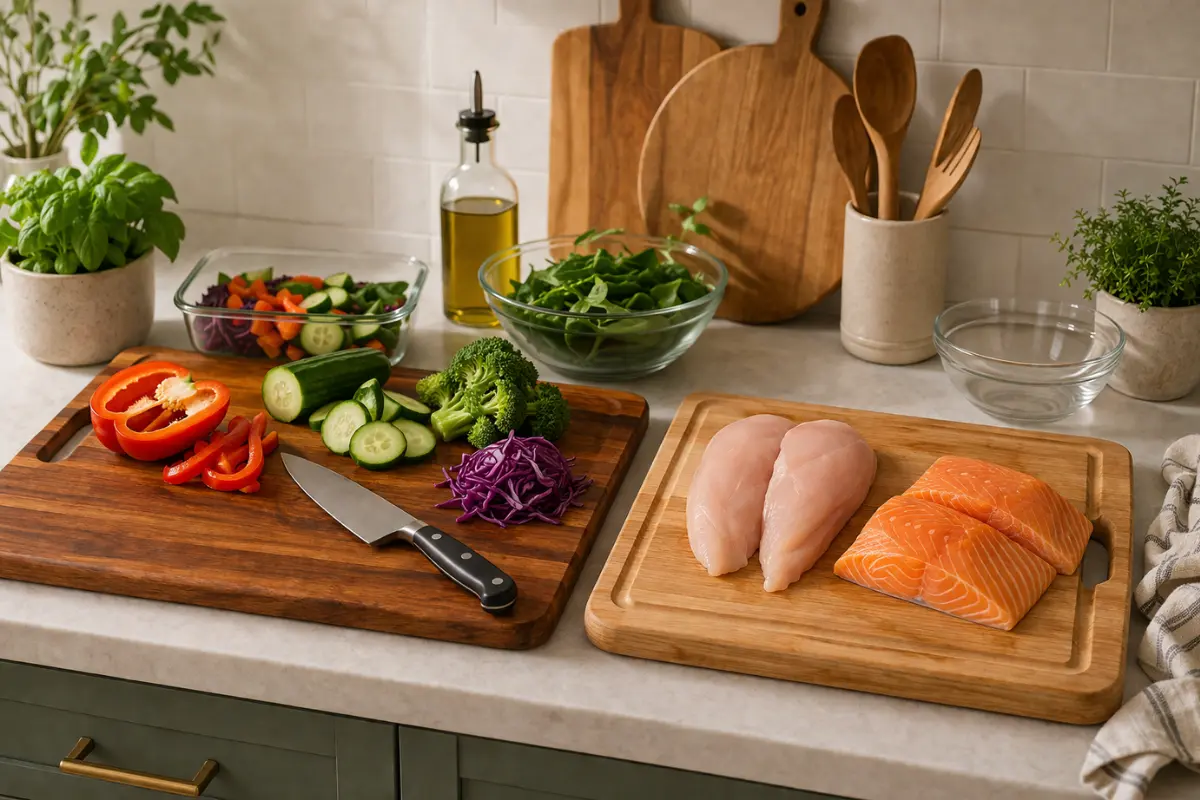
A real Zero-Toxic-Load meal prep station is not a random pile of “healthy kitchen” products. It is a system where the pieces actually work together, lower daily friction, and make the cleaner choice easier to keep repeating. For most homes, that means one solid hardwood board for daily prep, one separate board for raw meat if needed, one practical chef’s knife plus a small paring knife, and glass or stainless steel containers for storage. FDA allows hard maple or an equivalently hard, close-grained wood for cutting boards, USDA says separate boards help reduce cross-contamination, and Iowa State Extension describes glass, stainless steel, and ceramic containers as non-reactive, non-toxic, and easy to sanitize.
I remember the moment I realized my kitchen was creating friction instead of supporting good habits, because every time I tried to prep something simple, I ended up fighting mismatched boards, awkward tools, and containers I did not really want to use.
If you are still deciding which board is worth maintaining in the first place, it helps to read this guide to the best non-toxic cutting boards before you build a cleaning routine around the wrong surface:.
At a Glance
| Piece | Best Core Choice | Why It Matches | Weak Link to Avoid |
| Main prep board | Solid hardwood | Durable, repairable, calmer for daily prep | Glass or stone for everyday chopping |
| Raw protein board | Separate nonporous board | Practical for raw meat workflows and easier replacement | Using one board for everything |
| Main knife | Chef’s knife | Covers most prep with less clutter | Oversized knife sets full of filler |
| Small knife | Paring knife | Handles detail work and small jobs | Forcing one large knife to do everything |
| Storage containers | Glass or stainless steel | Non-reactive, non-toxic, easy to sanitize | A pile of worn, cloudy, mismatched containers |
Also in This Article
- What a meal prep station should actually do
- Why kitchen friction matters
- The best board setup
- The knife setup that actually makes sense
- Why glass and stainless steel match the system
- Product recommendations
- The biggest mismatch people make
- FAQ
What a Zero-Toxic-Load Meal Prep Station Should Actually Do
A meal prep station is not just where you chop vegetables. It is the system that decides what touches your food, how easy the kitchen is to keep clean, and how likely you are to stick with better habits instead of defaulting to whatever is quickest.
That is why this article is not just a shopping list. It is about match and flow.
The best setup does four things well:
- It keeps daily food-contact materials simple.
- It separates higher-risk prep when needed.
- It lowers mental load, not just chemical load.
- It makes good habits easier to repeat.
That third point matters more than many people realize. If your setup is annoying to use, it quietly pushes you toward shortcuts. You start grabbing the old plastic tub because the glass containers are buried. You avoid the good board because it is cramped behind other things. You buy a better knife, then dull it on a glass board because the station was never thought through. That is kitchen friction, and in a Healthy Home kitchen it matters because bad flow usually creates worse material choices over time.
Why Kitchen Friction Matters
Most generic articles describe boards, knives, and containers as separate categories. Real kitchens do not work that way.
Kitchen friction is what happens when your tools do not support each other:
- a beautiful chef’s knife used on a cheap glass cutting board
- a good hardwood board paired with cluttered storage so prep still feels chaotic
- quality glass containers that are so disorganized you keep reaching for old plastic instead
- one board trying to handle produce, bread, and raw chicken because there was never a real workflow
That kind of mismatch changes behavior. The problem is not just aesthetics. It is that frustration makes people take shortcuts, and shortcuts usually push the kitchen away from the whole Zero Toxic Load idea.
Start with the right foundation: cutting board materials ranked for toxin load and durability
The Best Board Setup
For most kitchens, the best main board is still solid hardwood. FDA’s Food Code specifically permits hard maple or an equivalently hard, close-grained wood for cutting boards, which confirms that wood is an accepted food-contact material when it is well chosen and kept in good condition. FDA also says cutting surfaces that become too scratched or scored to be effectively cleaned and sanitized should be resurfaced or discarded.
That fits the HH logic well. A good hardwood board is simple, repairable, and built for real daily use. It does not pull you into the same disposable cycle as softer boards that become rough and tired too quickly.
If you prep raw meat, poultry, or seafood regularly, USDA recommends separate cutting boards for raw animal products and ready-to-eat foods to reduce cross-contamination. That is why the smartest system is often one hardwood board for daily prep and one separate nonporous board for raw proteins.
The best match here
- Main board: solid hardwood for produce, herbs, bread, fruit, and everyday prep
- Secondary board: a separate raw-protein board that you are willing to replace sooner if it becomes deeply worn
What does not match
University of Maine Extension says glass, marble, and stone cutting boards are nonporous and easy to clean, but also warns that these hard surfaces can dull knives quickly and are not recommended for heavy-duty chopping. That is exactly the sort of mismatch many people create without realizing it.
Keep boards pristine naturally: how to season, clean, and disinfect cutting boards without bleach.
The Knife Setup That Actually Makes Sense
This is where many kitchens become cluttered for no good reason.
Most people do not need a giant knife block. They need one good chef’s knife and one small paring knife they actually use. That is the calmer, more realistic setup, and it usually supports better prep habits than owning eight knives you never reach for.
The more important point is that the knife has to match the board. A decent knife on hardwood makes sense. The same knife on a glass cutting board does not. University of Maine Extension’s warning about hard surfaces dulling knives quickly is one of the clearest examples of broken kitchen logic.
That is the kind of mismatch HH should call out directly: people buy a “better” knife, then quietly sabotage it with the wrong prep surface every day.
My practical setup
- One chef’s knife for nearly all major prep
- One paring knife for fruit, trimming, and detail work
- optional: one bread knife if you use it regularly
That is enough for most homes. I would rather have two or three honest, useful knives than a large knife block full of filler.
Eliminate plastic entirely: how to reduce plastic contact in the kitchen.
Why Glass and Stainless Steel Match the System
If the board and knife are the action zone, containers are the holding zone. This is where meal prep either stays clean and organized or turns into refrigerator chaos.
For a Zero Toxic Load kitchen, glass and stainless steel make the most sense as core storage materials. Iowa State Extension describes glass, stainless steel, and ceramic as non-reactive and non-toxic, says they are easily sanitized, and notes that they are durable, long-lasting options for food storage. It also says these materials do not release chemicals or toxins into food and are inert with respect to the natural chemicals and dyes in food.
That is the HH note worth remembering: we choose these materials because they are stable. They make the system feel cleaner, more predictable, and less disposable.
Best matching container logic
- Glass containers for fridge meal prep, leftovers, and foods you want to see easily
- Stainless steel containers for transport, lunch packing, or kitchens where breakage matters
- Ceramic for some storage roles, though usually not as flexible as glass for everyday meal prep
Prep flows to cooking: safest cookware materials.
Product Recommendations
A Simple Hardwood Board Recommendation
A solid hardwood cutting board is still one of the easiest ways to make a meal prep station feel calmer and more dependable. It gives you a stable surface for daily chopping, holds up well over time, and usually feels better to work on than cheaper boards that wear out quickly. In a healthy home kitchen, I like it because it is simple, durable, and easy to keep in rotation for years. You can check a solid hardwood cutting board here.
Pair your food storage containers with a leakproof stainless steel lunch box for meals on the go.
A Practical Chef’s Knife Recommendation
A chef’s knife is the one knife I would build most meal prep around. It handles the majority of everyday chopping without making the station feel cluttered, and it is usually much more practical than owning a large set of knives you rarely touch. In a healthy home kitchen, a good chef’s knife makes prep feel smoother, faster, and less frustrating. You can check a chef’s knife here.
A Glass Container Recommendation
Glass food storage containers are one of the easiest upgrades in a Zero Toxic Load kitchen because they are non-reactive, long-lasting, and straightforward to use. They work especially well for meal prep because you can move from prep to storage without relying on a pile of worn, mismatched containers that never feel fully clean. I also like that they make the fridge feel more organized and less chaotic over time. You can check a set of glass food storage containers here.
The Best Matching Setups for Real Kitchens
This is the part many articles skip. A real prep station is about combinations, not isolated products.
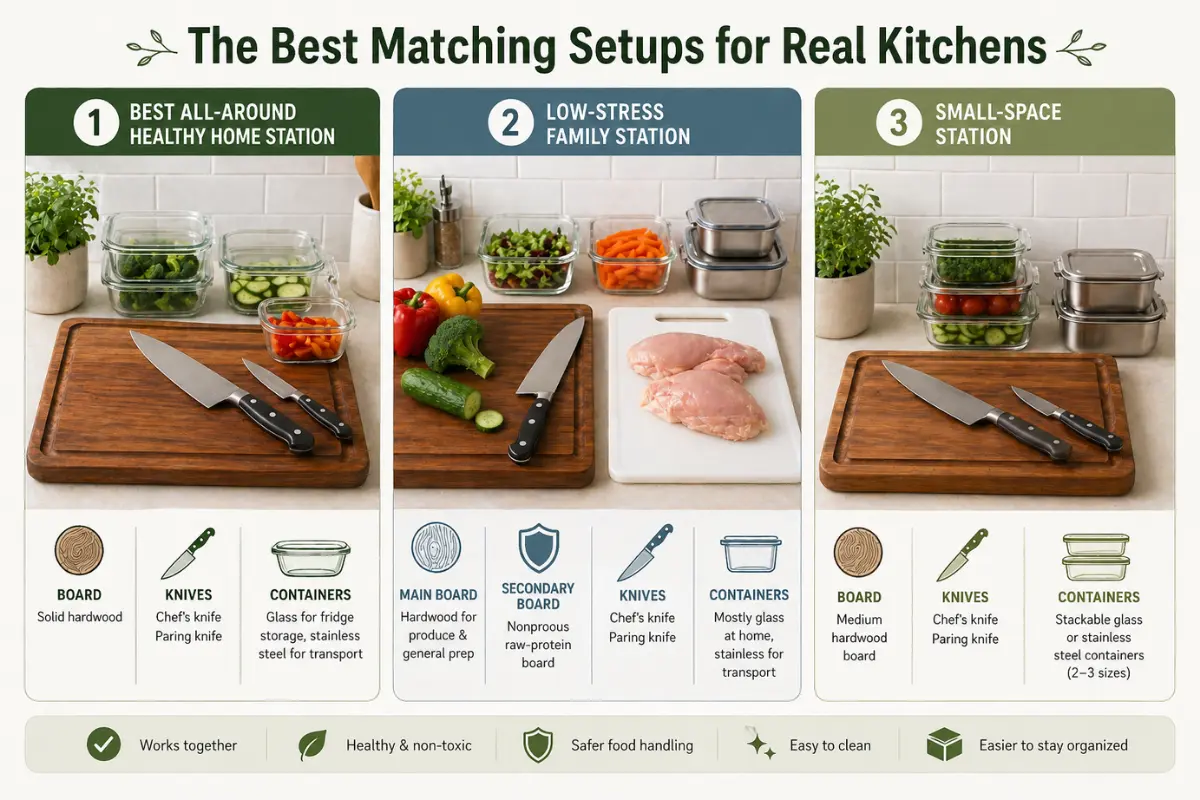
Setup 1: The Best All-Around Healthy Home Station
This is the one I would recommend for most readers.
- Board: solid hardwood
- Knives: one chef’s knife and one paring knife
- Containers: glass for fridge storage, stainless steel if you transport meals often
Why this works: it keeps the daily food-contact zone simple, avoids the obvious knife-surface mismatch, and makes the storage side easier to sanitize and organize. The board, knife, and containers all support each other instead of fighting each other. FDA, USDA, and Iowa State Extension all support the underlying material logic here.
Beeswax wraps for plastic-light meal prep can complement glass and stainless steel food storage solutions.
Setup 2: The Low-Stress Family Station
If you handle raw meat often and need a more practical workflow, do this:
- Main board: hardwood for produce and general prep
- Secondary board: nonporous raw-protein board
- Knives: one workhorse chef’s knife, one paring knife
- Containers: mostly glass at home, some stainless for transport
Why this works: it respects food safety without making the whole kitchen feel clinical. USDA’s separate-board guidance matters more here than pretending one board can do everything well.
Setup 3: The Small-Space Station
If your kitchen is tight, do not copy a giant influencer setup.
- Board: one medium hardwood board
- Knives: one chef’s knife and one paring knife
- Containers: stackable glass or stainless steel containers in just two or three useful sizes
Why this works: smaller systems are easier to maintain, easier to keep visible, and less likely to create the kind of friction that sends you back to random old containers and rushed prep habits.
The Biggest Mismatch People Make
The most common mistake is not buying the “wrong” premium item.
It is mixing incompatible logic.
A typical example looks like this: a beautiful hardwood board, a cheap glass cutting board somewhere else in the station, a fancy chef’s knife that keeps getting dulled on the wrong surface, and a pile of cloudy plastic containers that no longer stack, seal, or feel good to use. Nothing is technically impossible there. But the system does not match.
And once the system does not match, people stop using the best tools the way they were meant to be used.
FDA says scored cutting surfaces that can no longer be effectively cleaned and sanitized should be resurfaced or discarded, and Iowa State Extension emphasizes the value of stable, non-reactive storage materials. Put together, that points to a clear HH lesson: stop trying to make a broken system look intentional. Replace the weak links and make the station coherent.
Readers interested in premium cookware should take a look at our comparison of Lodge and Le Creuset before making a decision.
Final Verdict
If you want a Zero-Toxic-Load meal prep station that actually works, build it around this:
One solid hardwood board. One separate raw-protein board if needed. One chef’s knife. One paring knife. Glass or stainless steel containers that you can actually keep organized.
That is the station that makes sense because the pieces support each other. The board is appropriate for daily prep. The knives match the surface. The containers match the storage logic. And the whole system lowers both chemical load and mental load. For Healthy Home Upgrade, that is what a real Zero Toxic Load setup should feel like: simpler, calmer, and much harder to sabotage.
FAQ
What is the best cutting board for a low-tox meal prep station?
For most homes, a solid hardwood board is the strongest main-board choice. FDA specifically allows hard maple or an equivalently hard, close-grained wood for cutting boards, as long as the surface remains cleanable and in good condition.
Do I really need a separate board for raw meat?
If you prep raw meat, poultry, or seafood regularly, USDA’s separate-board guidance is smart and practical. It reduces cross-contamination risk and keeps your main produce-prep board from trying to do every job badly.
Are glass containers better than plastic for meal prep?
For a Zero Toxic Load kitchen, glass and stainless steel are stronger core materials because Iowa State Extension describes them as non-reactive, non-toxic, easily sanitized, and long-lasting.
How many knives does a real meal prep station need?
Most people are better served by one chef’s knife and one paring knife than a large knife block. That is a practical judgment call rather than an official rule, but it usually creates a calmer, more usable station.