Caraway Cookware Set Review: Is This Ceramic Non-Stick Worth the Price?
Quick Answer
The Caraway Cookware Set is worth considering if you want a beautiful, PFAS-conscious ceramic non-stick cookware set that is easier to use than stainless steel and more design-focused than most traditional non-stick pans.
It is best for everyday low to medium heat cooking, especially eggs, vegetables, sauces, soups, grains and simple family meals where easy cleanup matters.
It is not the best choice if you want cookware for high-heat searing, dishwasher use, metal utensils or lifetime durability. For that, stainless steel, cast iron or carbon steel will usually be a better long-term investment.
My honest verdict: Caraway is a strong choice for a low-toxin, design-conscious kitchen if you understand what ceramic non-stick can and cannot do.
Anita’s Take
When I look at cookware for a healthier home, I do not only ask, “Is it pretty?” or “Does food stick?”
I ask a different question first:
What is touching the food every single day?
That is why Caraway is interesting. It gives people a way to move away from traditional PTFE-based non-stick pans without asking them to suddenly become stainless steel experts overnight.
But I also want to be honest. Ceramic coated cookware is not magic. It needs gentle heat, hand washing and the right utensils. If someone buys Caraway expecting it to behave like a cheap pan they can throw in the dishwasher, use on high heat and scrape with metal, they will probably be disappointed.
For the right person, though, this is one of those kitchen swaps that makes a home feel calmer, cleaner and more intentional.
Caraway Cookware Set at a Glance
| Feature | Caraway Cookware Set |
| Best for | Everyday ceramic non-stick cooking |
| Main material | Aluminum body with ceramic coated cooking surface |
| Coating type | Ceramic non-stick coating |
| PFAS / PTFE | Made without PFAS, PTFE and PFOA according to Caraway |
| Lead and cadmium | Made without lead and cadmium according to Caraway |
| Stovetop compatibility | Gas, electric and induction |
| Oven safe | Up to 550°F according to Caraway |
| Dishwasher safe | No, hand washing is recommended |
| Best cooking style | Low to medium heat |
| Best buyer | Health-conscious home cooks who want easy cleanup and a coordinated set |
| Main weakness | The ceramic coating can lose non-stick performance over time |
| Skip if | You want high-heat searing, metal utensil use or lifetime cookware |
Check the latest price on Amazon
What Comes in the Caraway Cookware Set?
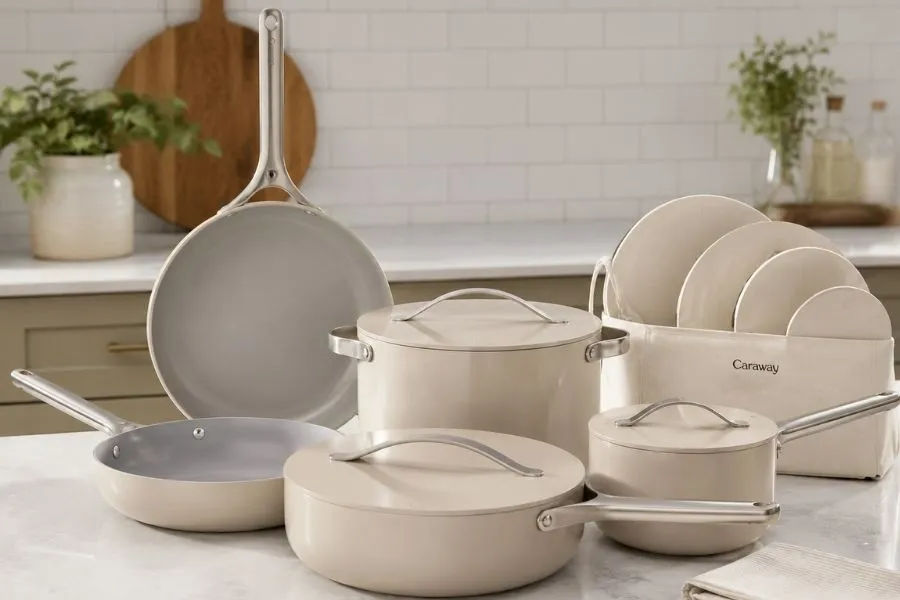
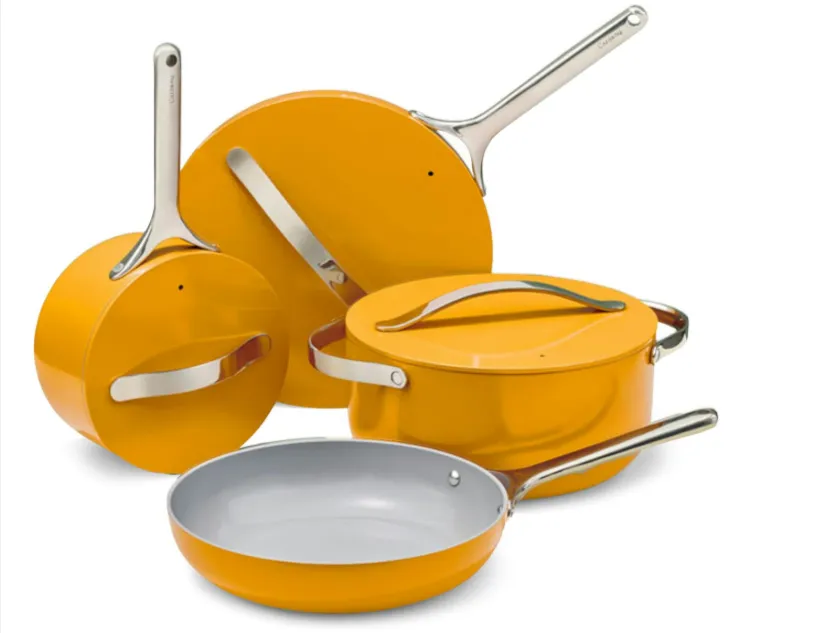
The classic Caraway Cookware Set is designed around four core pieces:
- 10.5-inch fry pan
- 3 qt saucepan with lid
- 4.5 qt sauté pan with lid
- 6.5 qt Dutch oven with lid
- Storage organizers
That is a practical setup for most kitchens. You are not getting a giant set full of duplicate pans you may never use. You are getting the daily basics: one fry pan, one saucepan, one sauté pan and one larger Dutch oven.
For a smaller household, apartment kitchen or first serious non-toxic cookware upgrade, that simplicity is a plus.
For a large family that batch cooks every day, you may eventually want extra pieces.
Weakness
The ceramic non-stick coating naturally degrades over time and is not designed for high-heat searing, rough dishwasher use or metal utensils.
Who should avoid it
Caraway is not the best choice for chefs who love high-heat steak searing, households where everything goes in the dishwasher, or anyone who wants lifetime cookware like stainless steel, cast iron or carbon steel.
If you’re still comparing non-stick alternatives, our guide to PFOA and PTFE-free pots and pans explains what these labels mean and how to choose safer cookware.
Why Caraway Is Popular
Caraway became popular because it solves three problems at once.
First, it looks beautiful. The colors are soft, modern and easy to match with a calm kitchen aesthetic.
Second, it gives people a non-stick option that is made without PFAS, PTFE and PFOA according to the brand.
Third, it comes with storage organizers, which makes the whole set feel more intentional and less messy than a random cabinet full of scratched pans.
That combination matters. A healthier home upgrade only works if people actually enjoy using it.
What I Like About the Caraway Cookware Set
1. It is a cleaner swap from traditional non-stick
Traditional non-stick cookware often raises questions around PTFE and PFAS. Caraway’s ceramic coating is marketed as made without PTFE, PFOA, PFAS, lead and cadmium.
That does not mean every “non-toxic” marketing claim in the cookware world should be accepted blindly. It does mean Caraway is positioned as a meaningful swap for people trying to move away from traditional coated non-stick pans.
For more background on safer cookware materials, read our guide to PFOA and PTFE-free pots and pans.
2. The set covers most daily cooking
You can make eggs, oatmeal, pasta, soup, stir-fried vegetables, sauces, rice dishes and simple family meals with this set.
The sauté pan and Dutch oven are especially useful because they give more depth than a shallow fry pan. That matters if you cook vegetables, sauces or one-pan meals often.
3. It is easier than stainless steel for beginners
I love stainless steel as a long-term material, but I also know it has a learning curve.
You need proper preheating, enough fat and the patience not to move food too early. Many people give up and go back to non-stick because they just want breakfast without a fight.
Caraway gives those people a more approachable middle step.
4. The storage system is genuinely useful
Cookware storage matters more than people think.
If pans are stacked badly, they get scratched faster. If lids are chaotic, you stop enjoying the kitchen. Caraway’s included pan racks and lid storage are not just aesthetic. They help protect the cookware and make the set easier to live with.
5. It fits a low-toxin kitchen visually and practically
A healthier kitchen should not feel clinical or fear-based. It should feel calm, functional and beautiful.
Caraway does that well. It is one of the few cookware brands that makes the better-material choice feel aspirational instead of restrictive.
Check the latest price on Amazon
What I Do Not Like
1. Ceramic non-stick is not lifetime cookware
This is the biggest thing to understand before buying.
Ceramic coated cookware can be very useful, but it will not usually age like stainless steel, cast iron or carbon steel. Over time, the slick non-stick effect can fade, especially if you use high heat, metal utensils, oil sprays, harsh scrubbing or the dishwasher.
If you want cookware your children may still use in 25 years, I would look at stainless steel, carbon steel, cast iron or enameled cast iron instead.
2. You need to use low to medium heat
Caraway recommends gentle cooking habits for its ceramic coated cookware.
That is not a small detail. If you are used to turning the burner high for everything, this set will require a habit change.
For eggs, vegetables, sauces and gentle everyday cooking, that is fine. For aggressive searing, it is not ideal.
3. It is hand wash only
Caraway recommends avoiding the dishwasher because it can affect the longevity of the cookware.
For me, that is not a dealbreaker because most better cookware lasts longer with hand washing. But it is important. If you know you will put everything in the dishwasher, this is probably not the right set.
4. It is more expensive than basic ceramic pans
Caraway is not the cheapest way to buy ceramic cookware.
You are paying for the design, the coordinated set, the storage system, the brand and the cleaner material positioning.
That can be worth it if you want one beautiful set that simplifies your kitchen. It is less compelling if you only need one inexpensive non-stick fry pan.
For cooks who prefer a completely uncoated cooking surface, our roundup of the best stainless steel cookware brands highlights some of the most durable options available today.
Who Should Buy the Caraway Cookware Set?
Caraway makes the most sense if you:
- Want to replace older traditional non-stick pans
- Care about PFAS, PTFE and PFOA-free cookware claims
- Cook mostly on low to medium heat
- Want easy cleanup without switching fully to stainless steel
- Like a calm, coordinated kitchen aesthetic
- Have a small to medium household
- Are willing to hand wash and protect the coating
This is especially good for someone building a healthier kitchen from scratch.
Who Should Avoid Caraway?
Skip Caraway if you:
- Cook on high heat often
- Want to sear steak regularly
- Use metal utensils
- Put all cookware in the dishwasher
- Want cookware that can last for decades
- Prefer uncoated materials only
- Are very rough with pans
- Want the lowest price possible
If that sounds like you, look at our best stainless steel cookware brands guide or our enameled cast iron Dutch oven guide instead.
If you enjoy slow cooking, braising, or one-pot meals, our guide to the best enameled cast iron Dutch ovens is a great next read.
Is Caraway Really Non-Toxic?
Caraway says its ceramic coated cookware is made without PTFE, PFOA, PFAS, lead and cadmium.
That is a meaningful claim for shoppers trying to avoid traditional non-stick coatings. But I would still avoid saying any cookware is “perfectly safe” or “100% toxin-free” in a blanket way.
A more careful way to frame it is this:
Caraway is a lower-toxin cookware option compared with many traditional PTFE-based non-stick pans, based on the brand’s material claims and available product information.
That is the kind of language I trust more.
In a healthy home setup, the goal is not to panic over every pan. The goal is to reduce repeated exposures where it is practical, especially in the products that touch food every day.
Creating a lower-toxin kitchen goes beyond cookware. Our non-toxic cutting board guide explores safer food-prep surfaces for everyday use.
Caraway vs Stainless Steel
| Feature | Caraway Ceramic Coated | Stainless Steel |
| Non-stick feel | Easier at first | Requires technique |
| PFAS concern | Made without PFAS according to Caraway | Usually uncoated and PFAS-free |
| High-heat cooking | Not ideal | Strong choice |
| Dishwasher use | Not recommended | Often dishwasher safe, but hand washing is still better |
| Durability | Coating may wear over time | Can last decades |
| Beginner friendly | Yes | Medium learning curve |
| Best for | Easy everyday cooking | Searing, longevity and serious cooking |
Choose Caraway if you want ease.
Choose stainless steel if you want durability.
Many healthy kitchens benefit from both: one ceramic non-stick pan for eggs and delicate foods, plus stainless steel or cast iron for high-heat meals.
If you’re planning a complete kitchen upgrade, see our best non-toxic cookware sets guide for carefully selected cookware collections.
Caraway vs Cast Iron
| Feature | Caraway | Cast Iron |
| Weight | Medium heavy | Heavy |
| Maintenance | Hand wash, protect coating | Seasoning and drying needed |
| Non-stick performance | Easy at first | Improves with seasoning |
| High heat | Not ideal | Excellent |
| Acidic foods | Better than bare cast iron | Can affect seasoning |
| Best for | Low to medium heat daily meals | Searing, frying, baking and long-term use |
Cast iron is more durable.
Caraway is easier for people who want quick cleanup and less maintenance.
Caraway vs Enameled Cast Iron
| Feature | Caraway | Enameled Cast Iron |
| Best use | Everyday non-stick cooking | Braising, soups, stews and slow cooking |
| Non-stick | Better at first | Not truly non-stick |
| Heat retention | Moderate | Excellent |
| Weight | Lighter than cast iron | Heavy |
| Durability | Coating can wear | Can last many years if protected |
| Best buyer | Easy daily cooking | Slow cooking and oven meals |
If you cook lots of soups, stews and slow meals, an enameled Dutch oven may be a better investment.
If you make eggs, vegetables and quick weeknight meals, Caraway is more convenient.
Proper maintenance can dramatically extend the life of your cookware. Learn how to care for non-toxic cookware to keep it performing at its best for years.
How to Make Caraway Last Longer
Ceramic cookware lasts longer when you treat it gently.
Here is the simple care routine I would follow:
- Use low to medium heat
- Add a little oil or butter
- Avoid aerosol cooking sprays
- Use wood, silicone or nylon utensils
- Never cut food inside the pan
- Let the pan cool before washing
- Hand wash with warm water, mild soap and a soft sponge
- Do not use steel wool or harsh scrubbers
- Store with the included organizers
- Replace the pan if the coating becomes badly damaged
This is not difficult, but it does require consistency.
Is Caraway Good for Induction?
Yes, Caraway says the cookware set works on induction, gas and electric stovetops.
That makes it flexible for modern kitchens and renters who may move between different cooking setups.
The key is still heat control. Ceramic coated cookware should not be treated like heavy stainless steel or cast iron on high heat.
Is Caraway Oven Safe?
Caraway says the cookware is oven safe up to 550°F.
That is useful for finishing frittatas, baked pasta, roasted vegetables or one-pan meals in the oven.
However, I would still avoid broiler-style use unless the brand specifically confirms it for the exact piece you own. High direct heat is not what I would choose for ceramic coated cookware.
Is Caraway Dishwasher Safe?
No. Caraway recommends hand washing its ceramic coated cookware.
This is one of the most important buying considerations. If dishwasher convenience is a must, Caraway may frustrate you.
For best results, let the pan cool, wash gently and avoid abrasive tools.
Is Caraway Good for Families?
Yes, Caraway can be a good family cookware set if your household wants an easier non-stick experience without traditional PTFE-based non-stick.
The included Dutch oven and sauté pan are practical for family meals. The storage system also helps keep the kitchen organized, which matters if you cook often.
But if your family is rough on cookware, uses high heat or relies heavily on the dishwasher, stainless steel may be a better long-term choice.
The Best Way to Use Caraway in a Healthy Kitchen
I would not build an entire kitchen around ceramic coated cookware only.
My ideal low-toxin cookware setup would look more like this:
- Caraway or another ceramic non-stick pan for eggs and delicate foods
- Stainless steel skillet or sauté pan for higher heat cooking
- Enameled cast iron Dutch oven for soups, stews and slow meals
- Cast iron or carbon steel skillet for searing
- Non-toxic cutting boards for food prep
- Glass or stainless steel food storage for leftovers
That gives you convenience without asking one material to do everything.
Check the latest price on Amazon
Caraway Pros and Cons
Pros
- Made without PTFE, PFOA and PFAS according to Caraway
- Made without lead and cadmium according to Caraway
- Attractive design and color options
- Includes useful storage organizers
- Works on gas, electric and induction stovetops
- Oven safe up to 550°F according to Caraway
- Easier learning curve than stainless steel
- Good for everyday low to medium heat meals
Cons
- Not lifetime cookware
- Requires hand washing
- Not ideal for high-heat searing
- Metal utensils can damage the coating
- More expensive than basic ceramic cookware
- Non-stick performance may fade over time
- Requires more care than many buyers expect
If you’re still comparing options, our best non-toxic cookware sets guide reviews several leading brands beyond GreenPan and Caraway.
Final Verdict: Is Caraway Cookware Worth the Price?
Caraway is worth the price if you want a beautiful, PFAS-conscious ceramic cookware set for everyday low to medium heat cooking and you are willing to care for it properly.
It is not worth it if you expect dishwasher safe, metal utensil friendly, high-heat, lifetime cookware.
The best way to think about Caraway is not as a forever replacement for stainless steel or cast iron. It is a cleaner, more beautiful alternative to traditional non-stick for the meals where non-stick convenience genuinely matters.
For a healthy home kitchen, that can be a very useful role.
FAQ
Is Caraway cookware PFAS-free?
Caraway says its ceramic coated cookware is made without PFAS, PTFE and PFOA. As with all cookware claims, it is still smart to check the latest brand documentation before buying.
Is Caraway cookware non-toxic?
Caraway is marketed as a lower-toxin ceramic coated cookware option made without PFAS, PTFE, PFOA, lead and cadmium. I would describe it as a safer material choice compared with many traditional non-stick pans, not as a perfect or risk-free product.
Can you use Caraway on high heat?
Caraway is best used on low to medium heat. High heat can shorten the life of the coating and reduce non-stick performance over time.
Can Caraway go in the dishwasher?
No. Caraway recommends hand washing the cookware with warm, soapy water and a non-abrasive sponge.
Can you use metal utensils with Caraway?
It is better to avoid metal utensils. Use wood, silicone, nylon or other gentle utensils to help protect the ceramic coating.
Does Caraway work on induction?
Yes, Caraway says its cookware set is compatible with induction, gas and electric stovetops.
Is Caraway better than stainless steel?
Caraway is easier for non-stick cooking, but stainless steel is more durable and better for high heat. The better choice depends on how you cook.
How long does Caraway cookware last?
That depends on use and care. Ceramic coatings generally do not last as long as uncoated stainless steel, cast iron or carbon steel. Gentle heat, hand washing and proper utensils can help extend its useful life.

Anita is the founder and writer behind Healthy Home Upgrade, where she shares her passion for transforming living spaces into foundations for smart health and wellness. Driven by her personal health journey, her goal is to provide valuable, practical articles that empower readers to use technology and design to improve their quality of life.