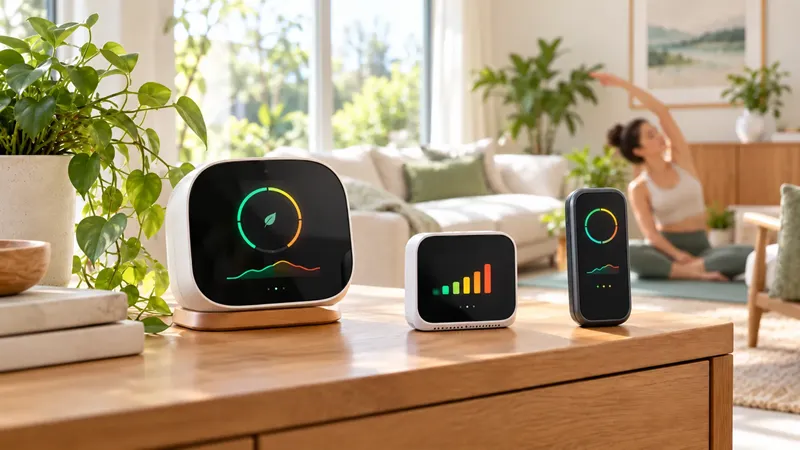
You can learn a lot about indoor air quality without buying an air quality tester. For everyday tracking, Airthings View Plus is the strongest broad-monitoring choice here; if you need an HCHO-specific channel, compare the Temtop LKC-1000S+ 2nd instead.
The key distinction is what a VOC air quality monitor measures: a broad signal for volatile organic compounds (VOCs) doesn’t show specific VOC levels. Start with the measurement you need, then choose the screen, connectivity and price that fit your home.
Key takeaways: choose your VOC air quality monitor
Your first decision is whether an air quality tester should track everyday trends, check HCHO, or send alerts from an empty property.
| Monitor | Choose it for | Main trade-off |
|---|---|---|
| Airthings View Plus | Broad home monitoring, including radon, CO2 and VOC trends | No formaldehyde-specific measurement |
| Qingping Air Monitor 2 | A clear display and lower-cost everyday monitoring | eTVOC tracks relative changes; check battery life for your routine |
| Temtop LKC-1000S+ 2nd | Portable checks with a dedicated formaldehyde channel | No CO2 measurement; accuracy needs scrutiny, and battery life limits extended checks |
| CabinPulse | Remote-property alerts without local Wi-Fi | Cellular coverage and a recurring plan required; battery life depends on signal and reporting frequency |
For most occupied homes, choose Airthings if radon monitoring matters. Choose Qingping for a lower-priced display if you don’t need radon or already have a CO2 monitor.
Choose CabinPulse when an empty property needs remote air quality alerts without local Wi-Fi.
If new furniture or renovation materials have raised an HCHO concern, Temtop is the relevant portable option. For a decision about whether a room is safe to occupy, use professional assessment rather than a consumer reading alone.
Before ordering, check the exact model, local warranty and return policy. Prices below are regional manufacturer listings, not guaranteed worldwide checkout prices.
Best monitors for everyday home tracking
Airthings View Plus: choose it for broader coverage

The Airthings View Plus is a battery-powered indoor air quality monitor designed for continuous home tracking. It measures radon, PM2.5, CO2, total VOCs, temperature, humidity, and air pressure in one device. Wi-Fi connectivity lets you review trends and alerts through the Airthings app, while the built-in display gives you quick in-room readings. It is best suited for broad everyday monitoring rather than formaldehyde-specific testing.
Specifications:
- Model: Airthings View Plus 2960
- Measures: Radon, PM2.5, CO2, total VOCs, temperature, humidity, air pressure
- Particle monitoring: PM2.5
- Connectivity: 2.4 GHz Wi-Fi
- Power: 6 AA batteries or USB-C
- Battery life: Up to 2 years, depending on use
- Display: Built-in air-quality display
- App support: Airthings app for readings, trends, and alerts
- Formaldehyde/HCHO: No dedicated formaldehyde channel
- Best for: Broad, long-term indoor air-quality monitoring
Pros:
- Tracks several important indoor air-quality factors in one device
- Includes radon, CO2, PM2.5, and VOC monitoring
- Long battery life for continuous monitoring
- Wi-Fi and app access make it easier to follow trends over time
- Useful for spotting changes in ventilation, particles, humidity, and VOC levels
- Can run on batteries or USB-C power
Cons:
- Does not measure formaldehyde separately
- Higher price than simpler CO2 or PM2.5 monitors
- TVOC readings show overall VOC trends rather than identifying individual chemicals
- Best for ongoing home monitoring, not professional exposure testing
Why Healthy Home Upgrade recommends it:
Healthy Home Upgrade recommends the Airthings View Plus for households that want a broad picture of indoor air quality instead of monitoring just one pollutant. Its combination of radon, PM2.5, CO2, VOC, humidity, and temperature tracking makes it especially useful for spotting patterns over time and seeing how ventilation, cooking, cleaning, weather, or new furnishings affect indoor conditions.
It is not the best choice if formaldehyde is your main concern, but for general home air-quality monitoring, it offers one of the most complete feature sets in this comparison.
Airthings View Plus, model 2960, measures radon, PM2.5, CO2, total VOCs, temperature, humidity and air pressure. Its listed US price is $329.99.
As an everyday air quality monitor, it covers several indoor-air concerns in one device. You can use its CO2 monitor readings to track ventilation, PM2.5 measurements to track particles, and longer-term readings to monitor radon.
It uses 2.4 GHz Wi-Fi and supports USB-C power or six AA batteries. The manufacturer states battery life is up to two years, though actual runtime depends on use.
Skip it if formaldehyde is your main question. Airthings lists the View Plus as measuring radon, PM2.5, CO2, VOCs, temperature, humidity and air pressure, while Temtop lists the LKC-1000S+ 2nd with a dedicated HCHO channel alongside TVOC and particle measurements.
Qingping Air Monitor 2: choose it for the display and price

The Qingping Air Monitor 2 is a compact indoor air quality monitor with a clear display and a lower price than many multi-sensor alternatives. It measures CO2, PM2.5, PM10, temperature, humidity, noise, and eTVOC, making it useful for everyday checks of ventilation, particles, and changes in indoor air conditions. Its eTVOC reading is best used for tracking relative trends rather than as a precise concentration measurement.
Specifications:
- Model: Qingping Air Monitor 2
- Measures: CO2, PM2.5, PM10, eTVOC, temperature, humidity, noise
- Particle monitoring: PM2.5 and PM10
- VOC monitoring: eTVOC trend measurement
- Display: Built-in color display
- Battery: 1,800 mAh rechargeable battery
- Battery life: Approximately 3 hours of stated standby time
- Best use: Plugged-in everyday monitoring
- Formaldehyde/HCHO: No dedicated formaldehyde channel
- Best for: Clear display and lower-cost everyday air quality tracking
Pros:
- Measures CO2, particles, temperature, humidity, noise, and eTVOC in one device
- Easy-to-read display for quick room checks
- Lower-priced option compared with broader monitors such as Airthings View Plus
- Useful for tracking ventilation and particle changes
- eTVOC can help reveal changes after cleaning, cooking, or bringing new materials indoors
- Good choice if you do not need radon monitoring
Cons:
- Does not measure formaldehyde separately
- eTVOC is intended for relative trends, not precise absolute TVOC concentration
- Short battery runtime makes it better suited to plugged-in use
- Does not include radon monitoring
- Consumer readings should not be treated as professional exposure measurements
Why Healthy Home Upgrade recommends it:
Healthy Home Upgrade recommends the Qingping Air Monitor 2 for households that want an easy-to-read monitor for everyday indoor air tracking without paying for features they may not need. Its combination of CO2, PM2.5, PM10, temperature, humidity, and eTVOC makes it especially useful for seeing how ventilation, cooking, cleaning, and day-to-day activities affect indoor conditions.
Qingping Air Monitor 2 measures CO2, PM2.5, PM10, temperature, humidity, noise and eTVOC. Its US store listing is $149.99.
Choose it as a more accessible air quality tester for ventilation and particles, without paying for radon monitoring. It also works as a CO2 monitor, while its eTVOC signal helps you notice changes after cleaning, cooking or bringing something new indoors.
The drawback is interpretation. Qingping describes eTVOC as a relative-trend measurement, not an accurate absolute TVOC concentration. It doesn’t measure formaldehyde.
Plan to keep it plugged in. Its 1,800 mAh battery has approximately three hours of stated standby time, so its battery life isn’t suited to monitoring through an unattended weekend.
Best portable option with a formaldehyde channel
Temtop LKC-1000S+ 2nd: choose it for room-by-room checks

The Temtop LKC-1000S+ 2nd is a portable air quality monitor designed for room-by-room checks, especially when formaldehyde is a specific concern. It measures HCHO, TVOC, PM2.5, PM10, particle count, temperature, and humidity, making it more targeted than general-purpose monitors that only provide broad VOC trends. It is best used for screening and comparing conditions between rooms rather than as a substitute for professional exposure testing.
Specifications:
- Model: Temtop LKC-1000S+ 2nd
- Measures: HCHO, TVOC, PM2.5, PM10, particle count, temperature, humidity
- Formaldehyde monitoring: Dedicated HCHO channel
- HCHO sensor: Electrochemical
- TVOC range: 0 to 5 mg/m³
- TVOC resolution: 0.01 mg/m³
- Data export: Yes
- Battery life: Approximately 6 to 8 hours
- CO2 monitoring: No
- Best for: Portable, room-by-room formaldehyde and VOC checks
Pros:
- Includes a dedicated formaldehyde/HCHO channel
- Useful for checking bedrooms, renovation areas, and rooms with new furniture
- Measures both gaseous pollutants and particulate matter
- Portable enough to move between rooms
- Includes TVOC, PM2.5, and PM10 measurements
- Data export can help compare readings over time
Cons:
- Does not measure CO2
- Shorter battery life than monitors designed for continuous home monitoring
- Consumer readings should not be treated as professional exposure measurements
- HCHO readings can be affected by interfering gases and measurement conditions
- Better for spot checks than unattended long-term monitoring
Why Healthy Home Upgrade recommends it:
Healthy Home Upgrade recommends the Temtop LKC-1000S+ 2nd when formaldehyde is the main concern and you want a dedicated HCHO reading rather than a general VOC trend. It is especially useful for checking individual rooms after renovations, new furniture, flooring, or other potential sources of chemical off-gassing.
It is not the best all-around monitor for continuous home use, but for targeted room-by-room screening of formaldehyde, VOCs, and particles, it offers more relevant measurements than broader monitors without an HCHO channel.
The Temtop LKC-1000S+ 2nd lists HCHO, TVOC, PM2.5, PM10, particle count, temperature and humidity. HCHO is the abbreviation for formaldehyde.
Its manufacturer product listing describes an electrochemical HCHO sensor and data export. The documented TVOC range is 0 to 5 mg/m³, with 0.01 mg/m³ resolution.
Choose it as a portable air quality monitor for room-by-room checks in bedrooms, renovation areas, or rooms with new furniture and possible chemical off gassing. It can serve as an air quality tester for screening, not as a validated exposure assessment. The listed US sale price is around $170, subject to change.
Skip it if you need a CO2 monitor or unattended remote alerts. Its stated battery life is six to eight hours. Confirm the “+” and “2nd” in the model name before buying.
When you should pay for testing instead
Temtop describes its HCHO sensor as pre-calibrated and publishes an accuracy specification for the formaldehyde channel. However, consumer readings can still be affected by interfering gases and measurement conditions, so the device should be used for screening and trend checks rather than as a substitute for professional sampling.
Before relying on a reading, ask about accuracy, interfering gases, calibration and sensor replacement. A precise-looking decimal isn’t evidence that the result is equally precise.
If you’re investigating persistent irritation, a renovation dispute or suspected formaldehyde emissions, professional sampling is the stronger next step.
You can also reduce uncertainty before purchasing furnishings. Our guide to low-emission mattress materials and certifications explains why documented emissions testing is more useful than smell or a broad “non-toxic” label.
Best for a remote property without Wi-Fi
CabinPulse is a cellular air quality monitor for tracking indoor air quality at a vacant cabin or rental when you aren’t there.
It uses built-in cellular connectivity, so you don’t need local Wi-Fi or property internet, but supported cellular coverage is required. This air quality tester reports CO2, total VOCs and an overall indoor-air-quality score. It can serve as a basic CO2 monitor, but it has no formaldehyde-specific channel. Its overall score shouldn’t be treated as a standardized air quality index unless the documentation confirms that comparison.
Choose it for remote monitoring when temperature drops, humidity changes or power failures matter alongside air trends. It offers configurable air quality alerts by text and email, with stated battery life of two to three days on its internal battery.
The store lists hardware at CAD $199, plus CAD $14 monthly on a one-year plan or CAD $10 monthly on a three-year plan. Cellular service is advertised across major networks worldwide, but confirm coverage and purchasing availability for your location before ordering.
Skip it for a normal occupied home with dependable internet unless those remote-property features justify the recurring cost. Confirm cellular coverage at the property’s location before ordering.
What your VOC readings can tell you
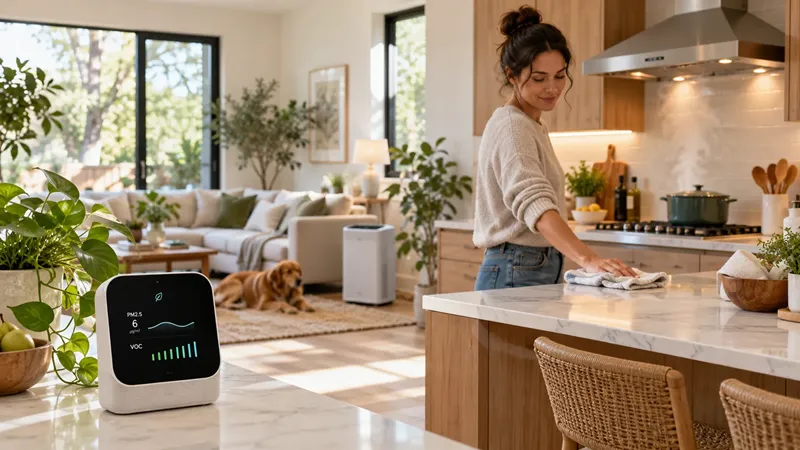
TVOC and VOC index measure different things
A consumer VOC air quality monitor usually responds to a mixture of gases, including volatile organic compounds. Depending on its sensor, alcohol vapour, cleaning products, fragrances and material emissions may affect the reading and reported VOC levels.
TVOC measurements are aggregate estimates of volatile organic compounds. A VOC index expresses changes relative to the sensor’s baseline. You shouldn’t compare an index directly with a concentration reported in ppb or mg/m³.
AirGradient’s explanation of TVOC and VOC index measurements helps clarify that distinction.
Use TVOC measurements to spot patterns and compare conditions on the same device. An air quality tester can show changes in VOC levels, but it can’t identify a specific chemical. Don’t use it to apply a formaldehyde exposure limit to a general VOC number.
Sensor technology matters more than the parameter count
Metal-oxide sensors are common in consumer VOC monitoring. A consumer grade monitor with this sensor responds broadly, making it useful for trends but limiting chemical identification.
Electrochemical sensors can provide a dedicated HCHO channel. That still leaves questions about accuracy and cross-sensitivity, meaning responses to other gases.
For a CO2 monitor, look for documented direct measurement technology such as NDIR rather than a VOC-derived “eCO2” estimate. Laser particle sensors measure particulate matter, not gaseous pollutants or specific sources such as wildfire smoke.
An “8-in-1” label tells you how many values appear on a screen. It doesn’t tell you whether each value comes from a suitable, independently documented sensor. Displayed or transmitted real time data doesn’t validate the chemical measurement.
When commercial monitoring is worth considering
For a print shop, managed building or workplace investigation, you may need a commercial grade air quality tester, not just a household app. It can support indoor air quality tracking.
Tongdy’s IAQ Monitor documentation lists laser particle sensing, an NDIR CO2 monitor, metal-oxide TVOC sensing and electrochemical HCHO sensing. Its documented HCHO range is 0.001 to 0.6 mg/m³.
It also lists building-system connections for remote monitoring, including RS-485 with Modbus RTU or BACnet MS/TP, plus Ethernet and Wi-Fi options.
Those features matter when facilities staff need readings linked to ventilation controls or a central dashboard. They don’t establish greater chemical accuracy.
Before requesting a quote, obtain the exact model, HCHO accuracy, calibration procedure and maintenance costs. For occupational exposure assessment, have a qualified professional choose the sampling method. A commercial grade label alone doesn’t show that a monitor is accurate or suitable for regulatory decisions.
Set up your monitor and respond calmly to spikes
Start with placement and a baseline
Put your air quality monitor where you spend time, with clear airflow around it. Avoid placing it beside a window, purifier outlet, cooker or cleaning-product cupboard unless you’re investigating that location.
Follow the manufacturer’s warm-up and baseline instructions. Record ordinary conditions for several days before interpreting every colour change as a problem.
Keep a short record of cooking, cleaning, window opening and new furnishings. Change one factor at a time when investigating a pattern.
Check units before comparing readings. A VOC index, ppb estimate and mg/m³ estimate aren’t interchangeable. One monitor can’t establish conditions throughout a large home.
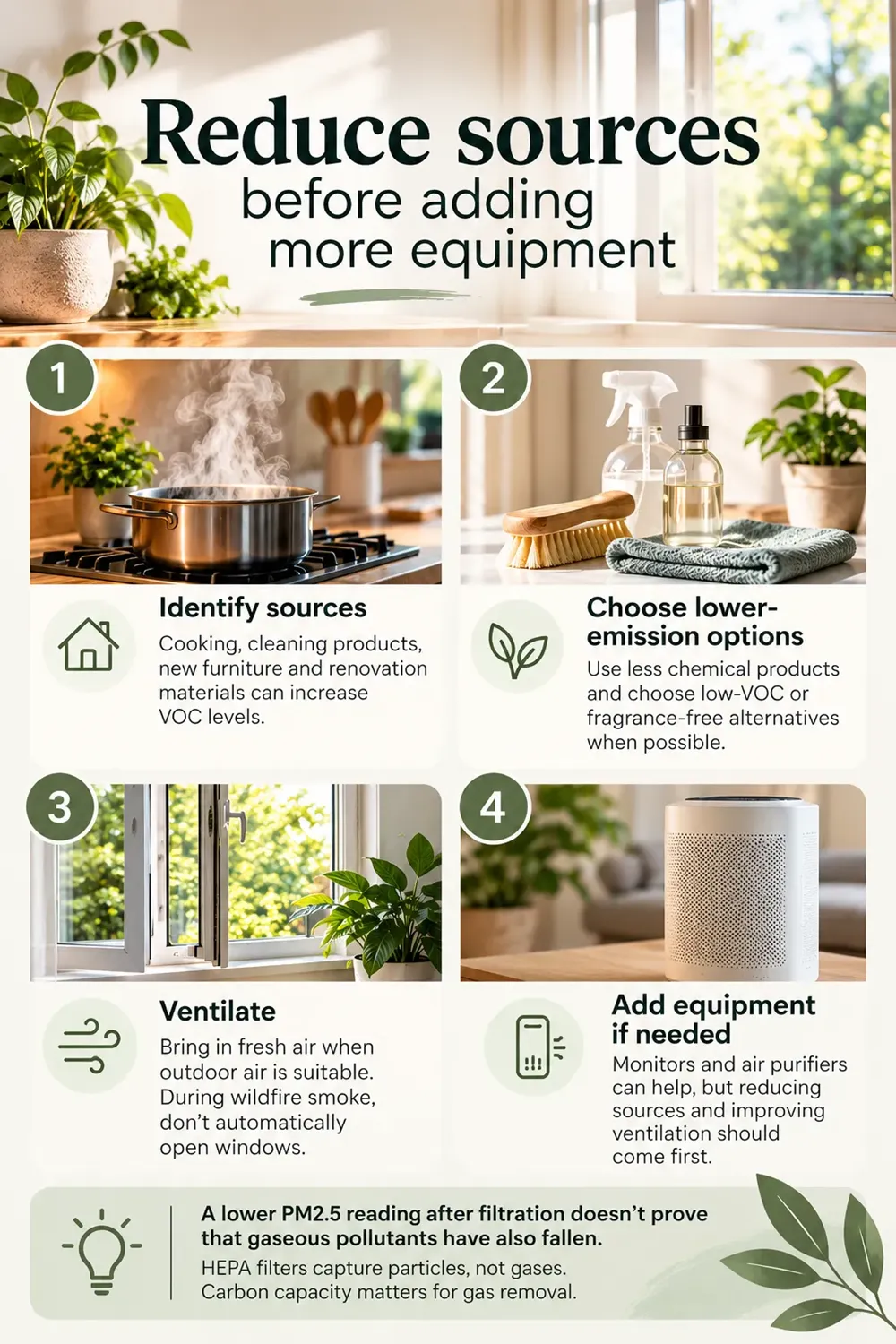
Reduce sources before adding more equipment
A spike after cleaning or cooking gives you a useful starting point. Nighttime changes may reflect reduced ventilation, environmental changes or sensor behaviour. Timing alone doesn’t establish the cause.
Check recent activities and ventilate when outdoor air is suitable. During wildfire smoke, don’t automatically open windows.
The EPA’s guidance on indoor VOC sources supports source reduction and ventilation.
“A lower PM2.5 reading after filtration doesn’t prove that gaseous pollutants have also fallen.”
Our guide to what HEPA filters can capture explains the distinction. Carbon capacity matters for gas removal. A thin odor filter isn’t equivalent to a substantial carbon bed.
Frequently asked questions
Can a monitor distinguish wood smoke from other pollution?
A consumer TVOC reading can’t identify wildfire smoke, garbage burning or a particular cleaning chemical. A simultaneous PM2.5 increase may help you recognise a possible combustion event, but it still doesn’t prove the source.
If identifying individual chemicals matters, use professional sampling. Keep certified smoke and carbon monoxide alarms installed separately; none of these recommendations replaces them.
Do portable monitors need professional calibration?
Requirements vary by sensor and model. Follow the manufacturer’s instructions rather than applying one calibration routine to every device.
Temtop’s pre-calibrated HCHO sensor doesn’t establish indefinite accuracy. For CO2, check the documented calibration procedure and whether automatic baseline correction suits your space. A continuously occupied or sealed building may need different handling from a room that regularly receives fresh outdoor air.
Choose the measurement before the monitor
Choose an air quality tester based on the question you need answered. Choose Airthings or Qingping for everyday trends, Temtop for a documented HCHO channel, and CabinPulse for remote-property alerts.
Check regional support and measurement limitations before ordering. Explore our indoor air quality guides for more help understanding monitors, filtration, and ways to improve your home’s air.
Choose an air quality monitor based on the measurement you need. Use its readings to guide decisions without treating every fluctuation as a concern.
Save this guide for later
Pin this infographic to your Healthy Home or Indoor Air Quality board so you can come back to these VOC-reduction tips whenever you need them.