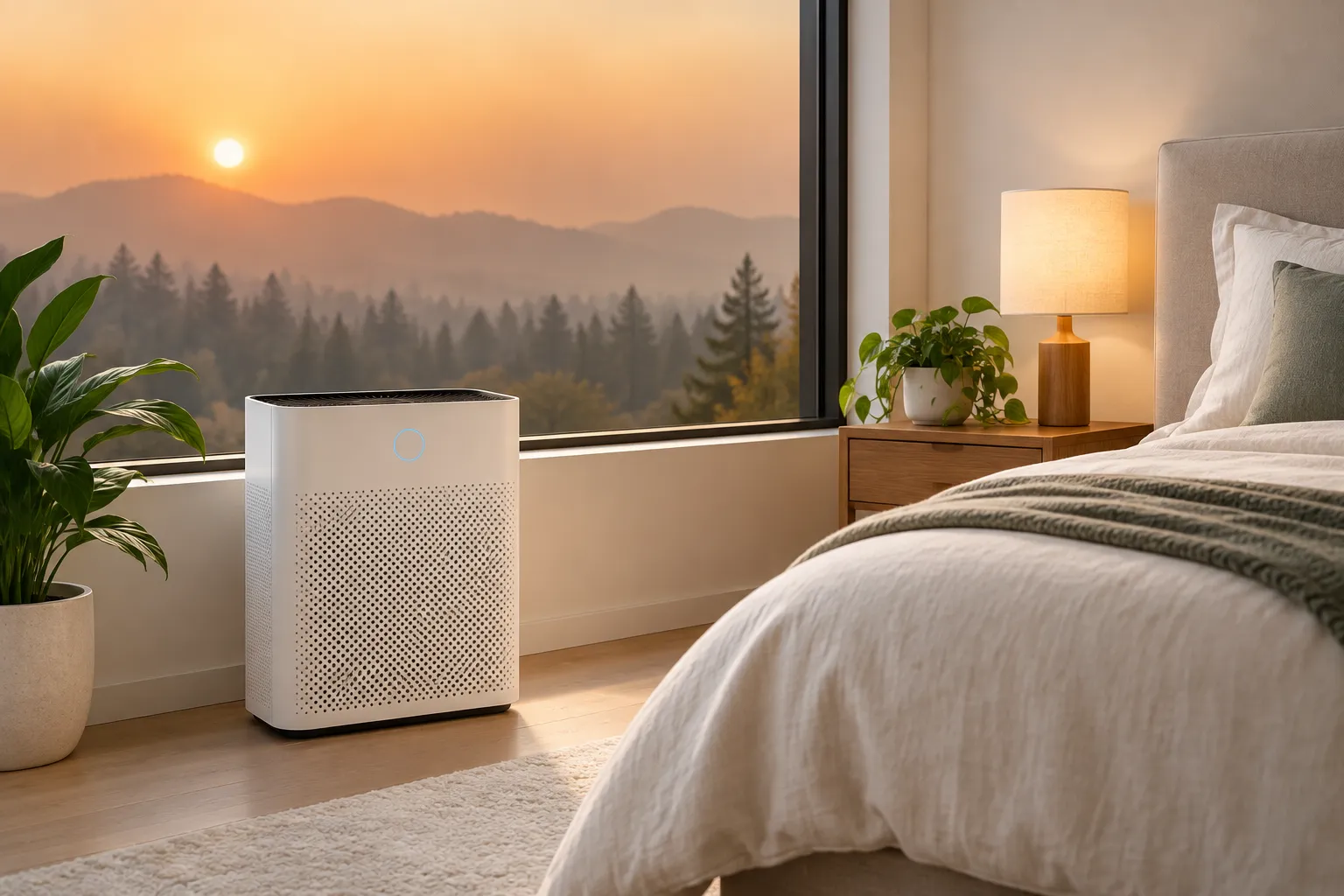
You don’t need the most expensive air purifier for wildfire smoke to make your bedroom air cleaner during wildfire season. For a typical bedroom, the Coway Airmega AP-1512HH Mighty is a sensible starting point, with HEPA filtration and useful smoke-cleaning capacity.
A wildfire smoke air purifier needs enough airflow to improve indoor air quality at a speed you can sleep beside. Quiet operation matters, but a whisper-quiet setting can leave you with too little filtration.
Start with your room size, then compare these three options and their trade-offs.
The quick buying answer
Choose the Coway Airmega AP-1512HH Mighty as an air purifier for wildfire smoke in a small or medium bedroom. Its separate ionizer can be switched off, and you can choose an overnight fan setting based on noise level.
Consider the Levoit Vital 200S-P if smart controls and a lower purchase price matter. Treat it as a particle-filtration alternative, and check the exact local filter specification before buying if you need HEPA filtration.
Choose the Coway Airmega 250 if you prefer its larger design and washable pre-filter. Its premium price doesn’t buy a dramatic increase in smoke CADR over the Mighty.
Before ordering, measure your room size and check that genuine replacement filters are available. Outside the US, confirm the local model number, voltage and warranty. An inexpensive imported unit becomes less useful when compatible filters are difficult to find.
Coway Airmega AP-1512HH Mighty: the practical HEPA pick
The Mighty combines a washable pre-filter, an odor filter and a HEPA filter. Its manufacturer-rated smoke clean air delivery rate (CADR) is 233 cubic feet per minute.
That gives you useful capacity for many bedrooms without buying a very large appliance. For smoke events, it’s a stronger fit for rooms around 200 square feet than for spaces approaching its general advertised coverage.

A practical HEPA air purifier for bedrooms during wildfire smoke events. The Coway Airmega Mighty combines strong particle filtration with a 233 CFM smoke CADR, adjustable fan speeds, air quality monitoring, and a compact design. Its optional ionizer can also be switched off if you prefer mechanical filtration only.
Choose it if you want physical controls, replaceable filters and enough airflow to use something above the lowest setting.
Skip it if you need substantial gas removal or dislike switching off optional ionization. The odor filter isn’t a deep carbon bed, and the highest setting’s noise level won’t suit every light sleeper.
Keep the ionizer off for a mechanical-filtration setup. During smoke events, avoid Eco mode, which can stop the fan when the air quality sensor judges the air clean. Steady filtration is the more predictable choice.
Levoit Vital 200S-P: the lower-cost smart alternative
The Levoit Vital 200S-P is worth comparing if budget and app controls matter, especially if you want a smart air purifier. US manufacturer listings show prices around $190 to $200, though promotions and availability change.
Its filter system includes a washable pre-filter, a main particle filter and an activated carbon filter. The standard genuine replacement filter is listed at $49.99.

Designed for larger rooms, the LEVOIT Vital 200S-P combines powerful air filtration with smart controls for everyday indoor air quality support. It features multiple fan speeds, app control, air quality monitoring, a washable pre-filter, and filtration designed to help capture dust, pollen, pet dander, smoke particles, and other airborne pollutants. A practical option for bedrooms, living rooms, and other larger spaces.
Choose it if you want scheduling and remote control without paying premium prices. Check the noise level against your bedroom needs. A washable pre-filter is also useful if your bedroom collects pet hair.
Skip it if you require an explicitly documented HEPA specification and the local product listing doesn’t provide it. Levoit’s particle-capture descriptions shouldn’t be treated as interchangeable with a verified HEPA claim.
Before buying, check the Levoit Vital’s exact model smoke CADR instead of relying on a coverage headline. Verify current local specifications and prices. Also distinguish the standard filter from specialty versions. Levoit lists a Smoke Remover replacement around $64.99, but the name alone doesn’t establish how much carbon it contains or how long it will control odors.
Coway Airmega 250: the premium option to compare carefully
The Coway Airmega 250 has a washable pre-filter and a Max2 replacement filter that combines HEPA filtration with activated carbon. Coway’s US listing shows a $499 price.
Coway publishes a smoke CADR of 235 CFM, close to the Mighty’s rating. Don’t assume the larger body delivers proportionately more smoke removal.
The Airmega 250 product specifications also include large coverage claims. Check the air changes per hour basis and current regional specifications before applying those figures to wildfire conditions.

Designed for larger living spaces, the Coway Airmega 250 combines a washable pre-filter, activated carbon, and HEPA filtration to help reduce smoke particles, allergens, pet dander, odors, and other airborne pollutants. It also includes air quality monitoring, Smart Mode, Rapid Mode, and adjustable fan settings for convenient everyday use.
Choose it if you prefer its design, controls and filter-access arrangement enough to justify the extra cost.
Skip it if your main goal is the most smoke-cleaning airflow for your money. Compare the local Max2 replacement price before ordering, too. Coway’s one-year filter-life estimate isn’t a promise during repeated heavy smoke events.
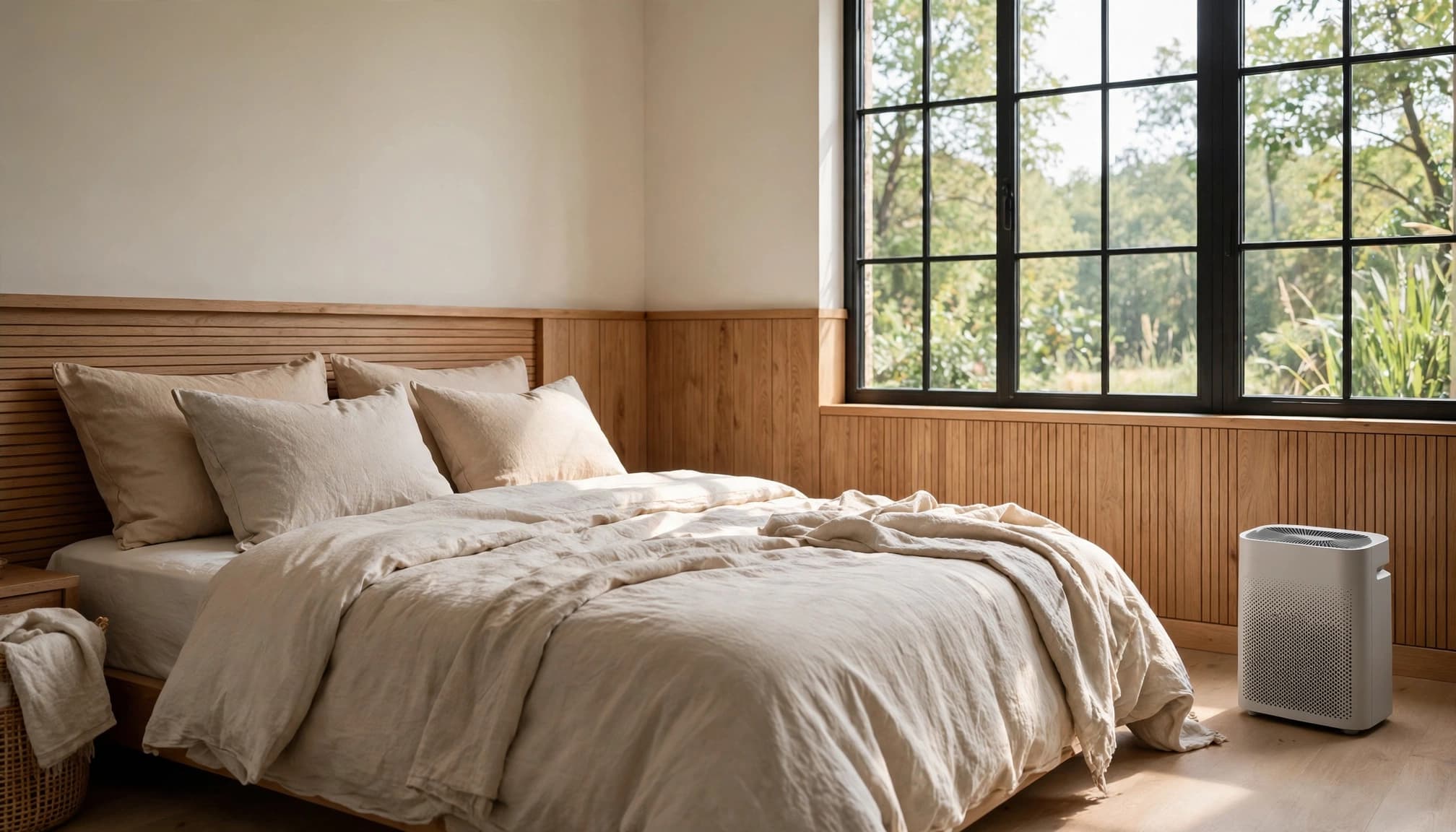
Size your wildfire smoke air purifier for the bedroom
Use smoke CADR, not maximum coverage
CADR describes how much filtered air a purifier delivers. For wildfire smoke, compare the smoke rating rather than dust or pollen ratings. Use smoke CADR alongside room size to estimate air changes per hour.
AHAM’s general sizing rule uses smoke CADR of at least two-thirds of room area in square feet. Its air-change and room-sizing guidance recommends stronger sizing for wildfire smoke, roughly matching smoke CADR in CFM to room area for more air changes per hour.
When comparing commercial air cleaners for a bedroom, apply the same room-area-to-smoke-CADR calculation rather than relying on maximum coverage claims.
Use these figures as a starting point for rooms with standard-height ceilings.
| Bedroom area | General minimum smoke CADR | Stronger wildfire target |
|---|---|---|
| 120 square feet | 80 CFM | 120 CFM |
| 180 square feet | 120 CFM | 180 CFM |
| 250 square feet | 167 CFM | 250 CFM |
For international specifications, 1 CFM is about 1.7 cubic meters per hour. A 180-CFM target is roughly 306 m³/h.
Leave room for a quieter fan speed
Published CADR usually describes maximum-speed performance. Sleep mode can deliver much less clean air.
A larger-capacity unit gives you more flexibility to reduce noise without reducing airflow too far. High ceilings, frequent door opening, and outdoor-air leakage can affect delivered clean air and air changes per hour.
“A purifier sized exactly to your bedroom at maximum speed may be undersized at the setting you use overnight.”
Check the return policy, then assess the noise level at a useful operating speed.
Understand what HEPA and carbon can remove
HEPA handles particles, not every smoke pollutant
Wildfire smoke contains fine particulate matter, including PM2.5 and smoke particles. HEPA filtration captures airborne fine particles, including those smaller than 0.3 microns.
It doesn’t remove gases, such as volatile organic compounds, simply because a product is marketed for smoke. Our guide to what HEPA filters can capture explains that distinction.
For a bedroom, prioritize strong particle removal first. Avoid ozone generators. If you consider washable electrostatic or TPA technology, compare independently documented smoke CADR, ozone emissions and maintenance requirements. Washable plates alone don’t establish better performance or lower ownership costs.
An electrical safety mark and a HEPA claim answer different questions. Neither proves that a whole product is “non-toxic.”
If you’re comparing filtration types, our guide to the best HEPA and carbon air purifiers explains how particle filtration and activated carbon work together for broader indoor air cleaning.
Carbon capacity matters more than the label
Activated carbon filter can adsorb some odors and gaseous pollutants, but its capacity is finite. A thin carbon layer offers much less capacity than a substantial carbon bed.
Bonded carbon sheets and combined HEPA-carbon filters are convenient. Their drawback is that capacity for smoke odors may run out before the particle filter needs replacement.
If smoke smells return, you may need to replace the combined cartridge. Standard purifier carbon filters also aren’t reliable protection against carbon monoxide.
Don’t use odor as your only air-quality check. A smart air quality monitor can help you track PM2.5 and changes in indoor air quality, but it won’t confirm that gases are absent.
Make filtration work while you sleep
Reduce incoming smoke and indoor sources
Close windows and exterior doors during smoke conditions. Smoke particles can still enter through gaps and ventilation pathways, so closed windows don’t eliminate the need for filtration.
Keep the bedroom door mostly closed and leave clearance around the purifier’s intake and outlet. Don’t hide it behind curtains.
Set compatible HVAC equipment to recirculate, close its outdoor-air intake where appropriate, and use a MERV 13 filter if the system supports it. Don’t block required combustion-air vents.
Skip candles, incense and aerosol fragrances during smoke events. Use unscented cleaning products, and ventilate when outdoor conditions improve rather than automatically opening windows each morning.
Run continuously and inspect filters
Keep your wildfire smoke air purifier running throughout the event, including overnight. Use the highest speed you can comfortably tolerate rather than assuming sleep mode provides enough airflow.
Smart controls are convenient, but the air quality sensor measures conditions near the appliance. It doesn’t establish that your whole bedroom is clean.
Check pre-filters and inspect the main filter during heavy smoke. Heavy smoke can shorten the usual filter lifespan. Replace filters when dirty or airflow falls, rather than waiting for the calendar interval. Only wash components the manufacturer identifies as washable.
The Levoit Vital 200S-P’s standard filter costs $49.99. At its stated six-to-twelve-month interval, that’s roughly $50 to $100 annually under ordinary conditions. Smoke events can shorten that interval. A unit drawing 40 watts continuously uses 28.8 kWh over 30 days.
When a DIY air purifier, such as a Corsi-Rosenthal box, makes sense
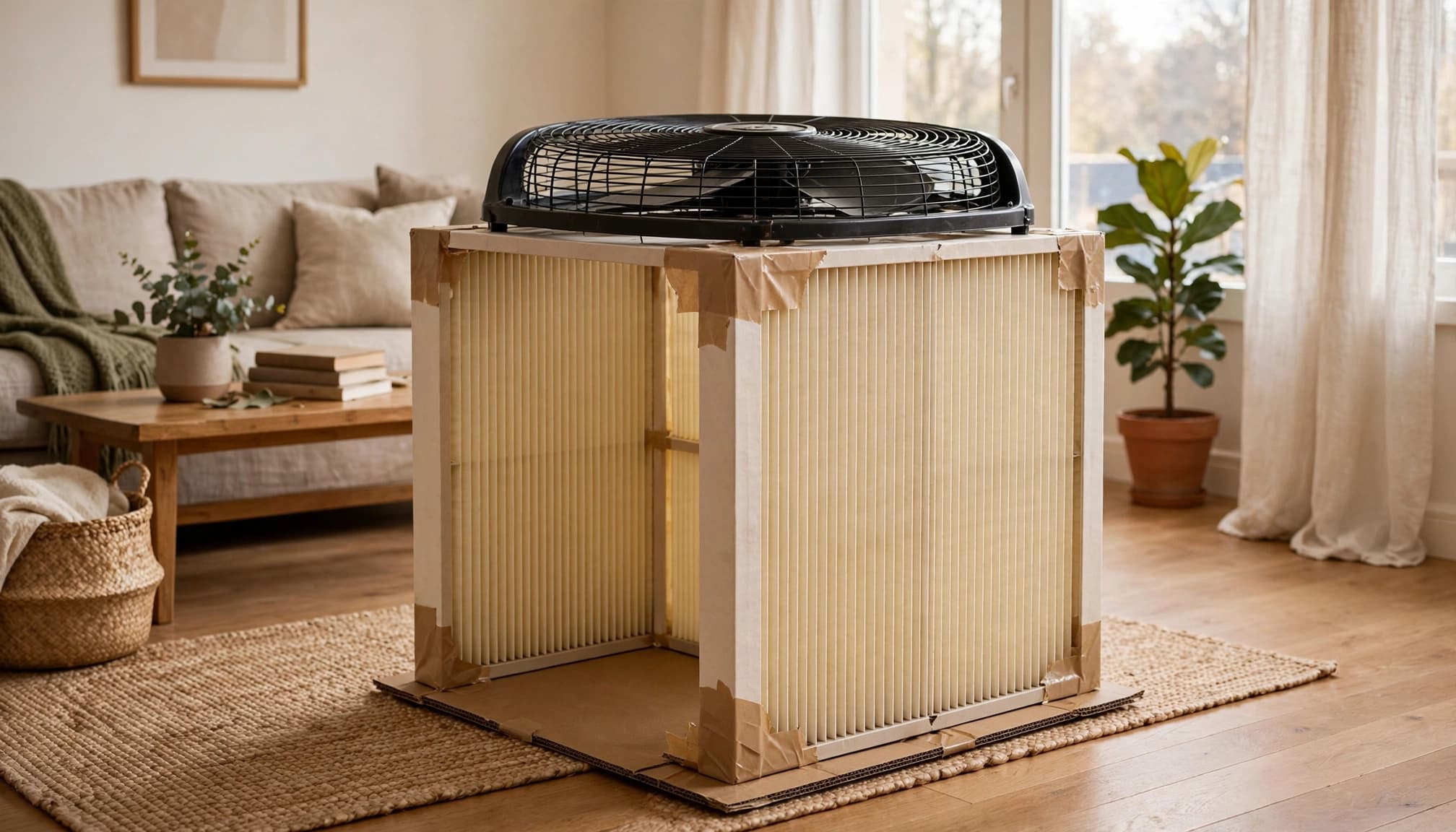
A useful temporary particle-filtering option
A Corsi-Rosenthal box uses four filters made with MERV 13 filter media, a box fan, cardboard and sealed joints. This DIY air purifier draws air through the filters and blows cleaned air out.
This DIY air purifier is worth considering when commercial air cleaners are unavailable or your immediate budget is limited. EPA’s research on DIY air cleaners found strong particle removal from well-built designs. One tested four-filter configuration delivered about 401 CFM of smoke CADR.
That result can help you compare DIY builds with commercial air cleaners, but it doesn’t apply to every homemade assembly. Filter depth, fan choice, seals and loading all affect performance. The box also takes considerable floor space and may be too noisy for your bedroom. MERV 13 filtration isn’t HEPA, and it doesn’t remove smoke gases.
Use the right fan and maintain it
Follow EPA guidance: use a newer fan manufactured in 2012 or later with a UL or ETL safety mark, meeting UL 507 or an equivalent standard.
EPA and UL testing found no observed fire hazard under the tested conditions for qualifying newer fans. That doesn’t certify every DIY assembly.
Follow the box fan’s instructions, avoid extension cords and keep it unobstructed. Inspect the DIY air purifier and its filters daily during smoke events, and replace them when heavily discolored or smoky-smelling. Don’t use an older fan unattended or while sleeping.
Frequently Asked Questions
Should I run an air purifier all night during wildfire smoke?
Yes. Run it continuously during smoke events, including overnight, and choose the highest fan speed you can comfortably tolerate. Sleep mode may deliver too little clean air for your bedroom.
What size air purifier do I need for wildfire smoke?
Compare the purifier’s smoke CADR with your bedroom’s area in square feet. A stronger wildfire target is roughly one CFM of smoke CADR per square foot, which gives you more flexibility to lower the fan speed.
Does a HEPA filter remove wildfire smoke odors and gases?
HEPA filtration captures smoke particles, including PM2.5, but doesn’t remove gases just because a purifier is marketed for smoke. Activated carbon can adsorb some odors and gaseous pollutants, though a thin carbon layer has limited capacity.
Should I use an air purifier’s ionizer during wildfire smoke?
For a mechanical-filtration setup, keep the ionizer off and use the purifier’s fan and filters. Avoid ozone generators, and check the model’s instructions for how to disable optional ionization.
Choose enough clean air, then keep it moving
The Mighty is a practical HEPA starting point for many bedrooms. The Levoit Vital deserves a value comparison, while the Airmega 250 needs a clear reason for its higher price.
Your strongest purchase is a correctly sized unit you can run consistently, with replacement filters you can obtain. Explore our recommended healthy home products through Explore our recommended healthy home products when you’re ready to compare other practical upgrades.
Keep the bedroom closed during smoke conditions, maintain the filters, and choose airflow you can live with overnight.