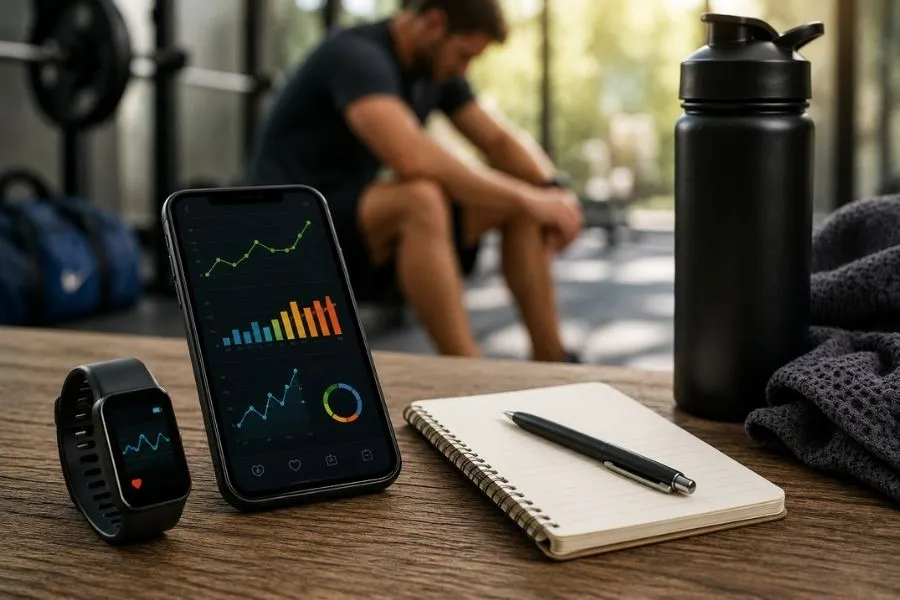
Heart rate variability, recovery scores, readiness scores, strain scores, body battery, sleep debt, respiratory rate, resting heart rate, temperature trends.
Athletes have more body data than ever.
That can be powerful. It can also become confusing.
One morning your app says you are ready, but your body feels heavy.
Another morning your recovery score is low, but you feel sharp and motivated.
Sometimes HRV drops after a hard training session. Other times it drops after stress, alcohol, poor sleep, travel, dehydration, illness, emotional overload, or not eating enough.
So what should you trust?
The answer is not to ignore the data.
The answer is also not to obey the app.
The real skill is learning how to coach yourself with the data, not from the data alone.
This guide explains how athletes should interpret HRV and recovery scores in a calm, practical, and performance-focused way.
Quick Answer
Athletes should interpret HRV and recovery scores as trend signals, not daily commands. A low HRV or poor recovery score can suggest fatigue, stress, poor sleep, illness risk, or incomplete recovery, but it should always be checked against how you feel, how you slept, your training load, resting heart rate, soreness, motivation, mood, and warm-up response.
Use the app as a coach’s assistant, not the boss. The best approach is to compare today’s score with your personal baseline, look for patterns over several days, and adjust intensity when low recovery matches real body signs such as heaviness, poor sleep, elevated resting heart rate, unusual soreness, low motivation, or poor warm-up response.
Before opening the app in the morning, take five minutes to feel your own body first. Notice your breathing, mood, soreness, energy, and motivation. Then check the data. This one habit can stop the app from becoming the first stress signal of your day.
At a Glance: How to Read HRV and Recovery Scores Like an Athlete
| App Signal | What It May Mean | What to Check Before Deciding | Smart Training Response |
| Low HRV, poor sleep, high resting heart rate | Likely under-recovered | Soreness, mood, warm-up, illness signs | Reduce intensity or switch to recovery work |
| Low HRV, but body feels good | Temporary dip, stress artifact, or app mismatch | Warm-up performance and recent life stress | Start easy, then decide |
| High HRV, but body feels heavy | Possible rebound recovery or parasympathetic dominance | Mood, soreness, coordination, power | Do not force intensity |
| Normal HRV, low motivation | Mental fatigue or life stress | Sleep quality, emotional load, training history | Choose lower complexity or easier work |
| Green recovery, but recent hard block | App may not see full training load | Muscle fatigue and plan context | Respect the plan, not just the score |
| Red recovery, upcoming key session | Reduced capacity warning | Warm-up, resting heart rate, symptoms | Modify session, do not panic |
| Several poor days in a row | Accumulated stress | Training load, illness, nutrition, sleep | Deload or add recovery days |
Also in This Article
- What HRV actually tells athletes
- Why recovery scores are estimates, not truth
- The five-minute body check before opening the app
- The High HRV Trap
- How to use HRV without becoming anxious
- When to train hard despite imperfect data
- When to back off even if the app says you are ready
- A practical athlete decision system
- How smart rings and wearables fit into coaching
What HRV Actually Measures
Heart rate variability is the variation in time between heartbeats. Cleveland Clinic describes HRV as the small fluctuation in timing between heartbeats, even when the heart rate itself may look steady. HRV is commonly used as a window into autonomic nervous system balance, stress, recovery, and adaptability.
In simple terms:
Higher HRV for you often suggests better recovery and adaptability.
Lower HRV for you often suggests more stress, fatigue, illness risk, or incomplete recovery.
The important phrase is for you.
HRV is highly individual. One athlete may feel excellent with an HRV of 35. Another may feel under-recovered at 75. Comparing your number to another athlete’s number is usually not useful.
Garmin’s HRV Status is built around a personal baseline, where a balanced status means the seven-day average is within your own baseline range, not someone else’s.
Why Recovery Scores Are Not the Same as Reality
Most wearable recovery scores are algorithms. They combine signals such as HRV, resting heart rate, sleep quality, respiratory rate, temperature trends, activity load, and sometimes previous strain.
Oura describes its Readiness Score as a measure of recovery and balance using sleep, activity, and body signals. Oura’s readiness contributors include HRV balance, which compares recent HRV patterns against a longer-term average and can highlight prolonged stressors such as overtraining or illness.
WHOOP describes its Recovery score through color zones, with green suggesting higher readiness for strain, yellow suggesting moderate readiness, and red suggesting lower recovery. WHOOP’s support page lists high recovery as 67 percent or above, moderate recovery as 34 to 66 percent, and low recovery below that range.
That can be helpful.
But a recovery score is still an estimate.
It does not know every detail of your life. It may not fully understand muscle damage, emotional stress, competition pressure, menstrual cycle changes, a bad argument, travel fatigue, heat exposure, dehydration, or the way a session actually felt.
That is why athletes should never treat the score as a command.
View the Latest WHOOP Price on Amazon
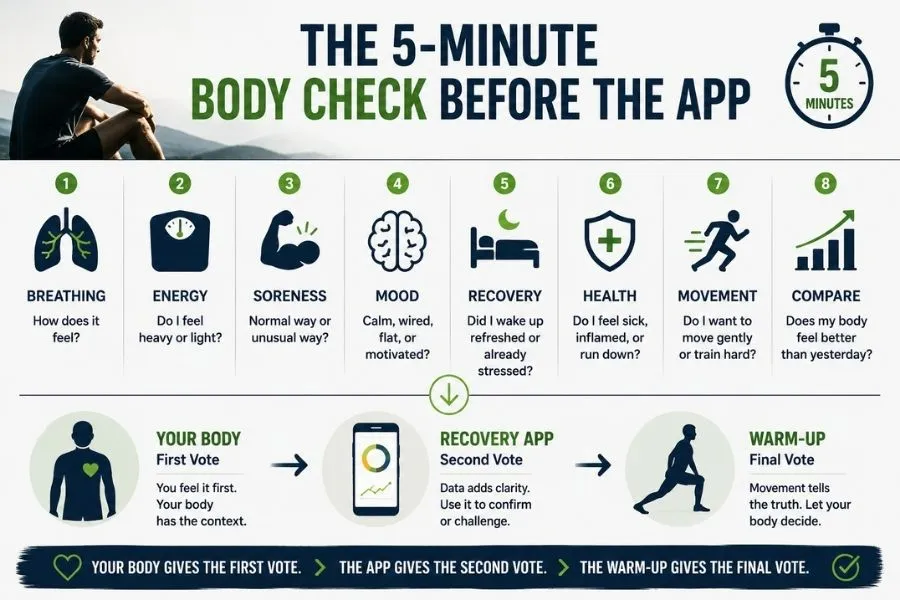
The Five-Minute Body Check Before the App
One of the biggest mistakes athletes make is checking the app before checking the body.
You wake up.
You open the app.
The score is red.
Your mood changes before you have even stood up.
That is not neutral data anymore. That is a mental load.
Before opening your recovery app, take five minutes and ask:
- How does my breathing feel?
- Do I feel heavy or light?
- Am I sore in a normal way or an unusual way?
- Do I feel calm, wired, flat, or motivated?
- Did I wake up refreshed or already stressed?
- Do I feel sick, inflamed, or run down?
- Do I want to move gently or train hard?
- Does my body feel better than yesterday?
Then open the app.
This order matters.
Your body gives the first vote.
The app gives the second vote.
The warm-up gives the final vote.
This is one of the simplest ways to keep recovery tech helpful instead of mentally toxic.
The Core Rule: Do Not Coach From One Number
One bad score does not mean your training is ruined.
One green score does not mean your body is bulletproof.
A good athlete reads patterns.
Look at:
- HRV compared with your own baseline
- Resting heart rate
- Sleep duration
- Sleep quality
- Training load from the past 3 to 7 days
- Muscle soreness
- Mood
- Motivation
- Appetite
- Coordination
- Warm-up response
- Performance trend
- Life stress
- Illness signs
The more signals point in the same direction, the more seriously you should take the data.
HRV-Guided Training: What the Research Suggests
HRV-guided training is not just a wellness trend. It has been studied in endurance and strength-conditioning contexts.
A 2021 systematic review and meta-analysis found that HRV-guided training may be more effective than predefined training for maintaining and improving vagally mediated HRV, with less likelihood of negative responses.
A 2024 review in strength and conditioning described HRV as a useful metric for assessing training status, adaptability, and recovery, but also emphasized that HRV should be interpreted with context and secondary markers.
The takeaway is simple:
HRV can help guide training.
It should not replace coaching judgment.
The Athlete Problem: Data Can Make You Too Passive
Many athletes start using wearables because they want to train smarter.
But after a while, some begin to wait for permission.
They open the app before checking their own body.
They feel anxious when the score is red.
They feel guilty resting when the score is green.
They push too hard because the app says they are ready.
They skip a useful session because one number looks bad.
That is not performance intelligence.
That is outsourcing your body awareness.
The goal is not to become less disciplined. The goal is to become a better self-coach.
Sleep researchers have even described “orthosomnia,” where people become overly focused on sleep tracker data and may trust device numbers over their own experience or clinical reassurance. That research was about sleep, but the lesson also matters for athletes using recovery scores. Data can support awareness, but obsession with the number can become part of the problem.
The High HRV Trap
High HRV is often treated as good news.
Most of the time, a strong HRV trend within your normal baseline can suggest good recovery and adaptability.
But high HRV is not always a green light.
Sometimes, after a period of heavy training, under-recovery, or functional overreaching, the nervous system can shift strongly toward parasympathetic activity. In simple terms, the body may be trying very hard to recover. Garmin also notes that HRV above your personal baseline can mean the body is working overtime to recover, especially after a significant increase in training.
This is the High HRV Trap:
Your app may look positive.
Your body may feel flat.
Your muscles may feel heavy.
Your coordination may feel off.
Your motivation may be low.
Your warm-up may feel wrong.
That is not the day to force a brutal session just because one number is high.
A very high HRV day should be interpreted with the same maturity as a low HRV day. Ask whether it fits your body, your training history, your mood, and your warm-up.
If HRV is high but you feel heavy, slow, or unusually flat, train like a smart athlete, not like a slave to the green score.
The Three-Layer Athlete Recovery Check
Before changing a session, check three layers.
Layer 1: The App
Look at:
- HRV
- Recovery or readiness score
- Resting heart rate
- Sleep score
- Respiratory rate
- Temperature trend
- Training load or strain
This gives you the data picture.
Layer 2: The Body
Ask:
- Do I feel heavy or sharp?
- Is my resting heart rate higher than usual?
- Am I unusually sore?
- Did I sleep well?
- Do I feel coordinated?
- Do I feel inflamed, flat, or wired?
- Do I have signs of illness?
- Is my mood unusually low?
This gives you the human picture.
Layer 3: The Warm-Up
Start the session gently and notice:
- Does your body open up after 10 to 15 minutes?
- Does your breathing settle?
- Does coordination improve?
- Does the planned pace or power feel normal?
- Does effort feel unusually high?
- Do you feel worse as you warm up?
This gives you the performance picture.
Only then decide.
The Best Decision System for Athletes
Use this simple rule:
If the app is low and the body feels bad, back off.
If the app is low but the body feels good, warm up and reassess.
If the app is green but the body feels bad, do not force intensity.
If the app is green and the body feels good, train as planned.
This removes fear from the process.
The app gives information.
Your body gives context.
The warm-up gives confirmation.
What to Do When HRV Is Low
A low HRV day can mean many things.
It may reflect:
- Poor sleep
- Alcohol
- Late meal
- Dehydration
- Mental stress
- Illness beginning
- High training load
- Heat exposure
- Travel
- Menstrual cycle changes
- Not enough calories
- Not enough carbohydrates
- Emotional stress
- Too much intensity too often
Do not panic.
First ask: does it match how I feel?
Low HRV plus bad body signs
Choose:
- Zone 2 work
- Mobility
- Walking
- Technique work
- Easy strength
- Breathwork
- Full rest
- Earlier bedtime
Low HRV but good body signs
Choose:
- Longer warm-up
- Lower first interval
- Technique-focused intensity
- Reduced volume
- Stop if effort feels wrong
- Keep the session, but remove ego
What to Do When HRV Is High
Many athletes assume high HRV always means “go hard.”
Not always.
A high HRV day can be excellent, especially when it sits inside your personal healthy pattern and your body feels sharp.
But a high HRV day can also be misleading if it comes after heavy training, stress, poor sleep, or several days of feeling flat. Garmin’s HRV guidance specifically notes that HRV above baseline can sometimes mean your body is working overtime to recover.
So if HRV is high but you feel heavy, unmotivated, slow, or flat, do not force a max-effort day just because the app looks good.
Ask:
- Do I feel powerful?
- Do I feel coordinated?
- Is my resting heart rate normal?
- Did I sleep well?
- Does the warm-up feel smooth?
- Is today actually meant to be hard?
High HRV is useful only when it fits the whole picture.
Recovery Score vs Readiness vs Performance
These three are related, but not identical.
Recovery
Recovery is how well your body appears to have restored after previous stress.
Readiness
Readiness is whether your body seems prepared to handle new stress today.
Performance
Performance is what you can actually produce in the session.
A wearable may estimate recovery and readiness.
It cannot fully predict performance.
An athlete can sometimes perform well on imperfect recovery. That does not mean it is wise to do it every day. Performance is not only about today’s output. It is about adaptation over time.
The App Does Not Know Your Goal
Your wearable does not always know whether you are:
- In a base phase
- In a peak phase
- In a deload week
- Returning from illness
- Training through a stressful life period
- Preparing for a competition
- Building strength
- Building aerobic capacity
- Trying to lose weight
- Trying to preserve hormones
- Trying to recover from burnout
This matters.
A red score before an easy recovery run may not change much.
A red score before a high-intensity interval session should make you pause.
A green score during a planned deload does not mean you should destroy the deload.
Your training plan still matters.
The “Do Not Chase the Score” Rule
The goal is not to make your HRV higher every day.
The goal is to become more adaptable, more consistent, and more resilient.
Chasing HRV can lead to:
- Fear of hard training
- Over-resting
- Anxiety after a bad score
- Avoiding necessary stress
- Obsessing over sleep
- Confusing data with identity
Hard training will sometimes lower HRV. That is not failure. It may be the signal that the session created stress your body now has to adapt to.
Adaptation requires stress plus recovery.
Not just recovery.
When to Ignore the App
You do not fully ignore it, but you can choose not to let it decide.
You may train as planned if:
- HRV is slightly low but you feel good
- Resting heart rate is normal
- Warm-up feels strong
- You slept enough
- You have no illness signs
- The session is important but not reckless
- You are not in a repeated pattern of poor recovery
- You are willing to adjust mid-session
In this case, the best move is not blind intensity. It is controlled confidence.
When to Override a Green Score
Back off even with a good score if:
- You feel unusually heavy
- You slept badly
- You have a sore throat or illness signs
- Resting heart rate is elevated
- You feel emotionally overloaded
- Your warm-up feels terrible
- Coordination is poor
- You have unusual pain
- You are deep in a high-load training block
- You feel wired but not recovered
- HRV is unusually high, but your body feels flat
A green score is not a license to ignore the body.
The Warm-Up Test
The warm-up is one of the best ways to coach yourself.
Use this:
First 5 minutes
Move easy. Notice breathing, stiffness, and mood.
Next 5 minutes
Gradually increase effort. Notice whether the body opens up.
Final 5 minutes
Add short pickups, mobility, or technique work depending on your sport.
Then decide:
- Continue as planned
- Reduce intensity
- Reduce volume
- Switch to easy work
- Stop and recover
This is how you combine data with athletic intelligence.
How Endurance Athletes Should Use HRV
For runners, cyclists, rowers, and endurance athletes, HRV is most useful for managing intensity distribution.
Use HRV to protect your hard days.
If HRV is low and you feel poor, do not waste your best interval session on a bad recovery day. Move it. Do zone 2, mobility, or rest.
If HRV is normal and you feel sharp, that may be a better day for tempo, intervals, hills, or threshold work.
The goal is not to train less.
The goal is to place intensity where your body can adapt from it.
How Strength Athletes Should Use HRV
For strength training, HRV can be helpful, but it does not always reflect local muscle fatigue.
You may have a normal HRV and still have heavy legs.
You may have a low HRV but still feel neurologically sharp for lifting.
Strength athletes should combine HRV with:
- Bar speed
- Warm-up weight feel
- Grip strength
- Joint comfort
- Muscle soreness
- Sleep
- Motivation
- Previous session load
A low recovery day may not require skipping strength completely. It may mean reducing volume, avoiding max attempts, lowering complexity, or focusing on technique.
How HIIT Athletes Should Use HRV
High-intensity interval training is demanding because it stresses the nervous system, muscles, hormones, and recovery capacity.
If HRV is low, resting heart rate is elevated, and motivation is poor, HIIT is usually not the best choice that day.
Better options:
- Zone 2
- Walking
- Mobility
- Light strength
- Technique drills
- Easy intervals
- Breathing and recovery work
HIIT should be earned by recovery, not forced by guilt.
How Older Athletes Should Use HRV
For athletes over 40, 50, or 60, HRV can be especially useful because recovery capacity may become more sensitive to sleep, stress, inflammation, hormones, alcohol, medication, heat, and life load.
That does not mean older athletes cannot train hard.
It means they need cleaner feedback loops.
For older athletes, the best question is not:
“How hard can I push today?”
It is:
“What session will make me better tomorrow, next week, and next year?”
HRV can help answer that, but only when combined with body awareness.
The Zero Toxic Load View: Data Should Lower Stress, Not Add It
At Healthy Home Upgrade, we look at sleep and recovery technology through a Zero Toxic Load lens.
That includes mental load.
A wearable should not make you afraid of your own body. It should not turn sleep into a scorecard or training into obedience.
The healthiest order is:
Feel your body first.
Check the app second.
Make the training decision third.
When you check your recovery score before you have even noticed how you feel, the app can become the first emotional trigger of the day. A red score can create worry. A green score can create pressure. A yellow score can create doubt.
That is not recovery. That is another layer of stress.
The best recovery tech helps you notice patterns:
- Alcohol lowers recovery
- Late meals raise resting heart rate
- Poor sleep affects readiness
- Zone 2 improves stability
- Too much HIIT creates fatigue
- Stress shows up in the body
- Recovery habits matter
That is useful.
But when the app becomes another source of pressure, the technology is no longer supporting recovery. It is adding load.
My Experience With Oura Ring 4 and Apple Watch
I personally use an Oura Ring 4 and an Apple Watch, and I find the combination useful because they give different types of feedback.
The Oura Ring feels quieter for sleep and recovery. It helps me notice trends in readiness, sleep, temperature, and overnight recovery without wearing a screen to bed.
The Apple Watch is useful for workouts, movement, and daily activity.
But I do not want any device to become the boss of my body.
For me, the most useful approach is to feel my body first, then look at the data. If the data and my body agree, I take it seriously. If they disagree, I slow down, warm up gently, and make a more intelligent decision.
That is the real value of recovery tech.
Not control. Awareness.
Check the latest Apple Watch price on Amazon
Common Mistakes Athletes Make With HRV
Mistake 1: Comparing HRV with other athletes
Your HRV is personal. Compare yourself to your own baseline.
Mistake 2: Panicking over one bad day
Look for patterns, not isolated numbers.
Mistake 3: Training hard because the app is green
Green does not erase soreness, stress, or poor warm-up response.
Mistake 4: Resting every time the app is red
Sometimes a gentle session is better than doing nothing.
Mistake 5: Ignoring life stress
Mental stress can affect recovery just like training stress.
Mistake 6: Chasing high HRV
The goal is better adaptation, not a perfect number.
Mistake 7: Forgetting the training plan
A wearable supports the plan. It does not replace it.
Mistake 8: Trusting high HRV without checking the body
High HRV can be useful, but unusually high HRV with heaviness, poor motivation, or bad warm-up response should make you pause.
A Simple Athlete Decision Table
| App Data | Body Feeling | Best Choice |
| Green | Strong, motivated, normal warm-up | Train as planned |
| Green | Heavy, sore, poor warm-up | Modify the session |
| Green, unusually high HRV | Flat, heavy, low power | Treat as possible recovery demand |
| Yellow | Good body feel | Train, but monitor intensity |
| Yellow | Tired or stressed | Reduce volume or intensity |
| Red | Good body feel | Warm up, reassess, keep ego out |
| Red | Bad body feel | Recovery day or full rest |
| Red for several days | Declining mood, soreness, poor sleep | Deload and review stressors |
What to Track Alongside HRV
To make HRV useful, track a few simple notes:
- Sleep quality
- Bedtime
- Alcohol
- Late meals
- Stress level
- Training type
- Training intensity
- Soreness
- Mood
- Menstrual cycle phase if relevant
- Travel
- Illness symptoms
- Caffeine timing
- Sauna or heat exposure
- Resting heart rate
- Warm-up feel
After a few weeks, patterns become obvious.
That is where the real coaching value appears.
The 7-Day Rule
Do not overreact to one day.
Look at a seven-day pattern.
Ask:
- Is HRV trending down?
- Is HRV unusually high after heavy training?
- Is resting heart rate trending up?
- Is sleep getting worse?
- Is mood lower?
- Is training feeling harder?
- Is motivation dropping?
- Are small pains increasing?
- Am I relying on caffeine?
- Am I losing appetite or craving sugar?
- Is my body asking for rest?
One low HRV score is information.
A week of poor signals is a message.
When to Seek Professional Help
Recovery scores are not medical diagnosis.
Speak with a qualified professional if you notice:
- Persistent unusually low HRV
- Unexplained elevated resting heart rate
- Chest pain
- Dizziness
- Fainting
- Shortness of breath
- Irregular heartbeat symptoms
- Severe fatigue
- Repeated illness
- Sudden performance collapse
- Overtraining symptoms that do not improve
Apps can show patterns, but they cannot replace medical care or professional coaching.
Best Internal Links to Read Next
If you are using sleep and recovery data to train smarter, read these related guides:
- Best Sleep Tracking Ring
- Best Sleep Tracker
- WHOOP vs Oura
- Best Sleep Tracker Settings for Sensitive Nervous Systems
- Ring Sizing, Metals, and Allergies
- Apollo Neuro Review
- Oura Ring Coupon Code
These articles help connect wearable data with real recovery habits, sleep quality, nervous system regulation, and smart product choices.
Final Thoughts
HRV and recovery scores can be incredibly useful for athletes, but only when used with maturity.
The app is not your coach.
The score is not your identity.
One bad morning does not define your fitness.
One green score does not guarantee readiness.
One unusually high HRV score does not always mean “go harder.”
The best athletes do not obey the data blindly. They learn from it.
Use your body first. Use your wearable second. Use your warm-up to confirm the decision.
That is how you coach yourself off the app data and back into a smarter relationship with your own body.

Anita is the founder and writer behind Healthy Home Upgrade, where she shares her passion for transforming living spaces into foundations for smart health and wellness. Driven by her personal health journey, her goal is to provide valuable, practical articles that empower readers to use technology and design to improve their quality of life.