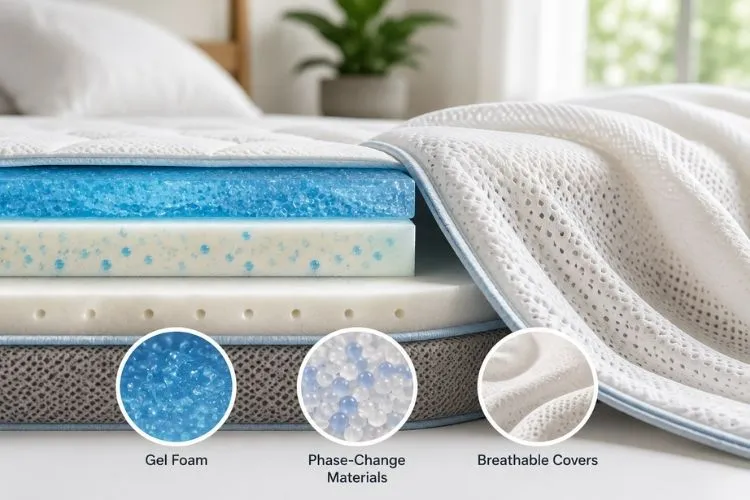
Cooling Technologies Explained: Gel Foam, Phase-Change Materials, and Breathable Covers Without Toxic Additives
A mattress can feel pleasantly cool for the first five minutes and still trap heat by 2 a.m.
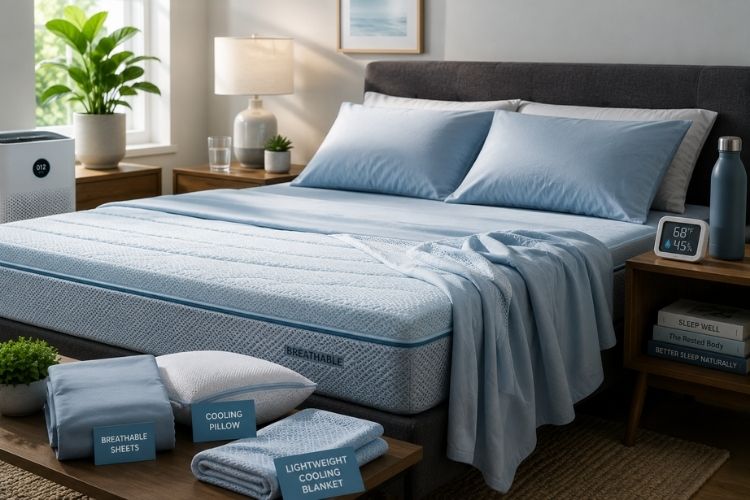
That is one of the biggest problems with the word “cooling” in the mattress industry. It may describe a cool-to-the-touch cover, gel mixed into foam, phase-change materials, ventilation holes, moisture-managing fabrics, or a hybrid construction designed to improve airflow.
These technologies do not work in the same way.
Some temporarily absorb heat near the surface. Some help heat move away from the body. Others improve airflow inside the mattress or manage moisture so the bed feels less warm and clammy.
For anyone creating a healthier, lower-toxin bedroom, there is another important question:
For anyone creating a healthier, lower-toxin bedroom, there is another important question:
What materials, coatings, and treatments are being used to produce the cooling effect?
A genuinely well-designed cooling mattress should explain:
- Which cooling technologies it uses
- Where those technologies are placed
- Whether they provide surface cooling, airflow, or moisture management
- What the mattress layers are made from
- Which components have been independently tested
- What each certification actually covers
Understanding these differences makes it easier to separate meaningful cooling design from impressive-sounding marketing.
Quick Answer
The best cooling mattress technology is rarely one special ingredient. It is usually a combination of several features working together.
An effective cooling mattress may include:
- A hybrid or coil structure that allows internal airflow
- A breathable cover that does not trap warm, humid air
- Comfort layers that do not surround the body too deeply
- Open-cell or ventilated foam
- Phase-change material near the sleep surface
- Moisture-managing textiles
- Clearly documented materials and emissions testing
Gel foam may improve the initial temperature and feel of a foam layer, but it does not guarantee all-night cooling.
Phase-change materials can help buffer temperature changes near the surface. However, they are passive and have a limited capacity to absorb heat.
Breathable covers may sound less technologically impressive, but they can play an important role because they sit directly between the sleeper and the mattress.
For persistent overheating, the complete mattress construction usually matters more than the number of cooling ingredients listed on the product page.
Jump Directly to What You Need
Need the Fastest Answer?
Hot as soon as you get into bed: Start with phase-change materials and breathable mattress covers.
Overheating later during the night: Read about hybrid airflow, open-cell foam, and moisture management.
Memory foam feels too warm: Go to gel foam and open-cell foam.
Frequent night sweats: Start with moisture management and which technology to choose.
Concerned about additives or off-gassing: Read lower-toxin materials and mattress certifications.
Passive cooling is not enough: Go directly to active cooling systems.
Anita’s Take
The most useful cooling feature is not necessarily the one with the most impressive name.
I would begin with the mattress structure: how much foam it contains, how deeply you sink, whether air can move through the support system, and whether the cover manages moisture.
Gel and phase-change materials can improve a well-designed mattress. They cannot fully compensate for several inches of dense foam surrounding the body and restricting airflow.
I would therefore treat gel and PCM as supporting technologies rather than the foundation of the purchasing decision.
Why Mattresses Trap Heat
Your body continuously produces heat while you sleep. Some of that heat needs to move away from the body to prevent the immediate sleep environment from becoming uncomfortably warm.
The small area between your skin, sleepwear, bedding, and mattress is sometimes called the bed microclimate.
Several factors can make this microclimate warmer:
- Dense foam can restrict airflow
- Soft foam may contour closely around the body
- Thick comfort layers can hold heat near the sleeper
- Waterproof protectors may reduce breathability
- Heavy bedding can trap warm air
- High humidity slows the evaporation of perspiration
- Two people sharing a bed produce more combined heat
- A warm bedroom gives passive cooling materials less opportunity to release stored heat
This is why touching a mattress surface for a few seconds tells you very little about its all-night performance.
A cool initial sensation and lasting temperature regulation are not the same thing.
When evaluating a cooling mattress, ask whether it:
- Absorbs some heat close to the body
- Helps heat move away from the sleep surface
- Allows warm air to escape from inside the mattress
- Helps perspiration evaporate
- Combines several of these functions in the complete construction
The strongest cooling designs normally address more than one of these jobs.
Cooling Technologies Compared
| Cooling technology | Primary function | Potential strength | Main limitation |
|---|---|---|---|
| Gel-infused foam | Changes how heat moves through foam | May reduce initial heat buildup | Dense foam can still trap heat |
| Phase-change material | Temporarily absorbs and releases heat | Useful for surface-temperature buffering | Passive and limited in capacity |
| Breathable cover | Supports airflow and moisture movement | Important because it sits near the body | Performance depends on construction and finishes |
| Open-cell foam | Creates more space for air movement | May sleep cooler than dense foam | Still depends on layer depth and density |
| Perforated foam or latex | Creates physical airflow channels | Can improve ventilation | Surrounding layers may block airflow |
| Hybrid coil system | Creates open space inside the mattress | Strong structural airflow | Thick foam above the coils may reduce the benefit |
| Active cooling system | Uses circulating air or water | Can provide longer-lasting temperature control | Higher cost and more maintenance |
A mattress with moderate performance across several cooling mechanisms may outperform one that relies heavily on a single headline feature.
Gel Foam
Gel foam is one of the most common technologies used in cooling mattresses.
The gel may appear as:
- Small particles dispersed through foam
- A gel swirl mixed into memory foam
- A separate gel layer
- A gel-infused upper comfort layer
- A surface coating or grid
The general goal is to change how the foam responds to heat and reduce the heavy, heat-retaining sensation associated with some traditional memory foams.
What Gel Foam May Do Well
A well-designed gel foam layer may:
- Improve the initial surface feel
- Help distribute heat through the foam
- Reduce rapid heat buildup near the body
- Change the responsiveness of the comfort layer
- Work alongside a breathable cover or coil system
However, gel does not actively remove unlimited heat from the bed.
Its performance depends on:
- Foam density
- Comfort-layer thickness
- Mattress firmness
- How deeply the sleeper sinks
- Ventilation channels
- The support structure beneath the foam
- Room temperature and humidity
- Sheets, protectors, duvets, and sleepwear
A deeply contouring mattress with several thick foam layers may still feel warm even when gel has been added.
Why “Gel-Infused” Is Not Enough Information
Consider two mattresses.
Mattress A contains gel-infused memory foam over several deep layers of dense foam.
Mattress B has a breathable cover, a thinner comfort system, responsive foam, and a pocketed coil structure with more open internal space.
Mattress A may have the more impressive cooling label. Mattress B may still provide better all-night airflow.
The word “gel” should therefore be treated as one construction detail, not proof that the complete mattress sleeps cool.
The Lower-Toxin Question
The presence of gel does not automatically tell you whether a mattress is a better or worse choice from a material perspective.
Instead, investigate the complete construction:
Instead, investigate the complete construction:
What type of foam contains the gel?
Is the foam formulation identified?
Is relevant emissions testing documented?
Does a certification apply to the foam or the complete mattress?
What adhesives, fire barriers, and textiles are used?
Are broad terms such as “eco foam” explained?
Can the certification be independently verified?
CertiPUR-US is one example of a certification program for participating flexible polyurethane foams. It does not automatically certify every material in the complete mattress.
Bottom Line on Gel Foam
Gel can be a useful supporting feature, especially when combined with a breathable cover and good internal airflow.
It should not be the primary reason to buy a mattress.
The complete structure, foam depth, responsiveness, and material transparency matter more than the word “gel.”
Phase-Change Materials
Phase-change materials, usually abbreviated as PCM, work differently from ordinary breathable fabrics.
A PCM is designed to absorb or release thermal energy as it changes physical state within a specific temperature range.
In simplified terms:
- As the surrounding area becomes warmer, the material absorbs thermal energy
- As the surrounding area cools, it releases some of the stored energy
Rather than producing cold air, PCM helps slow or moderate temperature changes.
Where PCM Is Used
PCM may be:
- Incorporated into the mattress cover
- Applied as a surface coating
- Encapsulated in microscopic particles
- Mixed into fibers
- Added to an upper foam layer
- Included in a separate cooling panel
Placement matters.
A PCM treatment close to the body can interact more directly with changing surface temperatures than a cooling ingredient buried deep inside the mattress.
What PCM May Do Well
PCM may help:
- Reduce rapid surface heat buildup
- Moderate sudden temperature changes
- Create a more temperature-neutral feel
- Support sleepers who become warm soon after getting into bed
- Manage temperature fluctuations during the night
However, a measurable temperature change does not guarantee that every sleeper will experience a dramatic improvement in comfort.
The Main Limitation of PCM
PCM is passive. It is not an air conditioner.
It has a finite capacity to absorb thermal energy. Once that capacity has been reached, it cannot continue absorbing increasing amounts indefinitely.
For the cycle to repeat effectively, surrounding conditions must eventually allow the material to release some of its stored heat.
This means that PCM placed over a thick, heat-retaining mattress may provide an initial cooling effect without solving the underlying airflow problem.
PCM usually works best with:
- A breathable cover
- Open-cell or ventilated comfort layers
- Moisture management
- A hybrid or coil support structure
- A reasonably cool bedroom
- Bedding that does not block airflow
Bottom Line on Phase-Change Materials
PCM is one of the more useful passive surface-cooling technologies.
It can help buffer temperature changes, particularly when positioned near the body. It should still be evaluated as one part of a complete cooling system rather than as a stand-alone solution.
Breathable Mattress Covers
The mattress cover is the layer closest to your body, yet it is often treated as decoration rather than part of the cooling system.
A breathable cover can help:
- Warm air move away from the surface
- Moisture spread across a larger area
- Perspiration evaporate more efficiently
- Reduce the warm, damp feeling around the body
- Allow cooling layers underneath to work more effectively
A cover does not need to feel icy to support better temperature regulation.
A fabric that remains breathable and manages moisture consistently may be more useful throughout the night than a cover designed mainly to create a dramatic cold sensation for the first few minutes.
Cotton
Cotton is soft, familiar, and generally breathable.
A loosely woven or knitted cotton cover may allow more airflow than a dense, heavily quilted design. Performance still depends on the thickness, backing, and any additional treatments.
Organic cotton may appeal to shoppers who prefer certified agricultural and textile standards, but the word “organic” does not automatically describe every mattress component.
Wool
Wool can help manage moisture and stabilize the microclimate around the sleeper.
It may absorb water vapor before the surface feels wet and release that moisture when conditions allow. Wool may also be used as part of a mattress fire-barrier system.
Its performance depends on:
- The amount used
- How densely it is packed
- Whether it is blended with synthetic fibers
- Whether additional treatments are applied
Lyocell and Tencel
Lyocell is a regenerated cellulose fiber commonly made from wood pulp. Tencel is a branded type of lyocell produced by Lenzing.
Lyocell fabrics are often smooth and effective at managing moisture. However, “plant-based” does not mean that the finished fiber is raw or unprocessed.
It is an engineered textile and should be described accurately.
Bamboo-Derived Fabrics
A “bamboo cover” normally contains viscose, rayon, or lyocell made from processed bamboo cellulose.
Look for the precise textile description:
- Bamboo viscose
- Bamboo rayon
- Bamboo-derived lyocell
- Bamboo blend
This is more informative than the word “bamboo” alone.
Synthetic Cooling Fabrics
Some covers use polyethylene, polyester, nylon, or proprietary synthetic fibers designed to transfer heat or moisture.
These materials may create a noticeable cool-to-the-touch effect.
Shoppers should still investigate:
- The exact fiber composition
- Whether additional coatings or finishes are used
- Whether independent textile testing is documented
- Whether the cover is removable
- Whether cooling comes from the fiber or a surface treatment
Synthetic does not automatically mean unsafe, just as natural does not automatically mean lower-toxin.
Transparency matters more than broad labels.
Cover Construction Matters
A breathable fiber may lose much of its advantage when combined with:
- Thick quilting foam
- Waterproof backing
- Dense adhesive layers
- Heavy synthetic batting
- A non-breathable mattress protector
The complete surface construction must allow air and moisture to move.
Bottom Line on Breathable Covers
Breathable covers are not merely a finishing detail.
They are the first part of the cooling system to interact with the sleeper. The most useful cover is not necessarily the coldest one in a showroom, but the one that supports airflow and moisture movement for several hours.
Open-Cell Foam and Ventilated Latex
Traditional memory foam often sleeps warm because its dense structure and close contouring can limit airflow.
Open-cell foam has a more interconnected internal structure, allowing air and heat to move more freely than through some denser foams.
Potential benefits include:
- Improved airflow
- Faster heat movement
- Less stagnant warm air
- A more responsive feel
- Reduced heat retention compared with very dense foam
However, the term “open-cell” is relative. Most flexible mattress foams contain some open-cell structure.
A company may therefore use the phrase without explaining how much more breathable the foam is than a standard alternative.
Questions to Ask About Open-Cell Foam
How thick is the layer?
Is it close to the surface?
What is the foam density?
Is the mattress deeply contouring?
Are there ventilation channels?
What layers sit above and below it?
Is it used in a hybrid or all-foam design?
Is emissions testing documented?
An open-cell foam beneath dense quilting may provide less cooling benefit than a thinner, responsive layer placed directly beneath a breathable cover.
Open-cell construction can improve airflow, but polyurethane foam is still a synthetic material. Cooling performance and material transparency should therefore be evaluated separately.
Perforated Foam and Latex
Some mattresses use holes, grooves, or channels to create physical pathways for airflow.
This may be found in:
- Memory foam
- Polyfoam
- Latex
- Zoned comfort layers
- Convoluted foam
- Ventilated mattress toppers
Perforation increases the exposed surface area and may allow more air to move through the layer.
Latex is generally more responsive than traditional memory foam, so the sleeper often remains closer to the mattress surface rather than sinking deeply.
This may reduce the amount of material surrounding the body.
Latex layers also commonly contain ventilation holes, which can further support airflow.
Product descriptions may use terms such as:
- Natural latex
- Organic latex
- Latex hybrid
- Latex blend
- Synthetic latex
These terms are not interchangeable.
Ask what percentage of the latex is natural and which certifications apply.
Dunlop and Talalay Latex
Dunlop latex is often:
- Denser
- More supportive
- Slightly firmer
- Common in support layers
Talalay latex is often:
- Lighter
- More consistent in feel
- Springier
- Highly ventilated
- Common in comfort layers
Neither process is automatically better for every sleeper.
Cooling still depends on firmness, layer depth, cover construction, and the layers below.
Ventilation holes can only help when air has somewhere to move. A perforated layer enclosed by dense foam or impermeable backing may not perform as well as the product images suggest.
Hybrid Airflow and Coil Systems
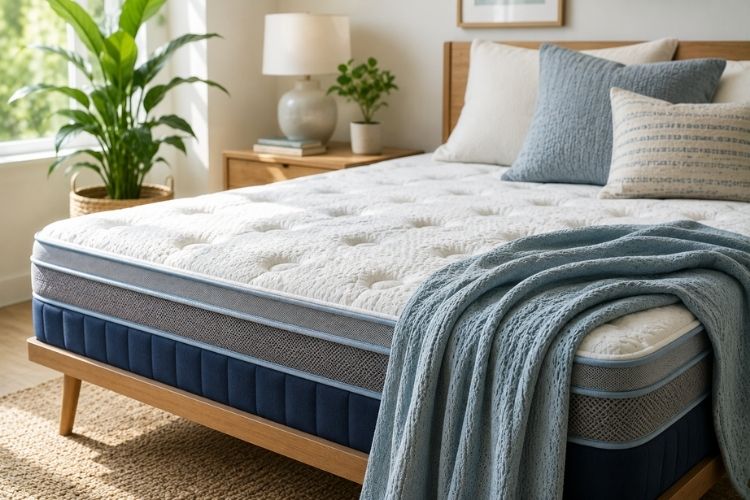
Hybrid mattresses combine comfort layers with a coil support system.
From a cooling perspective, coils offer one major structural advantage: open internal space.
Compared with a solid foam core, a coil system may allow more air to circulate through the lower part of the mattress.
This is one reason hybrids often sleep cooler than thick all-foam models.
Why Coils Can Improve Cooling
A coil unit may:
- Create open space inside the mattress
- Allow warm air to disperse
- Reduce the total amount of dense foam
- Increase responsiveness
- Prevent excessive sinking
- Support airflow around the edges
However, a hybrid is not automatically cool.
Some hybrids contain:
- Thick memory foam
- Dense pillow tops
- Multiple synthetic quilting layers
- Heavy foam encasement
- Non-breathable covers
These layers may reduce the airflow advantage provided by the coils.
The most breathable hybrid designs often combine:
- A breathable cover
- Moderate comfort-layer depth
- Responsive foam or latex
- Perforation or open-cell construction
- A ventilated coil system
- Minimal unnecessary barrier layers
For product-level options, see our guide to the best cooling hybrid mattresses.
Edge Support and Airflow
Some mattresses use thick foam around the perimeter for stronger edge support. This may reduce airflow through the sides.
Other mattresses use reinforced coils around the perimeter.
Neither design is automatically superior, but hot sleepers may benefit from understanding how the mattress edges are constructed.
The Bed Base Matters
Even a breathable mattress can retain more heat if it sits on a surface with limited ventilation.
A solid platform may restrict airflow underneath.
A slatted base can improve ventilation, provided:
- The spacing follows the mattress manufacturer’s requirements
- The base provides enough support
- The mattress warranty permits it
- The center support is appropriate
Placing a mattress directly on the floor can also reduce airflow and increase the risk of moisture accumulating underneath.
Moisture Management
Heat and moisture are closely connected in the sleep environment.
When perspiration cannot evaporate efficiently, the bed may feel hotter even when the measured temperature has changed only slightly.
Moisture-management materials move water vapor or perspiration away from the skin and spread it across a larger surface area so it can evaporate more effectively.
Common examples include:
Common examples include:
Wool
Lyocell
Cotton
Technical polyester
Nylon blends
Engineered wicking fibers
Moisture-wicking does not necessarily mean that a material actively lowers temperature.
Instead, it may reduce the humid, sticky feeling that contributes to discomfort.
This can be particularly important for:
- People experiencing night sweats
- Menopausal sleepers
- Athletes
- Couples sharing a bed
- People living in humid climates
- Sleepers using heavy bedding
A breathable, moisture-managing cover may sometimes make a greater practical difference than another cooling ingredient deep inside the mattress.
Readers dealing with persistent overheating can continue to our guide to the best mattresses for night sweats.
Active Cooling Systems
Passive cooling mattresses rely on materials, airflow, and heat transfer.
Active cooling systems use electricity to move temperature-controlled air or water through a pad, cover, or mattress layer.
Examples include:
- Water-circulating mattress pads
- Air-based cooling covers
- Dual-zone temperature-control systems
- Smart cooling mattress toppers
Advantages of Active Cooling
Active systems may:
- Maintain cooling for longer periods
- Offer adjustable temperature settings
- Cool each side of the bed separately
- Help people with persistent night sweats
- Provide more predictable temperature control
For severe overheating, an active system may be more effective than repeatedly buying mattresses with additional passive cooling claims.
Possible Drawbacks
Active systems may involve:
- Higher price
- Electricity use
- Pump or fan noise
- Maintenance
- Cleaning requirements
- Potential leaks in water-based systems
- Replacement parts
- App or subscription dependence
A mattress still benefits from good airflow and breathable materials even when an active cooling system is added.
Lower-Toxin Materials and Additives
The phrase “non-toxic mattress” is widely used, but it does not have one universal definition.
A mattress contains many components, and each may involve different materials, treatments, and certification standards.
Areas to investigate include:
- Foam composition
- Textile dyes
- Adhesives
- Fire barriers
- Antimicrobial treatments
- Stain-resistant finishes
- Waterproof membranes
- Cooling coatings
- Added fragrances
- Fiberglass
- VOC emissions
- The goal should not be an impossible promise of “zero chemicals.”
Everything is made of chemicals, including cotton, wool, latex, and water.
A more useful goal is to reduce unnecessary exposures and choose products with:
- Clear material disclosure
- Relevant independent testing
- Low-emission documentation
- Transparent fire-barrier information
- No unexplained antimicrobial or stain-resistant treatments
- Certifications whose scope can be verified
Be Cautious With Broad Claims
Marketing phrases that require further explanation include:
- Eco-friendly foam
- Bio-based foam
- Green foam
- Natural memory foam
- Clean cooling technology
- Chemical-free
- Non-toxic gel
- Sustainable cooling fabric
- Plant-based mattress
A “plant-based foam,” for example, is often polyurethane foam in which a portion of the petroleum-derived input has been replaced with plant-derived material.
It is not necessarily a foam made entirely from plants.
Ask About Added Treatments
A cooling cover may contain more than its listed base fiber.
Ask whether it includes:
- Antimicrobial treatments
- Odor-control treatments
- Stain resistance
- Moisture-repellent finishes
- Cooling coatings
- Silver, copper, graphite, or mineral additives
- Proprietary chemical finishes
These additions are not automatically harmful, but they should be clearly disclosed.
A company that cannot explain how its cooling effect is created is not providing enough information for an informed purchase.
Mattress Certifications
Certifications can help verify specific claims, but no single certification answers every question about a mattress.
The most important step is understanding which part of the product has been certified.
CertiPUR-US
CertiPUR-US applies to participating flexible polyurethane foam.
It does not certify the entire mattress, the company, or every component used in the finished product.
It also does not mean that the mattress is organic, natural, or made only from synthetic-free materials.
OEKO-TEX STANDARD 100
OEKO-TEX STANDARD 100 is used for textiles and related components tested for a range of harmful substances.
Depending on the certificate, it may apply to:
- Cover fabric
- Thread
- Zippers
- Labels
- Textile components
- Other specifically listed materials
Check the certificate scope rather than assuming the entire mattress is covered.
GREENGUARD Gold
GREENGUARD Gold focuses on chemical emissions from finished products and uses stricter emissions limits than the standard GREENGUARD certification.
It can be useful when evaluating indoor-air emissions, but it does not mean that every mattress material is natural or organic.
GOTS and GOLS
The Global Organic Textile Standard, or GOTS, applies to qualifying organic textiles and their processing.
The Global Organic Latex Standard, or GOLS, applies to qualifying products made with organically grown natural rubber latex.
A mattress containing a GOTS-certified cover or GOLS-certified latex may still contain other components that are outside that certificate’s scope.
Certification Red Flags
Be cautious when:
- A certification logo appears without verifiable details
- The company does not specify which component is certified
- An expired certificate is displayed
- A supplier’s certificate is presented as certification of the complete mattress
- “Meets the standards of” is used instead of confirming actual certification
Certifications are most useful when they are specific, current, and independently verifiable.
Which Technology Should You Choose?
The right technology depends on when and why you become hot.
You Feel Hot Almost Immediately
Prioritize:
- A breathable or cool-to-the-touch cover
- Phase-change material close to the surface
- Lightweight bedding
- A breathable mattress protector
- A bedroom temperature that allows passive materials to release heat
PCM may help with rapid surface heat buildup, but its impact will be limited if the mattress underneath contains several thick, dense foam layers.
You Sleep Hot Throughout the Night
Prioritize:
- Hybrid or coil construction
- Moderate comfort-layer depth
- Responsive materials
- A breathable cover
- Moisture management
- Open-cell or ventilated foam
- PCM as an additional feature rather than the only cooling mechanism
For persistent overheating, whole-mattress airflow normally matters more than a single cooling infusion.
You Love Memory Foam but Dislike Overheating
Prioritize:
- More responsive memory foam
- Open-cell construction
- Perforated layers
- A thinner foam comfort system
- A breathable cover
- A hybrid support core where possible
The depth and density of the foam may matter more than the number of cooling ingredients.
See our guide to cooling memory foam mattresses that won’t trap heat for product-level options.
You Want a Premium Hybrid
Look for:
- Coil airflow
- Responsive comfort layers
- A breathable or phase-change cover
- Clearly explained foam construction
- Reinforced coils instead of a thick perimeter foam wall
- Relevant certifications
- A realistic trial and return policy
For a closer look at one premium option already covered on Healthy Home Upgrade, read our Nectar Premier Hybrid review.
You Prefer Natural or Organic Materials
Prioritize:
- Certified organic cotton where relevant
- Wool for moisture management
- Natural latex with clear composition information
- GOTS-certified textile components
- GOLS-certified organic latex
- A ventilated coil structure
- Clear fire-barrier information
Natural-material mattresses may not provide the same dramatic cold-to-the-touch sensation as some synthetic covers.
However, wool, cotton, latex, and coils can create stable temperature regulation without relying on several proprietary cooling treatments.
Natural does not automatically mean cool. A thick or very soft natural mattress can still retain warmth.
You Are Sensitive to Odors or Off-Gassing
Prioritize:
- Transparent foam information
- Verifiable emissions certification
- Textile testing
- Clear adhesive and fire-barrier information
- A realistic return policy
- Adequate ventilation after unboxing
- A company that answers detailed material questions
Odor is not a perfect measure of emissions. The absence of a smell does not prove that every component has been independently tested.
How to Choose a Cooling Mattress
Cooling mattress shopping becomes easier when the decision is made in the correct order.
Step 1: Identify Your Overheating Pattern
Ask:
Ask:
Do I feel hot as soon as I lie down?
Do I wake sweaty after several hours?
Do I sink deeply into my current mattress?
Does my partner add significant heat?
Is the bedroom itself too warm?
Do I live in a humid climate?
Am I using a waterproof protector?
Are my duvet and sheets trapping heat?
Is the mattress on a poorly ventilated base?
This helps separate a surface-temperature problem from an airflow or moisture problem.
Step 2: Choose the Mattress Architecture
For persistent overheating, begin with the basic design.
A strong starting point may include:
- Hybrid construction
- A ventilated coil system
- Moderate foam depth
- Responsive comfort layers
- Good perimeter airflow
- A suitable ventilated base
This foundation is usually more important than an impressive list of cooling additives.
Step 3: Evaluate How Deeply You Will Sink
Softness and cooling are connected.
A very soft mattress may:
- Surround more of the body
- Reduce exposed skin area
- Restrict airflow
- Create a warmer pocket around the sleeper
Hot sleepers do not necessarily need a hard mattress.
Side sleepers still require enough pressure relief around the shoulders and hips. The goal is sufficient comfort without unnecessary engulfing.
Step 4: Evaluate the Cover
Look for:
- Exact fiber composition
- Breathable construction
- Moisture management
- Minimal unnecessary quilting
- Clear information about coatings
- Relevant textile testing
- A removable design where available
Do not judge the cover only by whether it feels cold for a few seconds.
Ask how it is designed to perform after several hours.
Step 5: Treat PCM as a Bonus, Not Magic
Ask:
Ask:
Where is the PCM placed?
Is it in the cover or buried deeper?
Is the construction explained?
What airflow system supports it?
Does the mattress rely too heavily on PCM marketing?
PCM is strongest when the mattress can also disperse the heat that it absorbs.
Step 6: Treat Gel as Supporting Technology
Do not automatically reject gel, but do not allow the word to make the purchasing decision.
Ask what surrounds the gel foam and whether the complete mattress is designed to release heat.
Step 7: Verify Lower-Toxin Claims Separately
Cooling performance and material transparency are two different evaluation tracks.
A mattress may sleep cool but provide limited information about adhesives, fire barriers, or textile treatments.
Another mattress may use transparent materials but lack enough airflow for a very hot sleeper.
The strongest option should perform well in both areas.
Step 8: Check the Trial and Return Terms
Cooling comfort is difficult to judge from technical specifications alone.
Check:
- Trial length
- Minimum required trial period
- Return fees
- Collection requirements
- Whether the mattress can be returned after opening
- Whether third-party retailer terms differ
- Whether a protector is required to preserve the trial
Temperature performance may change as the mattress softens and the sleeper sinks more deeply.
Common Buying Mistakes
Counting Cooling Ingredients
A mattress with gel, copper, graphite, PCM, and a cooling cover does not automatically outperform a simpler hybrid with better airflow.
More ingredients do not necessarily create better temperature regulation.
Judging the Mattress by Its Initial Touch
A cold surface can create a strong showroom impression.
The more important question is whether the mattress manages heat, airflow, and moisture after several hours.
Ignoring the Mattress Protector
A thick waterproof protector can reduce the benefits of an otherwise breathable mattress.
People sometimes blame the mattress when the protector or bedding is the main source of heat retention.
Ignoring Foam Depth
Even advanced cooling foam can feel warm when the sleeper is surrounded by several inches of soft, dense material.
Assuming Every Hybrid Sleeps Cool
A hybrid may still contain a thick pillow top, deep memory foam, and a dense perimeter foam wall.
Look at the entire layer structure.
Assuming Natural Always Means Cool
Natural latex, wool, and cotton can support breathable construction, but firmness, thickness, and overall design still matter.
Treating One Certification as Proof of Everything
A foam certification applies to foam.
A textile certification applies to the listed textile or components.
An emissions certification does not necessarily mean the mattress is organic.
Always check the scope.
Buying a New Mattress Before Checking the Complete Setup
Before replacing your mattress, consider whether overheating is being intensified by:
- A heavy duvet
- Polyester sheets
- A waterproof protector
- A solid, non-ventilated base
- High bedroom humidity
- Warm sleepwear
- A partner with different temperature preferences
The mattress may be part of the problem without being the only problem.
Frequently Asked Questions
Is Gel Foam Better Than Phase-Change Material?
Neither is universally better.
Gel is normally incorporated into foam and may help change heat distribution or reduce initial heat buildup.
PCM is designed specifically to absorb and release thermal energy within a defined temperature range, making it more directly focused on surface-temperature buffering.
PCM may provide a more noticeable initial effect when positioned close to the body. Gel performance depends heavily on the foam and mattress construction around it.
The complete mattress matters more than choosing gel or PCM in isolation.
Do Cooling Mattresses Stay Cool All Night?
Passive cooling mattresses do not continuously generate cold air.
They manage heat through absorption, heat transfer, airflow, and moisture movement.
Their effectiveness depends on:
- Mattress construction
- Bedroom temperature
- Humidity
- Bedding
- Mattress protector
- The sleeper’s body and preferred firmness
People with severe or persistent overheating may obtain more predictable control from an active air- or water-based system.
Are Cooling Chemicals Added to Mattress Covers?
Some covers create cooling through their fibers or construction. Others use PCM coatings, mineral additives, or moisture-management finishes.
The phrase “cooling cover” does not explain which method is being used.
Ask for the exact fiber composition and whether an additional treatment creates the cooling effect.
Is a Hybrid Mattress Always Cooler Than Memory Foam?
Not always.
A hybrid normally contains more internal open space than an all-foam mattress, but thick memory-foam comfort layers may still trap heat.
A well-designed hybrid with moderate foam depth and a breathable cover will often provide better airflow than a dense all-foam mattress.
Individual models must still be evaluated separately.
Is Natural Latex Cooler Than Memory Foam?
Natural latex is generally more responsive and less enveloping than traditional memory foam.
Ventilation holes and a springier feel may also support airflow.
This can make latex a strong option for sleepers who dislike the heat and deep sink of memory foam.
However, a thick, soft latex mattress can still feel warm, especially when combined with dense quilting or heavy bedding.
Can a Mattress Protector Stop a Cooling Mattress From Working?
Yes.
Waterproof membranes, thick padding, and tightly woven materials may restrict airflow and moisture movement.
People who need waterproof protection should look for the most breathable option compatible with their needs and mattress warranty.
Does CertiPUR-US Mean the Entire Mattress Is Non-Toxic?
No.
CertiPUR-US applies to qualifying flexible polyurethane foam.
It does not automatically certify the cover, adhesives, fire barrier, coils, backing materials, or complete finished mattress.
It can be a useful foam-screening tool but should not be interpreted beyond its scope.
What Is the Best Cooling Technology for Night Sweats?
For ongoing night sweats, prioritize structural airflow and moisture management.
A useful combination may include:
- A hybrid coil system
- Responsive comfort layers
- A breathable cover
- Wool, lyocell, or another moisture-managing textile
- PCM near the surface
- Breathable bedding
- A suitable protector
Persistent or unexplained night sweats can also have medical causes and should not be treated only as a mattress problem.
Final Verdict
There is no single ingredient that deserves to be crowned the universal winner.
Gel foam can improve the behavior of a foam layer, but it does not guarantee that a mattress will remain cool throughout the night.
Phase-change materials can buffer surface-temperature changes, but they have passive limits.
Breathable covers may look less exciting on a product page, yet airflow and moisture management close to the body can have a significant effect on comfort.
Open-cell foam, perforated layers, latex, and hybrid coils create the structural airflow that many cooling mattresses actually need.
For a lower-toxin bedroom, the smartest strategy is not to fear every engineered material. It is to demand better transparency.
Ask:
What is the material?
What does it actually do?
Where is it positioned?
Is its performance supported by the complete construction?
What has been independently tested?
What does each certification cover?
Is the whole mattress designed for airflow, or is one cooling ingredient doing all the marketing work?
That is the difference between buying a mattress because it sounds cool and choosing one because its construction genuinely makes sense.
For product recommendations, continue with our guides to the best cooling hybrid mattresses, the best mattresses for night sweats, and cooling memory foam mattresses that won’t trap heat.

About the Author
Anita
Anita is the founder and writer behind Healthy Home Upgrade, where she shares her passion for transforming living spaces into foundations for smart health and wellness. Driven by her personal health journey, her goal is to provide valuable, practical articles that empower readers to use technology and design to improve their quality of life.