Last Updated: May 2026
If you want the safer daily-use default, a stainless basket air fryer is the stronger choice. The reason is not marketing. It is material logic. Stainless gives you a simpler food-contact surface with no nonstick layer to wear down, chip, or slowly lose performance. Ceramic-coated air fryers are not automatically unsafe when new and intact, but they are still coated systems, and coatings are usually the weak link in long-term daily use. FDA says food-contact surfaces should be safe, durable, corrosion-resistant, nonabsorbent, smooth, easily cleanable, and resistant to pitting, chipping, scratching, scoring, and decomposition.
I run a healthy home website, so I notice when a product sounds “clean” on paper but becomes annoying in real life. That is exactly what happens when people buy an air fryer for the coating story instead of the food-contact surface they will actually be heating, scrubbing, and using every day. In a Zero Toxic Load kitchen, daily friction matters. If the surface is simpler, easier to trust, and easier to keep in good condition, that usually wins.
If you already know you want the simplest food-contact surface, start with our guide to the Safest Air Fryers with Stainless Steel Baskets before you compare anything else.
At a Glance
| Option | Best For | Material Logic | Main Weakness | Daily Use Verdict |
| Stainless basket | Frequent daily use | Uncoated, durable, simpler food-contact surface | Less naturally slick than coated baskets | Best overall |
| Ceramic-coated basket | People who want easier release at first | Smoother release when new | Coating becomes the weak link over time | Acceptable, but second-best |
This ranking follows FDA’s durability and cleanability logic for food-contact surfaces and ACS’s explanation of how modern ceramic nonstick systems are constructed and how they wear.
Also in This Article
- Why this choice matters more than marketing suggests
- Why stainless wins for daily use
- What “ceramic-coated” actually means
- The cleaning advantage nobody talks about
- The biggest labeling trap
- When ceramic still makes sense
- Product recommendation
- FAQ
Why This Choice Matters More Than Marketing Suggests
Air fryers are not gentle appliances. They cycle heat constantly, collect grease, and get cleaned over and over again. That means the real question is not whether a basket sounds “non-toxic” on day one. The real question is how the food-contact surface behaves after repeated heat, washing, scraping, and ordinary kitchen wear. FDA’s Food Code puts heavy weight on exactly those issues by requiring food-contact surfaces to stay smooth, durable, and resistant to chipping, scratching, scoring, and similar damage.
That is why this is not really a stainless versus ceramic beauty contest. It is a durability and trust question. In a Healthy Home kitchen, the safer material is usually the one with fewer layers, fewer unknowns, and fewer opportunities to degrade into a problem.
Why Stainless Basket Air Fryers Win for Daily Use
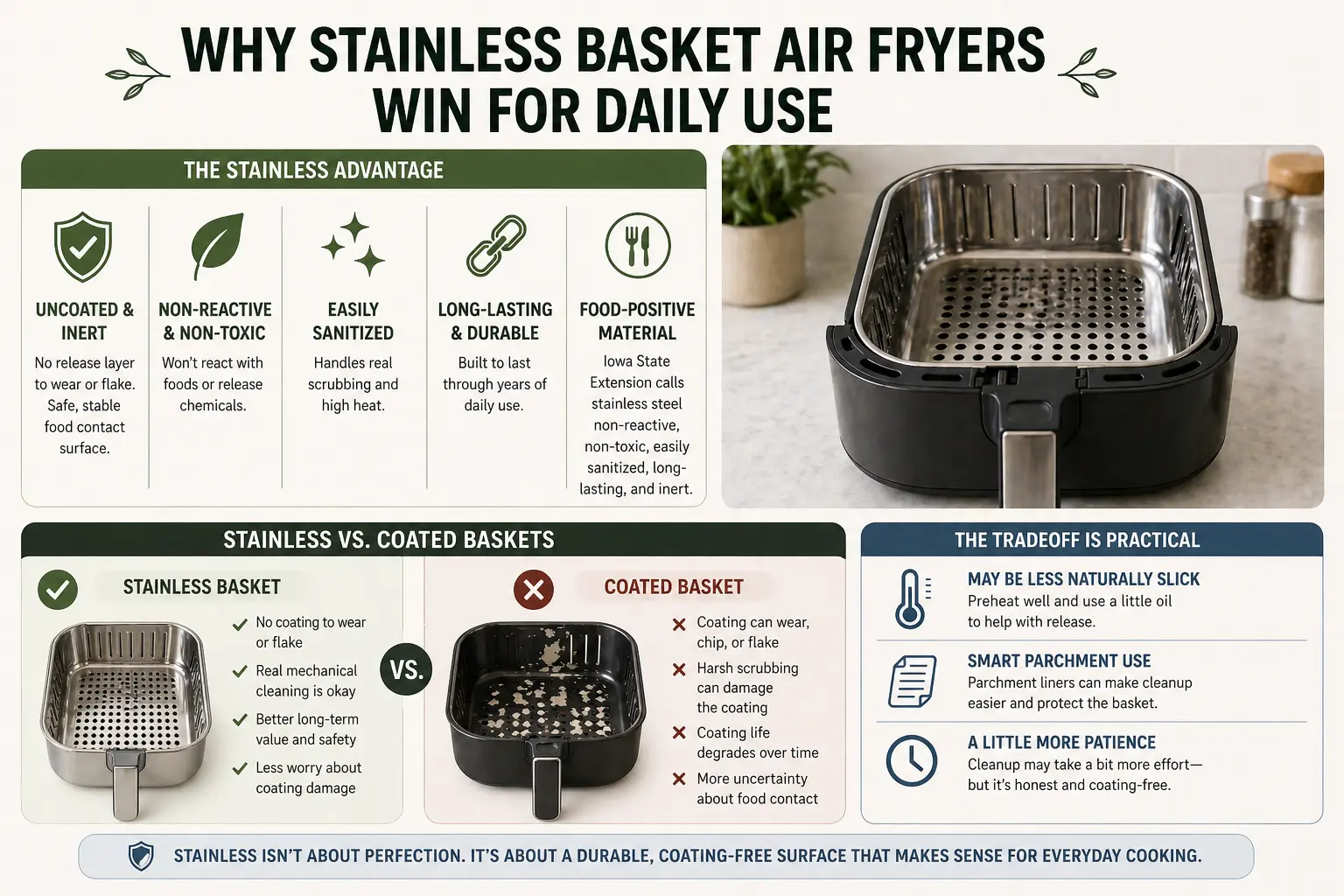
The case for stainless is simple. It is an uncoated food-contact surface. You are not depending on a thin release layer to stay perfect through repeated heating and cleaning. Iowa State Extension describes stainless steel as non-reactive, non-toxic, easily sanitized, long-lasting, and inert with respect to the natural chemicals and dyes in food. That is exactly the kind of material profile that makes sense for something you use all the time.
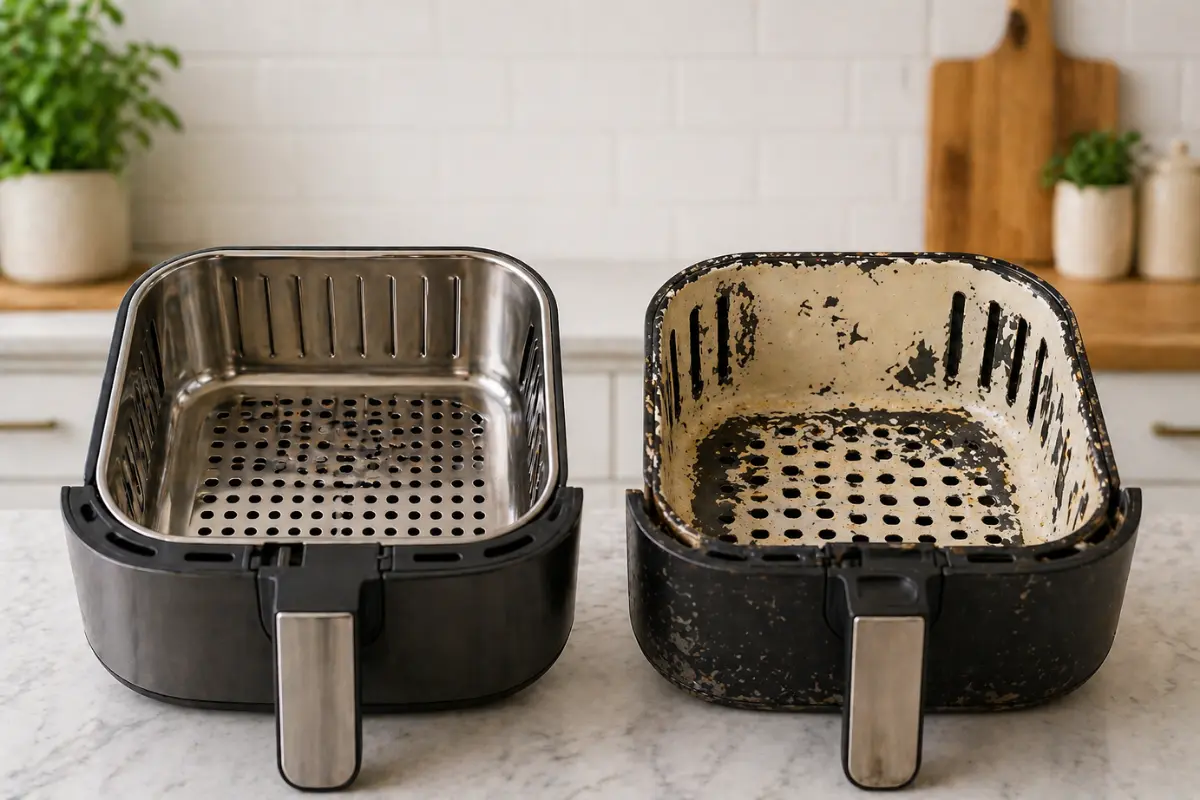
Stainless also has a very practical daily-use advantage: it allows more honest mechanical cleaning. Burnt-on residue is just a cleaning problem, not a coating-preservation problem. With a coated basket, aggressive scrubbing is always in tension with coating longevity. With stainless, the cleaning conversation is usually much simpler because there is no thin nonstick layer sitting at the center of it. FDA’s durability criteria are exactly why that matters.
The tradeoff is practical, not philosophical. Stainless is usually less naturally slick than a fresh coated basket, so you may need better preheating, smarter parchment use, or a little more patience with cleanup. But in return you get a surface that usually makes more sense for the long haul.
Top stainless performers tested: safest air fryers with stainless steel baskets.
What “Ceramic-Coated” Actually Means
This is where the marketing gets fuzzy.
In air-fryer language, ceramic-coated usually does not mean a thick piece of fired ceramic like an old stoneware dish. ACS explains that most modern ceramic nonstick coatings are generally made through a sol-gel process and typically involve silicon-based particles together with polydimethylsiloxane resins and silane additives applied over metal. In plain language, that means you are still dealing with a manufactured coating system on top of a metal base, not a simple inert slab of ceramic.
That is why “wear surface” is the right HH term. A ceramic-coated basket may be acceptable when new, but it is still a coating designed to sit between your food and the metal underneath. Once you see it that way, the daily-use question becomes much clearer: how much do you want your air fryer decision to depend on a surface layer staying pristine?
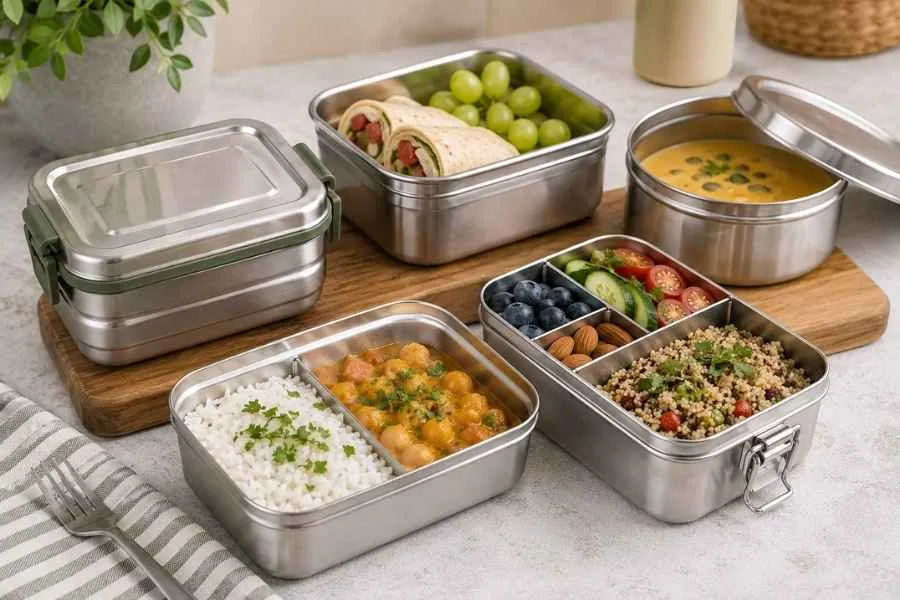
Prep feeds frying perfectly: zero-toxic-load meal prep station
The Biggest Labeling Trap
This is where shoppers get misled.
“Ceramic-coated” sounds cleaner than “nonstick,” but the label does not always tell you what people assume it does. ACS specifically warns that ceramic can be a misleading marketing term and notes that some cookware marketed as ceramic may still involve PFAS chemistry. It also notes that labels such as Teflon-free or PFOA-free are not the same thing as PFAS-free, and quotes an expert saying that consumers specifically trying to avoid PFAS in nonstick products should look for fluorine-free labeling.
FDA adds an important nuance here. For polymerized nonstick applications on cookware, the agency says studies show negligible amounts of PFAS in those coatings can migrate to food under the authorized use conditions. That means this is not a cartoon story where every coated basket is automatically toxic. But for HH, the cleaner decision is still to step away from the whole coated-surface question when you can. Stainless does that.
Air fryer + safe pans complete: safest cookware materials.
When Ceramic Still Makes Sense
A ceramic-coated air fryer can still be acceptable if the model is otherwise excellent, the coating is clearly disclosed, and you are willing to treat the basket more gently. It may also work for people who care more about easier release than long-term durability. But the ranking does not change: stainless is still the first choice because it is the simpler and more dependable surface for daily use. Ceramic only makes sense when you knowingly accept the coating tradeoff.
Product Recommendation
If you want the simplest daily-use option, I would start with an air fryer that uses a stainless basket instead of a coated one. It gives you a more straightforward food-contact surface, makes the long-term cleaning logic easier, and removes the coating question from the center of the decision. In a healthy home kitchen, that simplicity matters more than marketing language about “clean” finishes. You can check a stainless basket air fryer here.
No plastic before or after frying: how to reduce plastic contact in the kitchen
What I Would Choose for a Healthy Home Kitchen
If I were choosing for a Healthy Home Upgrade kitchen, I would pick stainless basket first almost every time.
Not because ceramic-coated is automatically dangerous. Because stainless is simpler. It is easier to understand, easier to trust, easier to clean decisively, and less dependent on a coating staying perfect through months and years of normal use. That is exactly the kind of decision that fits a Zero Toxic Load philosophy: less coating, less guesswork, less long-term friction. Iowa State Extension’s description of stainless as non-reactive, non-toxic, and long-lasting lines up directly with that logic.
Build your full toxin-free system: non-toxic cookware articles.
Final Verdict
If your question is which is safer for daily use, my answer is clear:
Choose the stainless basket air fryer if you can.
Ceramic-coated air fryers can still be acceptable when they are well made, intact, and honestly labeled. But for a daily-use appliance, stainless is the better fit because it gives you the simpler food-contact surface, the more straightforward cleaning logic, and the cleaner long-term decision. In a Zero Toxic Load kitchen, that is usually the smarter direction.
FAQ
Is a ceramic-coated air fryer safe?
It can be, especially when new and intact. The bigger question is long-term wear. ACS notes that ceramic-coated systems are still coatings, often made through sol-gel chemistry, and that users frequently report shorter-lived nonstick performance than PTFE.
Is stainless steel safer than ceramic-coated for daily use?
For daily use, stainless is the stronger default because it is uncoated, non-reactive, inert with food, and easier to evaluate over time. Iowa State Extension describes stainless steel as non-reactive, non-toxic, easily sanitized, long-lasting, and not prone to reacting with the natural chemicals or dyes in food.
Does “PFOA-free” mean PFAS-free?
No. ACS notes that cookware can be labeled Teflon-free or PFOA-free and still involve PFAS. For shoppers specifically trying to avoid PFAS in nonstick products, fluorine-free is the cleaner label to look for.
What should matter most when choosing an air fryer basket?
The real priority is the actual food-contact surface and how it will hold up under repeated heat and cleaning. FDA’s Food Code emphasizes smooth, durable, easily cleanable food-contact surfaces that resist chipping, scratching, scoring, and decomposition.

Anita is the founder and writer behind Healthy Home Upgrade, where she shares her passion for transforming living spaces into foundations for smart health and wellness. Driven by her personal health journey, her goal is to provide valuable, practical articles that empower readers to use technology and design to improve their quality of life.