
An adjustable bed base can look reassuringly simple from the outside. A frame, a motor, a remote control, maybe a fabric-covered platform and a few comfort settings.
But when you bring one into your bedroom, you are not only buying movement. You are also bringing in metals, foam, adhesives, fabric, wiring, motors, plastics, electronics, finishes and sometimes wireless technology.
That does not mean adjustable bases are bad. For many people, a well-made adjustable base can be one of the more practical sleep upgrades, especially when elevation, comfort, or shared-bed flexibility matters.
But through a Zero Toxic Load lens, the question is not only:
Does this bed base adjust?
It is also:
What is it made from, what does it release into my bedroom, how much electronics am I sleeping near, and does the design actually support recovery instead of adding more complexity to the bedroom?
This guide breaks down the main material categories in an adjustable bed base, including the frame, foam, upholstery, adhesives, motors and electronics, so you can choose with more confidence before comparing specific models.
When you are ready to compare full product options, start with our guide to the best adjustable bed base.
Anita’s Take
After my lobectomy, the bedroom became the most important room in my home. Not for decoration, but for recovery.
That changed the way I look at sleep products. I no longer ask only whether something looks beautiful, feels luxurious, or has a long feature list. I ask what it is made from, how it affects the air around me, whether it adds noise or electronics, and whether it helps my body settle into real rest.
I have not tested every adjustable bed base on the market personally, and I do not want to pretend that I have. But I am seriously interested in this category because I am building a healthier sleep environment for the next stage of life.
If I were choosing an adjustable base today, my first filter would not be massage mode, app control, or smart features. It would be materials.
I would look for a strong frame, low-odor upholstery, minimal unnecessary foam, simple electronics, quiet movement, good mattress compatibility, and a design that supports a calm bedroom instead of turning it into a gadget zone.
That is the lens behind this guide.
Quick Answer: What Materials Matter Most?
The most important materials in an adjustable bed base are the metal frame, the upholstered platform, any foam padding, the support panels, the adhesives, and the motor and electronic components.
From a low-toxin perspective, the priorities are:
- strong metal frame construction
- minimal unnecessary foam
- low-VOC certifications where available
- low-odor upholstery
- clear mattress compatibility
- simple electronics
- quiet motor movement
- no strong chemical smell after unboxing
If you want to go straight to product comparisons, start with our best adjustable bed base guide. For Nectar specifically, read our Nectar adjustable base review. If mattress compatibility is your bigger question, read our guide to the best mattress for an adjustable base before you buy.
Adjustable Bed Base Materials at a Glance
| Material or Component | Zero Toxic Load Status | Better Choice | Watch For |
| Steel or metal frame | Lower concern | Strong metal construction with clear weight capacity | Thin frames, vague specs, wobbling |
| Powder-coated finish | Usually lower concern once cured | Smooth, fully finished metal | Strong smell, chipping, poor finish |
| Upholstery fabric | Check carefully | Low-odor fabric, OEKO-TEX where available | Synthetic smell, no fabric information |
| Foam padding | Check carefully | Minimal foam, CertiPUR-US where relevant | Thick mystery foam, vague eco claims |
| Adhesives and glues | Check carefully | Low-VOC claims with evidence, GREENGUARD where available | Strong chemical odor, no disclosure |
| Composite or MDF panels | Use caution | Disclosed low-emission panels or metal platform | Glue smell, unclear wood product |
| Motors | Usually lower chemical concern | Quiet, enclosed, reliable movement | Loud, jerky, overheating complaints |
| Bluetooth or WiFi | Optional | Disable or skip if not needed | Always-on smart features near bed |
| Massage vibration | Optional | Adjustable intensity, easy off switch | Too stimulating for sensitive sleepers |
| Plastic parts | Usually practical, not the main concern | Durable, minimal, well-fitted parts | Cheap cracking plastic, weak connectors |
Why Adjustable Bed Base Materials Matter
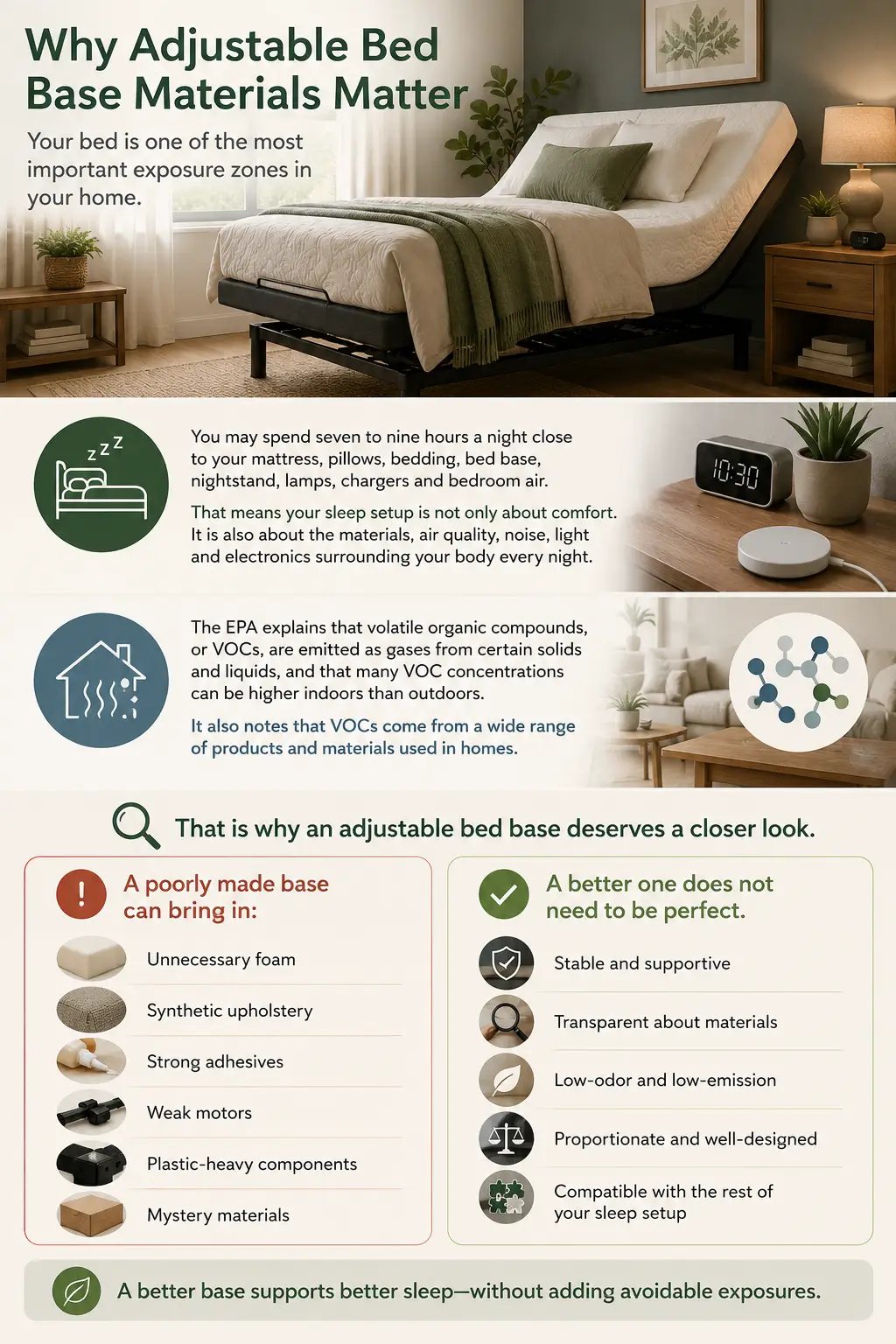
Your bed is one of the most important exposure zones in your home.
You may spend seven to nine hours a night close to your mattress, pillows, bedding, bed base, nightstand, lamps, chargers and bedroom air. That means your sleep setup is not only about comfort. It is also about the materials, air quality, noise, light and electronics surrounding your body every night.
The EPA explains that volatile organic compounds, or VOCs, are emitted as gases from certain solids and liquids, and that many VOC concentrations can be higher indoors than outdoors. It also notes that VOCs come from a wide range of products and materials used in homes.
That is why an adjustable bed base deserves a closer look.
A poorly made base can bring in unnecessary foam, synthetic upholstery, strong adhesives, weak motors, plastic-heavy components and mystery materials.
A better one does not need to be perfect. It simply needs to be stable, transparent, low-odor, proportionate and compatible with the rest of your sleep setup.
The Metal Frame: The Part That Matters Most for Durability
The structural skeleton of most adjustable bases is metal, often steel or reinforced steel.
From a Zero Toxic Load perspective, this is reassuring compared with material-heavy designs that rely heavily on foam, glued panels or soft synthetic padding. Metal is generally one of the lower-concern structural materials in a bed base because it is not a foam, fabric, adhesive or composite wood panel.
In most cases, if a new adjustable base smells strongly, the odor is more likely to come from upholstery, foam, adhesive, packaging or composite components than from the metal frame itself.
What to Look For
Look for:
- steel or reinforced metal frame construction
- clear weight capacity
- stable corners and legs
- smooth lifting movement
- no aggressive shaking when moving
- finished metal to reduce corrosion
- meaningful warranty
- replaceable parts where possible
A good adjustable base should feel calm, heavy and stable. It should not shake aggressively, creak loudly, or feel like a lightweight gadget pretending to be furniture.
What to Avoid
Be cautious with:
- vague “wood deck” or “platform” descriptions
- unclear weight limits
- wobbling at full elevation
- thin metal tubing
- weak legs
- no material details
- poor return policy
Composite wood is not automatically a dealbreaker, but it should be disclosed. If a base uses MDF, particleboard or engineered panels, the quality and emission profile matter.
If the product page does not explain what the platform is made from, that is worth asking before buying.
Foam and Upholstery: The Layer You Cannot Always See
Most adjustable bases are wrapped in a polyester-blend or synthetic fabric, often with a thin layer of foam underneath. This makes the base look more like furniture and less like a mechanical frame.
That can be beautiful, but this is where material questions become more nuanced.
Foam and upholstery are not automatically dangerous. The issue is that they are often poorly explained. Many brands use phrases like “premium fabric,” “eco foam,” “comfort padding,” or “clean design” without telling you what the material actually is.
Why Foam Matters
Polyurethane foam can release VOCs when new, especially in lower-quality products or when combined with strong adhesives. The reassuring part is that a bed base is not the same as a mattress. You are not sleeping directly on the base padding, and the amount of foam is usually smaller than what is found inside many mattresses.
Still, it matters because the bed base sits in your bedroom air for years.
CertiPUR-US certified foam is tested for specific content and emission criteria. Certified foams are made without formaldehyde, ozone depleters, certain phthalates regulated by the U.S. Consumer Product Safety Commission, mercury, lead and other heavy metals, and they meet low VOC emissions standards for indoor air quality.
What to Look For
Look for:
- CertiPUR-US foam where polyurethane foam is used
- low-VOC or emissions-tested materials
- minimal foam padding rather than thick mystery padding
- fabric that smells neutral after airing out
- transparent product specifications
- OEKO-TEX Standard 100 upholstery where available
OEKO-TEX Standard 100 is a textile label for products tested for harmful substances, from yarn to finished product. It does not mean the fabric is organic or plastic-free, but it is a useful textile safety signal.
Practical First Step After Delivery
When a new adjustable base arrives, air it out before sleeping on it.
A practical approach is to let it ventilate in a well-aired room for 48 to 72 hours if you notice any new-product smell. Open windows, keep packaging out of the bedroom, and do not make the bed fully until the initial odor has faded.
Some new-product smell can happen. A strong chemical odor that remains after several days is different, and it is worth taking seriously.
Adhesives and Glues: The Invisible Material Layer
Adhesives rarely get attention in adjustable bed base reviews, but they can matter.
They may be used to bond upholstery fabric, foam padding, backing layers and composite panels. In low-quality furniture, adhesives can be one reason a product smells strongly when new.
This does not mean all adhesives are bad. It means hidden adhesives should be part of your buying filter.
Better Signs
Look for:
- low-VOC claims that are specific
- GREENGUARD or GREENGUARD Gold certification where available
- clear material descriptions
- no strong chemical odor
- a clear return policy if odor is overwhelming
UL describes GREENGUARD Certification as a program focused on chemical emissions from products and materials, including indoor products. GREENGUARD Gold uses stricter criteria for sensitive environments.
Red Flags
Be careful with:
- “new smell is normal” with no further explanation
- strong solvent-like odor
- headache or throat irritation when near the product
- no ventilation guidance
- no certification or material transparency
- very vague eco language
The FTC warns that broad, unqualified environmental claims like “green” or “eco-friendly” can be difficult to substantiate and may mislead consumers if they are not specific and clearly qualified.
Motors: Useful, Enclosed, and Usually Not the Main Material Concern
Adjustable bases typically use linear actuator motors to move the head and foot sections.
From a material perspective, the motor itself is usually not the main low-toxin concern. It is typically an enclosed mechanical and electrical component, and you are not in direct contact with it. The more practical concerns are noise, reliability, smoothness, wiring, standby lights and whether the base adds more electronics than you actually need.
Some adjustable bed motor systems are similar in function to lifting mechanisms used in medical-style adjustable beds, but that does not mean every consumer adjustable base is medical-grade. For HH, that distinction matters.
What to Look For
Look for:
- smooth head and foot movement
- quiet operation
- no jerky lifting
- protected wiring
- clear reset instructions
- warranty coverage for motor components
- a remote that works without app dependency
What to Avoid
Be cautious with:
- loud motor complaints
- clicking, grinding or uneven lifting
- exposed wires
- no clear warranty terms
- app-only control
- under-bed lights that stay on
- no manual reset information
A motorized bed base should make the bedroom feel easier to use, not more stressful.
Electronics: Useful Features Versus Unnecessary Complexity
Modern adjustable bases may include:
- remote controls
- Bluetooth
- WiFi
- app control
- USB charging ports
- under-bed lighting
- massage vibration
- zero gravity presets
- anti-snore presets
- memory settings
- sleep tracking integrations
Some of these features are useful. Some are marketing.
The Zero Toxic Load question is simple:
Does this feature genuinely support your sleep, or does it add more stimulation to the room where your body is supposed to recover?
My Low-Exposure Approach to Electronics
For most people, I would prioritize:
- physical remote over app dependency
- no required WiFi setup
- simple controls
- ability to turn off lights
- no unnecessary glowing buttons
- tidy cords away from the pillow area
- no phone charging beside the head
- optional smart features rather than always-on smart features
This is not about fear. It is about designing a bedroom that feels calm.
If you are building a lower-electronics bedroom more intentionally, read our guide to EMF, motors and remote controls in smart beds.
CE, RoHS and Electrical Safety
Because adjustable bed bases include electrical components, product safety and compliance matter.
For EU buyers, CE marking means the manufacturer indicates that a product meets applicable EU requirements where CE rules apply. It is not the same as an independent luxury or quality award, and the manufacturer is responsible for compliance.
RoHS is also relevant for electrical and electronic equipment in the EU because it restricts certain hazardous substances in electrical and electronic products to help protect public health and the environment.
When buying an adjustable base, especially internationally, look for clear electrical compliance information, safe plug compatibility, protected wiring and warranty support in your region.
Massage Vibration: Useful Tool, Optional Feature
Many adjustable bases include vibration massage in the head and foot zones.
This can be genuinely useful for some sleepers as a wind-down tool. But it is also optional, and it is not equally calming for everyone.
Some people with a sensitive nervous system, high stress levels, or a body that stays alert easily may find vibration more activating than soothing. If that sounds like you, choose a base where massage can be ignored completely or turned off easily.
What to Look For
If massage matters to you, look for:
- separate head and foot zones
- adjustable intensity
- auto shutoff
- quiet vibration
- easy off button
- no forced app control
What to Remember
Massage is a comfort feature. It is not the foundation of a good adjustable bed base.
The foundation is still structure, stability, quiet movement, mattress compatibility and materials.
Heat and Airflow: A Smaller Factor Than the Mattress, But Still Worth Checking
An adjustable base does not usually create the same heat issues as a mattress, but it can influence airflow beneath your mattress.
A breathable, open-frame base may allow more ventilation. A heavily upholstered, padded, or fully enclosed platform can reduce airflow, especially when paired with a thick memory foam mattress.
If you sleep hot, the base is only one part of the picture. The mattress, bedding, room temperature, pajamas and ventilation matter more.
For that part of the sleep system, read our guide to choosing a cooling memory foam mattress.
Where This Article Fits in Your Sleep Setup
This article is the material lens. Use it before you compare models.
| If You Are Asking | Read This Next |
| Which adjustable base should I buy? | Best adjustable bed base |
| Is Nectar a good value? | Nectar adjustable base review |
| Will my mattress work with an adjustable frame? | Best mattress for adjustable base |
| Do I really need an adjustable base? | Adjustable bases vs traditional frames |
| Are smart beds too much electronics? | EMF, motors and remote controls in smart beds |
| How do I build a full recovery sleep setup? | Adjustable base, cooling mattress and sleep tracker stack |
This structure keeps the article focused. It explains the materials, then sends readers to the right buying or support guide.
Certifications That Actually Help
No certification is perfect. A label does not automatically make a product ideal. But third-party standards can help separate real material testing from vague marketing.
| Certification or Mark | Useful For | What It Does Not Mean |
| CertiPUR-US | Flexible polyurethane foam content and emissions | It does not certify the whole bed base |
| GREENGUARD or GREENGUARD Gold | Chemical emissions from products and materials | It does not mean zero emissions |
| OEKO-TEX Standard 100 | Textiles tested for harmful substances | It does not mean organic or plastic-free |
| RoHS | Restricted hazardous substances in electronics | It does not assess comfort or sleep quality |
| CE marking | EU compliance where applicable | It is not an independent quality award |
The best approach is to look for certification plus transparency plus your own sensory experience.
If a product has great claims but smells terrible, feels flimsy, hides its materials, or gives no meaningful warranty, that matters.
My Zero Toxic Load Buying Checklist
Before choosing an adjustable base, work through these questions.
1. Is the Frame Strong Enough?
Look for strong metal construction, clear weight capacity and a meaningful warranty.
A frame that lasts for years is not just a durability win. It also reduces waste and avoids replacing large furniture too often.
2. Is There Unnecessary Foam?
A small amount of padding is fine. Thick, uncertified foam under synthetic fabric with no material disclosure is not ideal.
3. Does It Smell Strong After Unboxing?
Some new-product smell can happen. A strong chemical odor that remains after several days of ventilation is a meaningful signal.
4. Are the Materials Disclosed?
A trustworthy brand should explain its frame, upholstery, platform, foam, electrical components and certifications clearly enough for you to make an informed decision.
5. Are the Electronics Proportionate?
Choose the features you will actually use.
For most people, the core features are simple:
- head elevation
- foot elevation
- quiet motor
- reliable remote
- stable frame
- mattress compatibility
Everything beyond that should earn its place.
6. Does It Match Your Mattress?
Not every mattress is compatible with adjustable movement.
Memory foam, latex and many hybrid mattresses often work well, but rigid innerspring mattresses may not bend properly. Always check mattress compatibility before buying the base.
7. Is the Return Policy Clear?
An adjustable base is heavy and expensive. Make sure you understand returns, trial periods, restocking fees, warranty terms and who handles pickup if the product does not work for you.
When an Adjustable Base Is Worth It
An adjustable base may be worth it if you:
- read in bed regularly
- want better head or leg elevation
- share a bed with someone who prefers a different position
- are considering a Split King setup
- want more flexibility as you age
- are building a recovery-focused bedroom
- have a compatible mattress
- will genuinely use the features
For some sleepers, head or leg elevation may make rest feel more comfortable, especially when a flat position feels restrictive.
But it is important to be honest: an adjustable bed base is not medical treatment. Chronic reflux, pain, snoring, breathing issues or sleep apnea should be discussed with a qualified clinician.
This article stays focused on materials. A separate guide can go deeper into sleep positions for reflux, back pain and snoring.
When You May Not Need One
You may not need an adjustable base if you:
- sleep well on your current flat setup
- do not need elevation
- have a mattress that is not compatible
- dislike electronics in the bedroom
- would get more benefit from a better mattress
- prefer a simple, non-motorized frame
- know you will not use the adjustable features
A low-toxin home is not about buying every upgrade. It is about choosing the upgrades that genuinely improve daily life.
What Adjustable Bed Base Materials Cannot Do
Better materials matter, but they cannot solve everything.
An adjustable bed base cannot:
- make a poor mattress suddenly low-toxin
- remove VOCs from the rest of the bedroom
- guarantee better sleep in a hot, bright or noisy room
- replace medical care for chronic reflux, pain, snoring or breathing issues
- make wireless features necessary for recovery
- compensate for a weak frame
- fix an incompatible mattress
- turn vague eco claims into proof
This is why I like proportionate upgrades.
A good adjustable base can support a more functional bedroom. But it should sit inside a larger sleep environment that also considers mattress materials, airflow, light, electronics, bedding and daily routines.
Best Material Profile for a Low-Toxin Adjustable Bed Base
The ideal adjustable bed base is not necessarily the most expensive one.
A strong low-toxin profile would look like this:
- steel or reinforced metal frame
- minimal foam padding
- low-odor upholstery
- low-VOC certifications where available
- quiet motor
- simple remote
- no required app control
- no unnecessary wireless features
- clear electrical compliance
- compatible with a breathable mattress
- easy to clean around
- no strong smell after airing out
That is the kind of base that supports the bedroom without turning it into a gadget zone.
My Final Recommendation
If I were choosing an adjustable bed base through a Zero Toxic Load lens, I would not start with the longest feature list.
I would start with the structure.
First, I would look for a strong metal frame with clear weight capacity and smooth, quiet movement. Then I would check the upholstered layers: what certifications exist, does the product smell neutral after airing out, and what is the foam actually made from?
After that, I would look at the electronics and ask whether each feature genuinely supports sleep or simply adds more complexity to the bedroom.
For most people, the best adjustable bed base is not the most advanced one. It is the one that gives comfortable elevation, stable support, quiet movement, simple controls, mattress compatibility and a calmer bedroom.
Ready to compare models? Go to our full best adjustable bed base guide. If you are looking specifically at Nectar, read our Nectar adjustable base review. If your mattress is the bigger question, read our guide to the best mattress for an adjustable base before you buy anything.
FAQ: Adjustable Bed Base Materials
What is the best material for an adjustable bed base?
A strong steel or reinforced metal frame is usually the best foundation for durability and stability. From a low-toxin perspective, metal is generally lower concern than thick foam, heavily glued composite panels or mystery upholstery.
Are adjustable bed bases toxic?
Not automatically. The risk depends on the specific materials used, including foam padding, upholstery, adhesives, composite panels and electronics. Choose a base with transparent material disclosure, low-VOC certifications where available, simple electronics and no strong chemical smell after unboxing.
Do adjustable bed bases off-gas?
Some can, especially models with foam padding, synthetic upholstery, adhesives or composite panels. If you notice a new-product smell, air the base out in a ventilated room before sleeping on it. If a strong odor remains after several days, that is worth taking seriously.
Is CertiPUR-US foam enough?
CertiPUR-US is useful for polyurethane foam, but it covers only the foam itself. It does not certify the frame, upholstery, adhesives, electronics or the entire adjustable base. Treat it as one useful data point, not the full answer.
Is OEKO-TEX upholstery better?
OEKO-TEX Standard 100 is useful because it means the textile has been tested for harmful substances. But it does not mean the fabric is organic, plastic-free or natural. It is a safety signal, not a complete sustainability claim.
Should I worry about EMF from an adjustable bed base?
A balanced approach is best. You do not need to panic, but it is reasonable to choose simple electronics, avoid unnecessary wireless features, keep cords tidy and avoid charging your phone beside your head. If this matters to you, choose a base that works well with a simple remote and does not require app control.
Can any mattress go on an adjustable base?
No. The mattress needs to flex and bend with the base. Memory foam, latex and many hybrid mattresses often work well. Rigid innerspring mattresses may not. Always check compatibility before purchasing either product.
Does an adjustable base make a mattress sleep hotter?
The base is rarely the primary heat source, but a heavily enclosed or padded platform can reduce airflow beneath the mattress. If heat is your main concern, focus first on mattress materials, breathable bedding, room temperature and ventilation.
Are massage features worth it?
Massage features can be useful for some people as a wind-down tool, but they are optional. If you have a sensitive nervous system or find vibration stimulating, choose a base where massage can be turned off completely.
What should I always check before buying?
Check the frame material, weight capacity, upholstery details, foam certifications, odor after unboxing, warranty, return policy, motor noise, electronics, and whether your mattress is compatible.
Final Thoughts
An adjustable bed base can be a meaningful upgrade when it is chosen well.
But the best one is not the one with the longest feature list. It is the one that supports your body, works with your mattress, fits your sleep environment, and does not add unnecessary complexity to the room where your nervous system is supposed to rest.
Through a Zero Toxic Load lens, the goal is simple:
Choose a strong frame. Keep foam and adhesives minimal. Look for transparent materials. Choose proportionate electronics. Make sure the motor is quiet. Pair the base with a compatible mattress. And create a bedroom that feels like a recovery space, not a showroom.
That is the real upgrade.