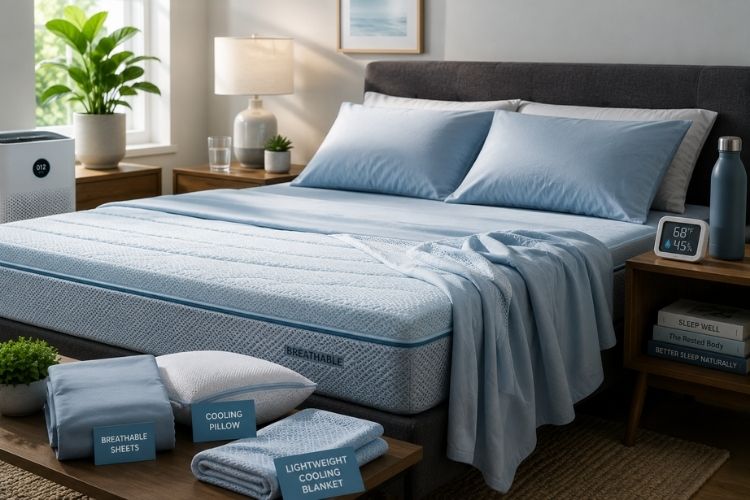
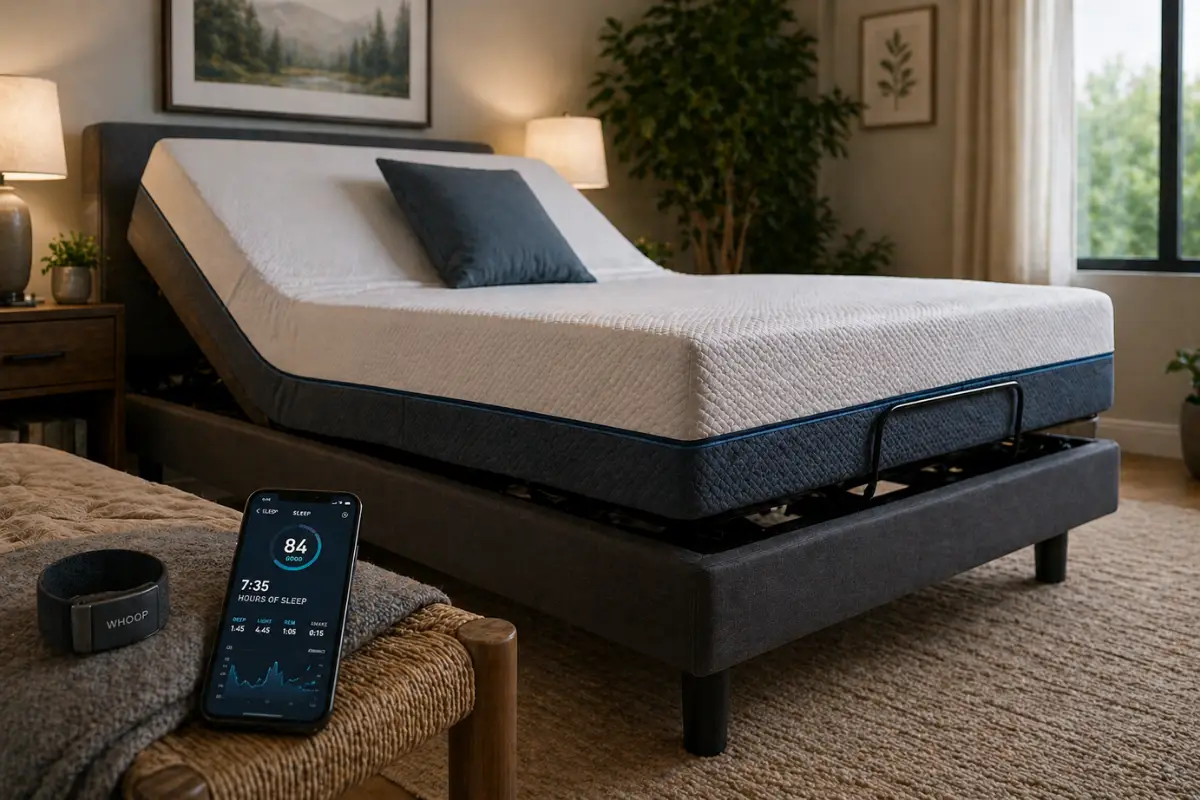
When the right pieces come together, a bedroom can genuinely feel like a recovery space, not just a room with a bed.
An adjustable base can help your body find a more comfortable position. A cooling mattress can help the sleep surface feel fresher and less heat trapping. A sleep tracker can help you notice patterns, so you can make calmer, more informed choices about your routine.
The best sleep recovery stack is not about buying every sleep gadget. It is about choosing the right layers for your real needs.
If elevation helps you relax, an adjustable base may be a smart upgrade. If heat wakes you up or makes sleep feel restless, a cooling mattress may be worth prioritizing. If you like data and use it calmly, a sleep tracker can help you understand what supports better rest.
From a Zero Toxic Load perspective, the goal is a bedroom that feels supportive, clean, calm, and easy to recover in. The best stack should improve comfort without adding unnecessary light, noise, cords, odors, app overload, or mental clutter.
If you are comparing adjustable bases, my full buying guide to the best adjustable bed bases is here: Elevate Your Sleep: The 5 Best Adjustable Bed Bases
Also in This Article
What Is a Sleep Recovery Stack?
A sleep recovery stack is a thoughtful combination of tools that help your bedroom support deeper, calmer rest.
In this article, the stack includes three main layers:
- Adjustable base
- Cooling mattress
- Sleep tracker
Each layer has its own role.
The adjustable base supports position. The cooling mattress supports temperature comfort. The sleep tracker supports awareness.
Together, they can create a more complete sleep setup, especially for people who want their bedroom to work harder for recovery, relaxation, and daily energy.
The key is intention.
A good recovery stack should feel supportive, not complicated. It should make your bedroom feel calmer, more comfortable, and easier to use, not more crowded with features you never touch.
The goal is not more technology.
The goal is better rest with smarter choices.
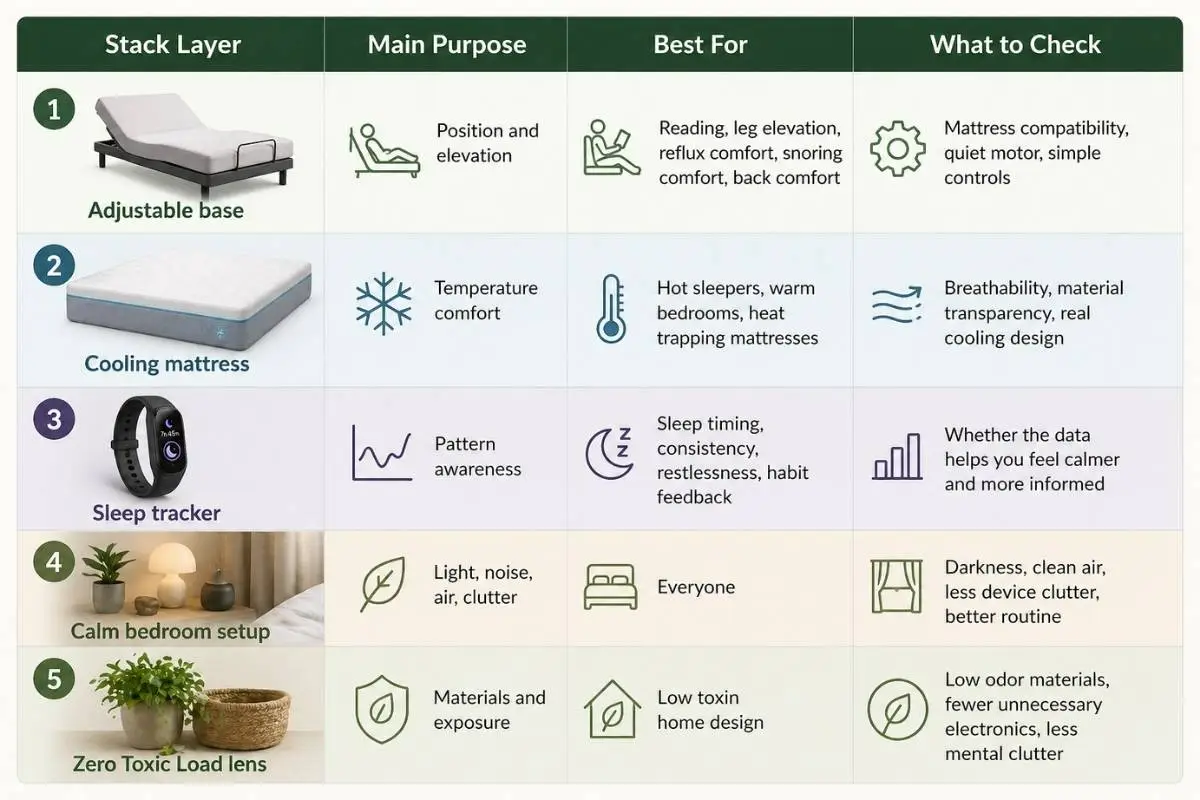
Quick Comparison
| Stack Layer | Main Purpose | Best For | What to Check |
| Adjustable base | Position and elevation | Reading, leg elevation, reflux comfort, snoring comfort, back comfort | Mattress compatibility, quiet motor, simple controls |
| Cooling mattress | Temperature comfort | Hot sleepers, warm bedrooms, heat trapping mattresses | Breathability, material transparency, real cooling design |
| Sleep tracker | Pattern awareness | Sleep timing, consistency, restlessness, habit feedback | Whether the data helps you feel calmer and more informed |
| Calm bedroom setup | Light, noise, air, clutter | Everyone | Darkness, clean air, less device clutter, better routine |
| Zero Toxic Load lens | Materials and exposure | Low toxin home design | Low odor materials, fewer unnecessary electronics, less mental clutter |
Start With What Would Make Sleep Feel Better
A recovery stack works best when you begin with one simple question:
What would make my bedroom feel more supportive?
For some people, the answer is position. They feel better when their head is slightly elevated, when their legs are raised, or when they can read comfortably without stacking pillows.
For others, the answer is temperature. They wake up warm, feel trapped in a hot mattress, or keep changing covers through the night.
For others, the answer is awareness. They want to understand whether bedtime, caffeine, late meals, light exposure, stress, or room temperature is affecting their sleep.
This is where the stack becomes useful.
The product is not the starting point. The feeling you want to create is the starting point.
The Role of an Adjustable Base
An adjustable base is the positioning layer of the stack.
It can raise the head, raise the legs, or create a more supported resting position. Some models also include zero gravity presets, massage, under bed lighting, app control, USB ports, or split partner settings.
For most people, the most valuable adjustable base features are the simple ones:
- Head elevation
- Foot elevation
- Flat preset
- Memory position
- Quiet motor
- Stable support
- Mattress compatibility
- Simple remote
The base becomes useful when it helps your body settle more comfortably.
It may be a strong upgrade if you use extra pillows to sit up, read in bed, raise your legs, or create a better resting angle. It can also be helpful for couples if one person prefers elevation and the other prefers a flatter position.
This is where an adjustable base can genuinely improve the bedroom. It gives the bed more flexibility without requiring you to change your whole sleep routine.
The Role of a Cooling Mattress
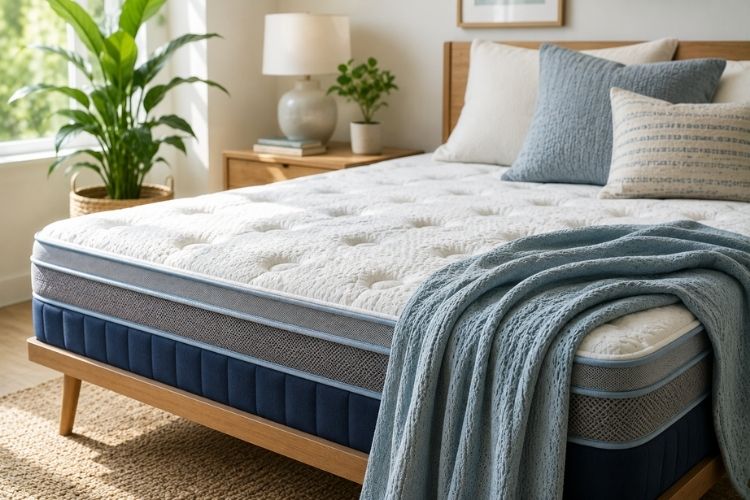
A cooling mattress is the temperature layer of the stack.
Temperature is one of the most overlooked comfort factors in sleep. A mattress can feel supportive and well made, but if it traps heat, sleep can still feel restless.
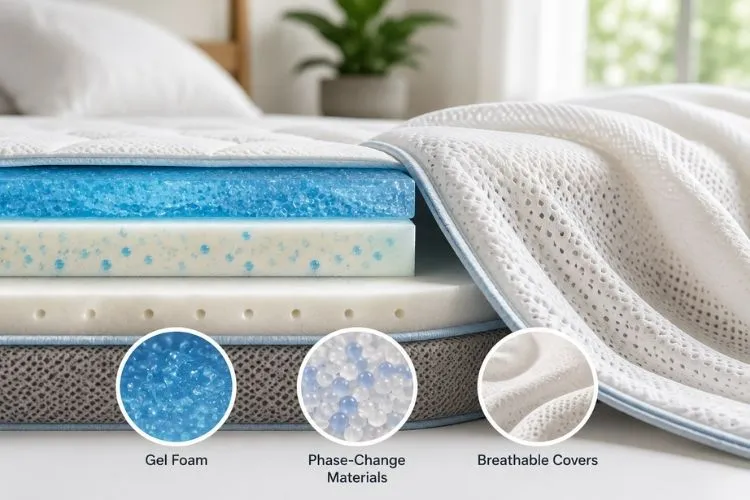
Cooling mattresses and cooling sleep materials may use:
- Breathable covers
- Latex
- Coils for airflow
- Gel infused foam
- Phase change materials
- Wool
- Cotton
- Tencel or other breathable fabrics
- Ventilated foam
- Hybrid designs with airflow
The important thing is not only the word “cooling.”
The important thing is how the mattress handles heat in real life.
A better cooling setup can make the bed feel fresher, lighter, and more comfortable through the night. For hot sleepers, this can be one of the most noticeable upgrades in the entire bedroom.
A cooling mattress works especially well when it is paired with breathable bedding, a good room temperature, and a mattress protector that does not trap heat.
Cooling Mattress and Adjustable Base Compatibility
An adjustable base and a cooling mattress can work beautifully together, but they need to be compatible.
A mattress must be flexible enough to bend with the base without damaging its structure. Many foam, latex, and hybrid mattresses are adjustable base compatible, but it is always worth checking before buying.
Before pairing a cooling mattress with an adjustable base, check:
- Is the mattress adjustable base compatible?
- Does the warranty allow adjustable base use?
- Is the mattress flexible enough to bend properly?
- Does the cooling layer stay stable when the base moves?
- Does the mattress stay in place when elevated?
- Does the base have a retainer bar or anti slip surface?
This is where the stack becomes a system.
A great adjustable base feels better when the mattress moves with it naturally. A great cooling mattress performs better when it supports your body and temperature without sliding, bunching, or feeling awkward in elevated positions.
The Role of a Sleep Tracker
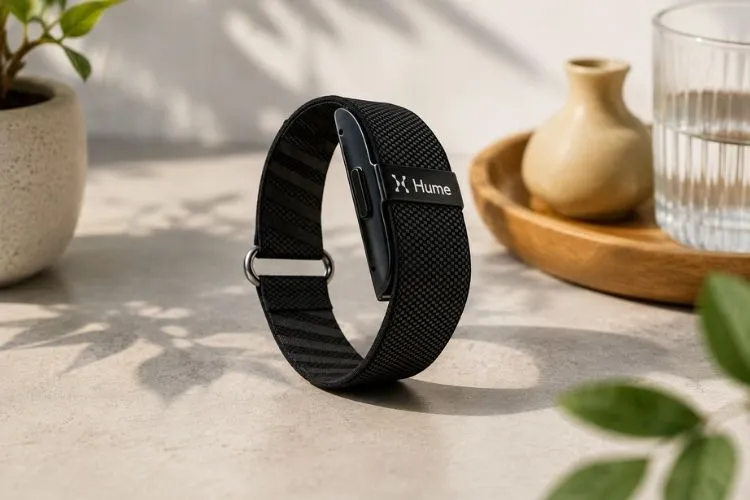
A sleep tracker is the feedback layer of the stack.
It can help you notice patterns in your sleep timing, restlessness, bedtime consistency, wake time, heart rate trends, movement, or recovery score depending on the device.
This can be useful when the data helps you make simple, calmer choices.
For example, a tracker may help you notice that you sleep better when:
- You stop caffeine earlier
- You go to bed at a consistent time
- The room is cooler
- You avoid late heavy meals
- You get morning light
- You reduce screen time before bed
- You avoid alcohol close to bedtime
- You keep the bedroom darker
- You use a slightly elevated sleep position
That kind of feedback can be valuable.
The best use of a sleep tracker is not to judge yourself. It is to notice patterns that help you build a better routine.
A tracker should support your sleep, not become the center of it.
Are Sleep Trackers Accurate Enough to Build a Recovery Stack?
Sleep trackers can be useful, but they are not perfect measurement tools.
Most consumer sleep trackers estimate sleep patterns using signals such as movement, heart rate, skin temperature, breathing patterns, or timing. That can give helpful trend information, but it does not mean the device knows everything happening in your body.
This matters because a recovery stack should not be built around one number.
A sleep tracker may help you notice patterns over time, such as whether a cooler room, earlier bedtime, less alcohol, or a different bed position seems to improve your rest. That is useful.
But one score should not decide how you feel about your night.
Use sleep data as a guide, not a verdict.
The best question is not only, “What did my score say?”
The better question is, “What pattern is this showing me, and does it match how I actually feel?”
My Own View on Sleep Tech
I like sleep technology when it helps remove friction.
I like the idea of a bedroom that supports the body more intelligently. A bed that can lift slightly for reading, a mattress that feels cooler, or a tracker that helps you understand your rhythm can all be useful when they make rest easier.
For me, a healthy bedroom should still feel quiet. The bed should support the body. The materials should feel clean. The air should feel fresh. The light should be low. The phone should not be the first thing my hand reaches for.
That does not mean a bedroom has to be technology free. It means every piece of technology should earn its place in a good way.
An adjustable base can earn its place if it helps with position. A cooling mattress can earn its place if heat is disturbing sleep. A tracker can earn its place if it helps you see patterns and make calmer choices.
The best sleep tech does not make the bedroom feel busier.
It makes rest feel easier.
The Best Order to Build a Recovery Stack
The best recovery stack is usually built one layer at a time.
A smart order looks like this:
- First, make the bedroom calm.
- Second, make sure the mattress supports your body.
- Third, solve temperature problems.
- Fourth, add position support if needed.
- Fifth, use tracking if it helps you understand patterns.
That order matters because many sleep upgrades work better when the basics are already in place.
A cool, dark, quiet bedroom makes every sleep product work harder. A supportive mattress makes an adjustable base feel better. A calmer evening routine makes sleep tracking more meaningful.
Build the stack slowly.
Let each layer make the room feel better.
Layer 1: The Calm Bedroom Foundation
Before building a sleep tech stack, make the bedroom itself easier to sleep in.
Focus on:
- Darkness
- Cooler temperature
- Clean air
- Low noise
- Comfortable bedding
- Less clutter
- Fewer lights
- Phone charging away from the bed
- Low odor materials
- Good airflow
This is the foundation.
A calm bedroom makes every other upgrade more effective. Even the best adjustable base or cooling mattress will feel better in a room that is dark, fresh, and easy to relax in.
The simplest changes often create the strongest feeling of recovery.
Layer 2: Mattress Support and Temperature
The mattress is still the most important sleep surface.
A good mattress should support your body, feel comfortable in your preferred sleep position, and help you stay at a better temperature through the night.
A good cooling mattress should do two things:
Support your body properly
Reduce heat buildup enough for your sleep style
For a Zero Toxic Load bedroom, also consider:
- Material transparency
- Low VOC certifications
- Natural or cleaner material options
- Whether the mattress has a strong smell
- Whether the foam content is necessary
- Breathability
- Durability
- Return policy
Cooling should feel clean and comfortable, not mysterious or overly chemical.
A mattress with breathable materials, clear certifications, and good airflow can become the center of a stronger recovery setup.
Layer 3: Adjustable Positioning
Once the mattress is right, an adjustable base can add more control.
This is where you ask:
- Do I sleep better elevated?
- Do I read or relax in bed often?
- Do I like leg elevation after long days?
- Do I use pillows to prop myself up?
- Would a split setup help my partner and me sleep better?
- Does zero gravity positioning feel genuinely better?
If the answer is yes, an adjustable base can be a meaningful upgrade.
The base should make the bed more useful, more comfortable, and more flexible. It should help your body find the position that feels easiest for rest.
That is when adjustable bases make the most sense.
Complete recovery blueprint: adjustable bases, cooling mattresses and sleep trackers recovery stack guide
Layer 4: Sleep Tracking
Sleep tracking works best when it supports the basics, not when it replaces them.
A tracker can help you understand patterns, but it should still work with common sense and body awareness.
Use a tracker to ask practical questions:
- Did I sleep better when the room was cooler?
- Did late caffeine affect my sleep?
- Did I wake less when I went to bed earlier?
- Did my recovery score improve when I walked outside during the day?
- Did alcohol or late meals affect restlessness?
- Did the adjustable base position make a difference?
That kind of tracking can be helpful because it turns vague sleep problems into clearer patterns.
The best sleep tracker is not the one that gives you the most numbers.
It is the one that helps you make better choices without adding pressure.
When the Full Stack Works Beautifully
A full recovery stack can work beautifully when each part has a clear job.
It may be worth building if:
- You sleep hot
- You enjoy a cooler sleep surface
- You benefit from elevation
- You read or relax in bed often
- You like data and use it calmly
- You are already upgrading your mattress
- You want a more recovery focused bedroom
- You share a bed with different comfort needs
- You want to understand which habits affect sleep
- You are willing to keep the setup simple
In this kind of setup, the pieces support each other.
The mattress helps with cooling and comfort. The base helps with position. The tracker helps you understand patterns. The bedroom environment supports calm.
That is when the stack feels less like technology and more like a well designed recovery system.
When to Keep the Stack Simple
A recovery stack does not have to include every possible product.
Sometimes the best version is simple:
- A supportive cooling mattress
- A clean traditional frame
- A dark bedroom
- Good bedding
- No tracker
Other times it may be:
- A compatible mattress
- A simple adjustable base
- No app control
- No sleep tracker
And for some people, the full version makes sense:
- Cooling mattress
- Adjustable base
- Sleep tracker
- Low light
- Good air
- Simple evening routine
The right stack is the one that helps you sleep better and feel calmer.
The goal is not maximum technology.
The goal is maximum usefulness.
Zero Toxic Load Lens: The Whole Stack Matters
The Zero Toxic Load lens applies to the full stack, not just one product.
With adjustable bases, think about:
- Motors
- Wiring
- Fabric covering
- Foam padding
- Adhesives
- Under bed lights
- Remote controls
- App control
- Off gassing
Noise
With cooling mattresses, think about:
- Foam density
- Cover materials
- Flame retardant approach
- Certifications
- Breathability
- Odor after unpacking
- Synthetic cooling treatments
- Durability
With sleep trackers, think about:
- Do you need it on your body?
- Does it require charging beside the bed?
- Does it use Bluetooth overnight?
- Does the data actually help?
- Does it make your routine feel calmer?
A low toxin recovery stack is not only about materials. It is also about reducing unnecessary inputs to the body and mind.
The best stack supports recovery on every level: comfort, air, light, materials, temperature, and mental calm.
Upgrade justification: adjustable bases vs traditional frames – when sleep quality actually improves
EMF and Sleep Tracking in the Stack
If you are building a low exposure bedroom, sleep trackers deserve a thoughtful look.
Some trackers are worn on the wrist or finger. Some sit under the mattress. Some connect through Bluetooth or WiFi. Some require apps and nightly syncing.
This does not mean you need to avoid them. It means you can choose how much tracking belongs in your bedroom.
Ask:
- Do I need overnight tracking every night?
- Can I use airplane mode or offline features?
- Do I feel calmer with the data?
- Can I charge the device away from the bed?
- Am I already using another tracker?
- Is the information changing my habits?
If a tracker helps you notice patterns and improve your routine, it may be useful.
If you prefer a simpler bedroom, occasional tracking may be enough.
Low-EMF foundation first: EMF, motors, and remote controls – how smart beds fit low-exposure bedrooms
Cooling Without Overcomplicating the Bed
You do not always need a high tech cooling mattress to sleep cooler, but cooling comfort is absolutely worth taking seriously.
Before replacing your mattress, also consider:
- Room temperature
- Breathable sheets
- Wool or cotton bedding
- A lighter duvet
- Better airflow
- A breathable mattress protector
- Cooling pillow options
- Reducing heat trapping synthetic bedding
- Keeping electronics away from the sleep area
Sometimes the mattress is the biggest factor. Sometimes the bedding is. Sometimes the room temperature is.
A good recovery stack looks at the whole system.
When everything works together, sleep can feel lighter, fresher, and less restless.
Adjustable Base Plus Cooling Mattress: Best Use Cases
The combination of an adjustable base and cooling mattress is strongest when both position and temperature matter.
It may be especially useful if:
- You sleep hot and benefit from elevation
- You read in bed and get warm from stacked pillows
- You use memory foam but dislike heat buildup
- You want leg elevation without heavy bedding
- You share a bed with different comfort needs
- You want a more flexible recovery setup
- You spend time in bed resting, reading, or recovering
This pairing can feel very different from a traditional bed.
The mattress supports temperature comfort. The base supports body position. Together, they can make the bed feel more personal, more flexible, and more supportive.
This is one of the strongest combinations in a sleep recovery stack.
Adjustable Base Plus Sleep Tracker: Best Use Cases
The combination of an adjustable base and sleep tracker is useful if you want to understand how position affects your sleep.
For example, you might compare:
- Flat position
- Slight head elevation
- Leg elevation
- Zero gravity position
- Reading upright before sleep
- Phone away from bed
- Cooler bedroom temperature
A tracker may help you notice patterns across several nights.
The value here is not perfection. It is awareness.
You may discover that a slight incline helps you settle more comfortably. Or that leg elevation feels best after long days. Or that your sleep score is less important than how rested you feel.
Use sleep tracking as a pattern tool, not a verdict.
Cooling Mattress Plus Sleep Tracker: Best Use Cases
A cooling mattress and sleep tracker can work well together if you are trying to understand temperature and restlessness.
You might track whether you wake less often when:
- The room is cooler
- You use lighter bedding
- You change mattress protector
- You switch to breathable sheets
- You reduce late meals
- You use a cooling mattress
- You stop charging devices near the bed
- You keep lights lower in the evening
The tracker may help you see whether cooling changes actually improve your sleep pattern.
But your own experience still matters. If you feel better, that counts too.
The best outcome is when data confirms what your body already feels: sleep is calmer, cooler, and easier.
Full Stack Decision Guide
Use this guide before buying.
Choose a simple mattress and frame if:
- You sleep well already
- You want a low tech bedroom
- You prefer fewer electronics
- You do not need elevation
- You do not sleep hot
- You dislike tracking
- You are prioritizing budget
Choose an adjustable base plus mattress if:
- You need position support
- You sleep better elevated
- You read or rest in bed often
- You want leg elevation
- Your mattress is compatible
- You want a flexible sleep surface
- You want comfort without too much technology
Choose a full stack if:
- You sleep hot
- You benefit from elevation
- You enjoy calm data tracking
- You want to test habits and patterns
- You are willing to keep devices minimal
- You can avoid app overload
- You want a structured recovery bedroom
The full stack is powerful when each layer has a purpose.
How to Keep the Stack Calm
If you build a full recovery stack, keep it beautiful and simple.
- Use a simple adjustable base.
- Choose a cooling mattress with clear materials.
- Use app control only if it genuinely helps.
- Charge devices away from the bed.
- Turn off under bed lights fully.
- Use sleep tracking as feedback, not judgment.
- Keep cords away from the pillow area.
- Avoid bright screens before sleep.
- Air out new products before sleeping on them.
- Remove any feature that makes the room feel busy.
This is how the stack stays supportive instead of overwhelming.
A good sleep setup should feel like relief.
My Honest Take
A full recovery stack can be genuinely useful when it is built with restraint.
I like the combination of an adjustable base and cooling mattress when the person actually needs both position support and temperature comfort. That pairing can make the bed feel more functional, more personal, and less frustrating.
I am more selective with sleep trackers. They can be helpful, especially for seeing patterns, but they should make your routine calmer, not more tense.
The healthiest stack is not the one with the most devices.
It is the one that helps your body feel safe enough to rest.
That may be a simple mattress and frame. It may be an adjustable base and cooling mattress. Or it may be the full stack.
The right choice is the one that makes your bedroom feel better.
Final Thoughts
Pairing an adjustable base with a cooling mattress and sleep tracker can create a strong recovery stack when each layer solves a real problem.
- The adjustable base supports position.
- The cooling mattress supports temperature comfort.
- The sleep tracker supports awareness.
- The bedroom environment supports calm.
When those pieces work together, the bed becomes more than furniture. It becomes part of a recovery routine.
The key is to choose with intention.
Before buying, ask:
- What would make my sleep feel better?
- Which layer solves that best?
- Will this make my bedroom calmer?
- Will I actually use this feature?
- Does this support rest in a real way?
If the answer is clear, the stack may be worth building.
If you are ready to compare adjustable bases, see my full guide to the best adjustable bed bases here:
[Insert internal link to “Elevate Your Sleep: The 5 Best Adjustable Bed Bases”]