Choose Airthings Corentium Home 2 for everyday radon tracking, Ecosense EcoQube for remote access, or Aranet Radon Plus for frequent updates. If you prefer a straightforward display without an app, Ecosense EcoBlu is the simpler choice.
A continuous radon monitor helps you understand exposure over time, rather than judge your home by one reading. You don’t need the most expensive model, but you do need the right combination of measurement, history and connectivity.
Start with how you’ll use the readings, then choose the monitor that fits.
Compare the four monitors at a glance
These four options cover different household routines.
| Product | Best for | Key documented feature | Main trade-off |
|---|---|---|---|
| Airthings Corentium Home 2 | Everyday app-supported tracking | 60-minute radon sampling and Bluetooth | No direct Wi-Fi remote access without a compatible Airthings hub |
| Ecosense RadonEye RD200 | Fast readings at a good value | OLED display, Bluetooth app and 10-minute updates | No Wi-Fi remote access |
| Ecosense EcoQube | Checking an occupied or rental home remotely | Wi-Fi app access, 10-minute updates and C-NRPP approval | Needs power and Wi-Fi |
| Ecosense EcoBlu | Simple in-room readings | Built-in display and 10-minute updates | No app or connected dashboard |
| Aranet Radon Plus | Battery-powered monitoring | Initial reading in 10 minutes and ±8% accuracy for 24-hour, 7-day and 30-day averages | Premi |
Radon is a naturally occurring radioactive gas that seeps up from the ground into homes. You can’t see or smell it, so the only way to know your level is to measure it. The EPA estimates that radon causes about 21,000 lung cancer deaths in the US every year, and it is the leading cause of lung cancer among non-smokers. A continuous monitor shows you how your levels change over days and seasons, so you know when to act.
A continuous radon monitor measures conditions; it doesn’t remove radon. Keep that distinction in mind when deciding how much to spend on monitoring versus addressing elevated levels.
Best connected continuous radon monitors
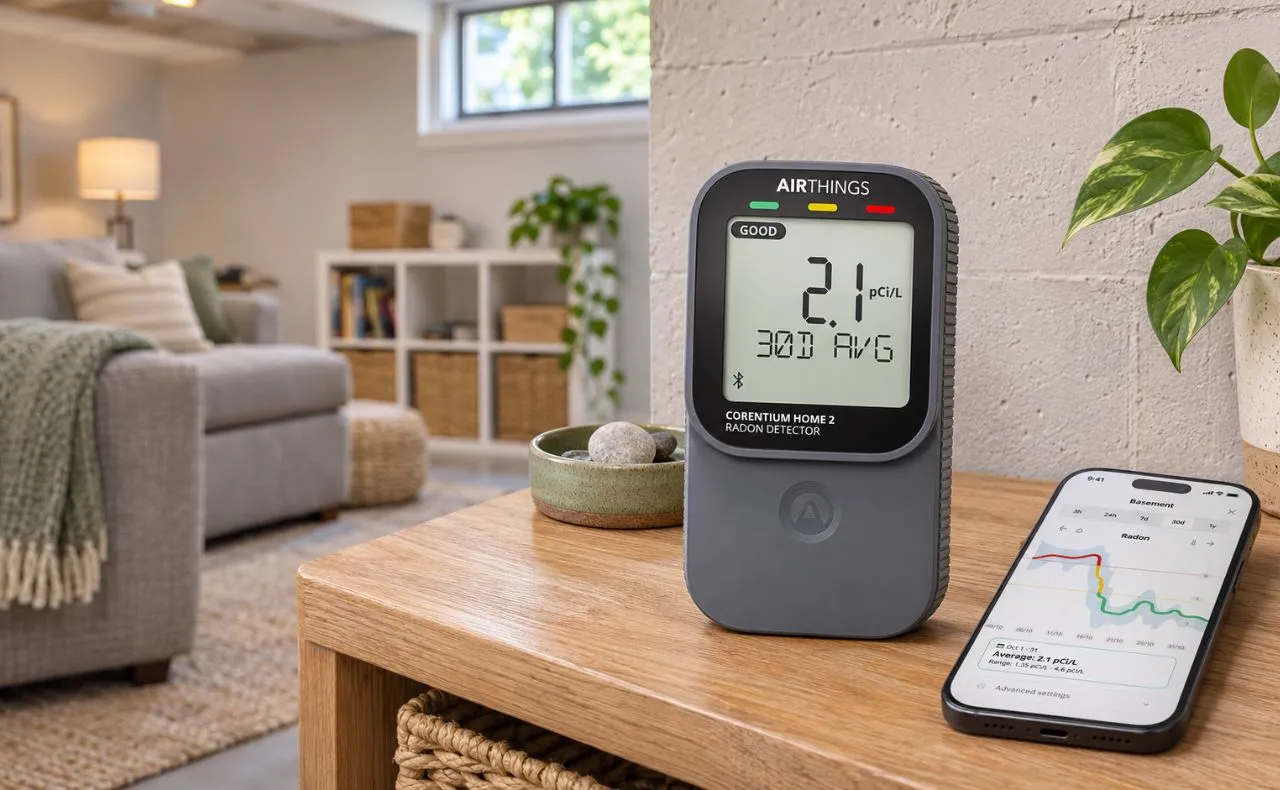
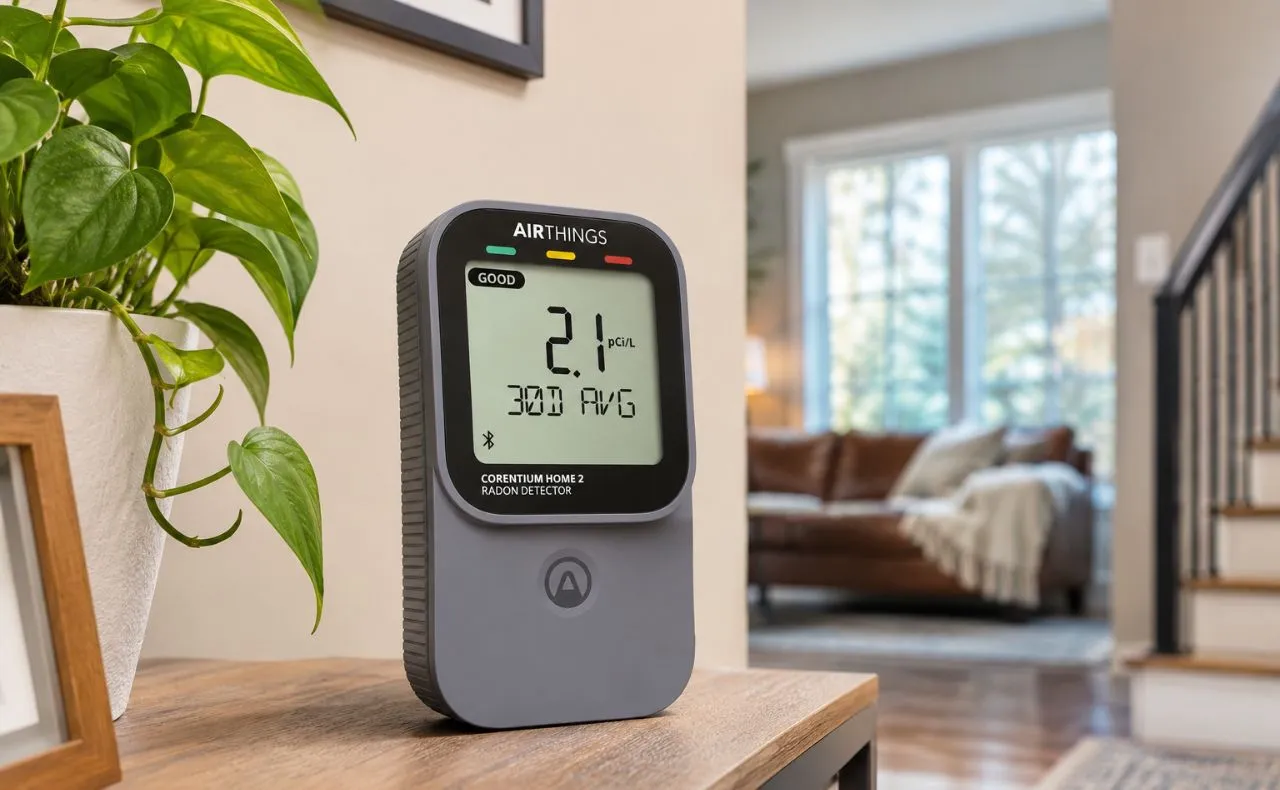
Airthings Corentium Home 2: Best Radon Detector for Everyday Tracking
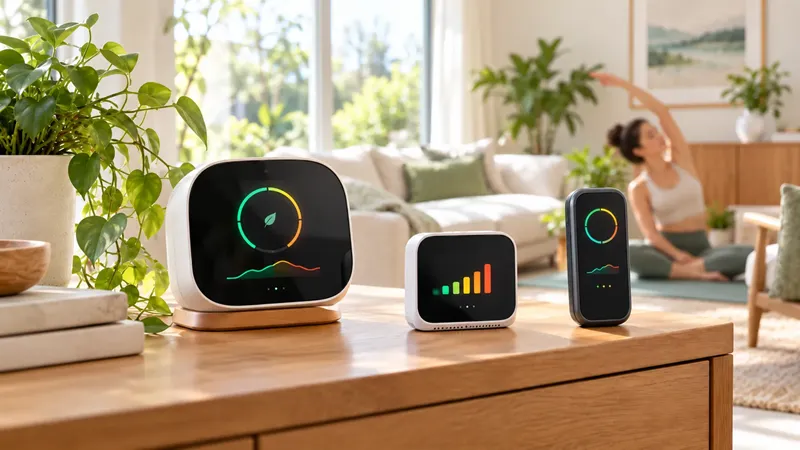
Choose Aitrhings Corentium Home 2 if you want ongoing radon readings with useful context, without building a whole-home monitoring system. Its Bluetooth connection gives you app access, while temperature and humidity sensors help you follow room conditions.
The radon sampling interval is 60 minutes. That’s appropriate for following patterns over days and months, when your main question is whether exposure stays elevated.

The main trade-off is connectivity. Bluetooth suits checking readings while you’re home, but it doesn’t provide direct Wi-Fi access from another location. Skip this model if remote-property monitoring is your priority.
For an occupied home where you’ll review trends regularly, Home 2 is a sensible starting point. Choose it when you want more context than a standalone display provides, without needing constant remote access.
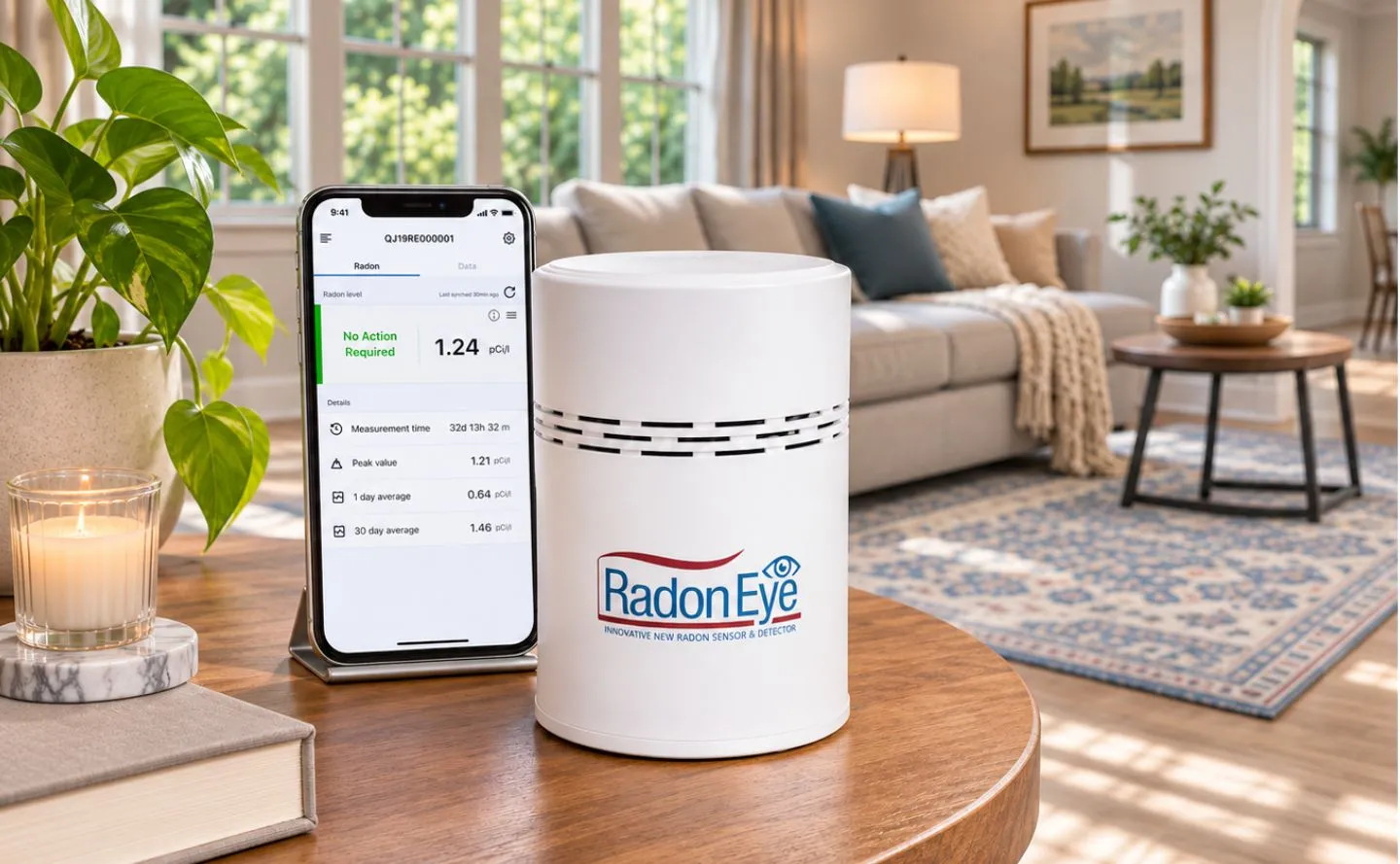
Ecosense RadonEye RD200: Best Value Radon Detector
Choose EcoQube if you want to review radon trends while you’re away. Its connected app makes it useful for a rental, a frequently travelled household, or a home where the monitor sits downstairs.

EcoQube provides updates every 10 minutes. That helps you see shorter changes rather than relying entirely on a daily average. Its official product information also lists C-NRPP approval.
The practical limitation is its dependence on household power and Wi-Fi. Skip it for an off-grid cabin or a property without dependable internet.
Choose EcoQube when remote visibility matters more than having a prominent in-room display. You can review the trend without walking downstairs, while keeping the monitor in the room that needs assessment.
Ecosense EcoQube: Best Wi-Fi Radon Detector for Remote Access
Choose EcoQube if you want to review radon trends while you’re away. Its Wi-Fi-connected app makes it useful for a rental, a frequently travelled household, or a home where the monitor sits downstairs.
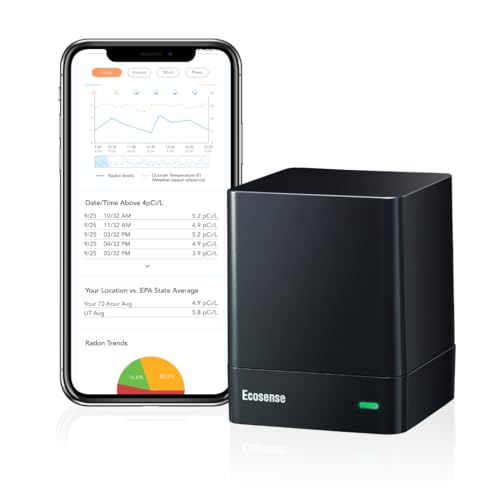
EcoQube provides updates every 10 minutes. That helps you see shorter changes rather than relying entirely on a daily average. Its official product information also lists C-NRPP approval.
The practical limitation is its dependence on household power and Wi-Fi. Skip it for an off-grid cabin or a property without dependable internet.
Choose EcoQube when remote visibility matters more than having a prominent in-room display. You can review the trend without walking downstairs, while keeping the monitor in the room that needs assessment.
Availability: Available in the US and Canada through Ecosense, and in Europe through Amazon’s regional stores.
Best options for simple readings and frequent updates
Ecosense EcoBlu: Best Simple Radon Detector Without an App
Choose EcoBlu if you want to read radon levels directly on the device. Its built-in display and 10-minute updates make it a practical option for anyone who doesn’t want another household app.
That simplicity is its strongest feature. If you prefer a quick glance during morning coffee to opening a dashboard, EcoBlu keeps the routine easy.

The trade-off is the lack of connected remote monitoring. Skip it if you need to follow readings from another property or share access with someone elsewhere.
Choose EcoBlu for uncomplicated, in-room monitoring. It makes more sense than a connected model when you’ll read the screen regularly and have no use for remote alerts. Spend on connectivity only when it solves a real problem.
Aranet Radon Plus: best for frequent, battery-powered tracking
Choose Aranet Radon Plus if you want 10-minute updates, app history and long battery life. It’s a strong fit when convenient power access would otherwise dictate where your monitor goes.
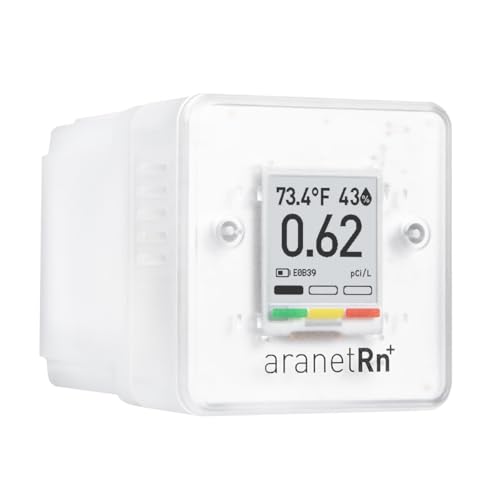
Aranet lists ±8% accuracy for its 24-hour, seven-day and 30-day averages. Those averaging periods matter: that specification shouldn’t be applied to every individual update.
The main trade-off is buying more monitoring detail than you may need. Skip it if your goal is a single assessment rather than ongoing tracking.
Choose Aranet for regular use where frequent updates and battery operation will make monitoring easier. Its history is more useful than repeatedly moving a detector between rooms, because a consistent location gives you a clearer record of changing conditions.
How we chose
These recommendations prioritize dedicated radon measurement, accessible historical readings and clear differences in everyday use. Manufacturer documentation provides the feature and specification basis.
Connectivity, update frequency and averaging periods answer different questions. A faster update can reveal variation, but it doesn’t automatically make a monitor more accurate.
For a radon-focused purchase, avoid paying for unrelated sensors unless you’ll use them. Our guide to choosing a smart air quality monitor helps separate the measurements that matter for different household concerns.
Other good options
Airthings View Plus suits households wanting radon alongside PM2.5, CO2, VOC trends, temperature, humidity and pressure, but its broader feature set is unnecessary for radon-only monitoring. Choose View Plus when you also want to follow particles after cooking or ventilation during a night’s sleep. Its VOC reading tracks a broad signal; it doesn’t identify individual chemicals or provide a dedicated formaldehyde measurement.
Airthings Corentium Home remains a straightforward LCD option with short- and long-term averages, but Home 2 adds Bluetooth, temperature and humidity tracking.
Set up your monitor and understand the readings
Give the monitor a consistent home
Continuous radon monitors build a record of hourly, daily and longer-term changes. A single-use short-term kit measures a limited testing window instead.
Place your monitor on the lowest level used regularly, away from drafts, direct heat, high humidity and exterior openings. EPA guidance specifies at least 20 inches above the floor and three feet from doors, windows or other outdoor openings.
Keep airflow around the device clear. Avoid a kitchen, bathroom or damp utility corner when a suitable living space is available.
Follow its startup period before interpreting results, and leave it in one location for a meaningful baseline. Humidity deserves separate attention too; our guide to tracking home humidity covers that measurement.
Read averages before reacting to spikes
The EPA action level is 4.0 pCi/L. WHO recommends a residential annual-average reference level of 100 Bq/m³, approximately 2.7 pCi/L.
For international comparisons, 1 pCi/L equals 37 Bq/m³. The WHO radon guidance also explains why reducing long-term exposure matters below an action threshold.
A rolling 24-hour average blends recent measurements together. That smooths short peaks, so compare the trend and averaging period before comparing two screens.
Compare matching dates, locations and averaging periods. A current display and a 48-hour laboratory result may describe different exposure windows.
Sustained elevated readings need follow-up testing and a radon mitigation plan. One lower reading doesn’t cancel an elevated longer-term average.
Frequently asked questions
Can a consumer monitor replace a professional radon test?
Use a consumer monitor for ongoing tracking. For a property transaction, disputed result or formal assessment, use radon testing under the applicable local protocol.
Under ANSI/AARST MAH-2019, 48 hours is optimal for short-term testing, with a 46-hour minimum. The ANSI/AARST standards address procedures as well as equipment. A connected app alone doesn’t make a consumer device suitable for a formal report.
How often should you retest?
Retest at least every two years, after mitigation, after major renovations, and when you begin regularly using a lower level. The EPA retesting guidance identifies changes in the building and occupied space as reasons to test again.
An existing reduction system doesn’t make future measurements unnecessary. Continuous tracking is useful for noticing a sustained change between formal tests.
Are home radon detectors accurate?
Good consumer monitors are accurate enough to show trends and long-term averages, but short readings jump up and down. Judge your home by the 7-day and 30-day averages, not a single number. If your average stays above the action level, confirm it with a professional test.
What radon level is safe?
No level is completely risk-free. In the US, the EPA recommends fixing your home at 4 pCi/L and considering it from 2 pCi/L. In Europe, many countries use 100–300 Bq/m³, and the WHO recommends 100 Bq/m³ (about 2.7 pCi/L).
Is a radon detector better than a test kit?
A test kit gives you one result from a few days or months. A continuous detector keeps measuring, so you see how radon changes with seasons, weather and ventilation. Use a certified test kit or professional test when you buy or sell a home, and a detector for ongoing peace of mind.
Does a consumer device need calibration?
Calibration requirements depend on the device and its quality-assurance plan. Professional monitoring involves scheduled calibration and performance checks; service charges, shipping and downtime belong in its operating budget.
Consumer devices have model-specific maintenance requirements. A fast refresh rate or several decimal places doesn’t demonstrate accuracy. When comparing specifications, the concentration range and averaging period matter as much as the percentage printed beside them.
Choose the monitor you’ll keep using
Choose Corentium Home 2 for everyday app-supported tracking, EcoQube for remote access, EcoBlu for a simple display, or Aranet Radon Plus for frequent battery-powered readings.
The strongest purchase is the one that makes consistent monitoring easy in your home. Keep it correctly positioned and use longer-term averages to guide follow-up.
If radon is your only concern, start with a dedicated monitor rather than paying for a broader sensor package. Save the extra spending for follow-up testing or mitigation when the readings call for it.