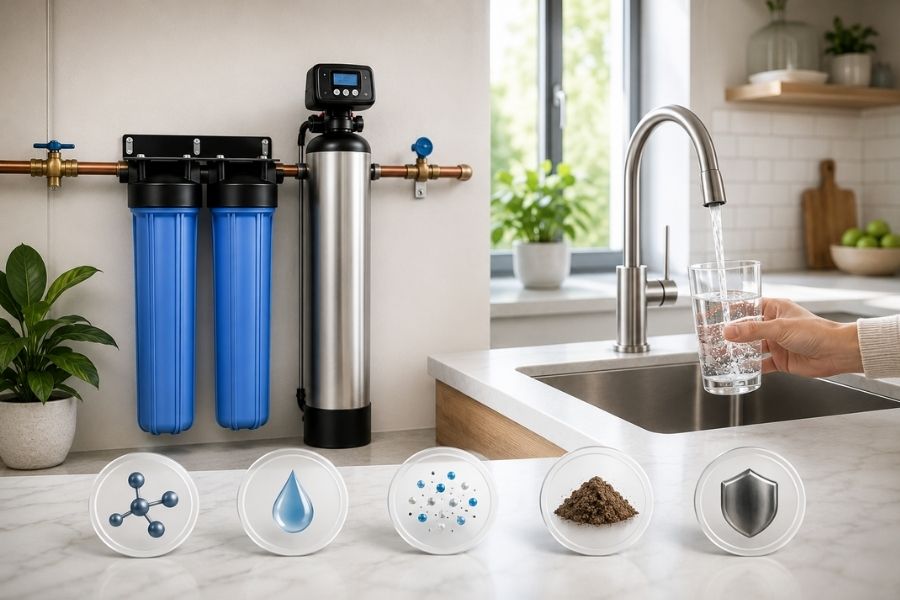
A whole-house water filter sounds like the ultimate “set it and forget it” solution for a healthier home.
One system.
Every tap.
Cleaner showers.
Better laundry.
Better-tasting water.
Less worry.
But here is the part many buyers miss:
Most whole-house filters are designed first for comfort and broad water quality, not total decontamination.
That does not make them useless. A good whole-house system can be a powerful upgrade for chlorine, sediment, rust, taste, odor, shower water, and general home comfort. But if you are buying one because you are worried about PFAS, lead, bacteria, VOCs, or microplastics, you need to look much more closely.
The water filter market is full of big claims. “Removes everything.” “Pure water from every tap.” “Whole-home protection.” Those phrases sound reassuring, but they do not tell you what the system is actually certified to reduce.
A system can make your water smell better and still leave you with contaminants you were trying to avoid.
That is why this guide focuses on what your whole-house filter should actually be removing, what it may not remove, and when you still need a stronger drinking-water filter at the kitchen tap.
Author Note
We have just sold our home in Denmark and are now preparing to rent a home for the next few years. That makes this topic very practical for me right now.
I want cleaner water in our next home, but I also need to think realistically. If we rent, I may not be able to install a permanent whole-house system immediately. I may need to start with the kitchen tap, a countertop system, or another removable solution before considering anything bigger.
That is why I look at water filtration in a layered way. I want to know what truly matters, what can wait, what a system is certified to reduce, and whether the materials touching the filtered water still fit a lower-toxin home.
Once I choose a real setup for our own next home, I plan to update this guide with what I picked, why I chose it, and what I learned from using it in daily life.
Quick Answer
A good whole-house water filter should usually target sediment, rust, chlorine, chloramine where relevant, taste, odor, and broader whole-home water quality first.
If PFAS, lead, VOCs, bacteria, nitrates, arsenic, or well water contamination are concerns, you need water testing and a filter certified for those specific contaminants.
For PFAS, the most relevant treatment technologies include granular activated carbon, anion exchange, reverse osmosis, and other membrane-based systems, depending on the setup, flow rate, and certification. EPA identifies activated carbon, ion exchange resins, and high-pressure membranes such as reverse osmosis as effective PFAS treatment technologies, and EPA also notes that point-of-use GAC, ion exchange, and RO systems can greatly reduce PFAS when properly maintained.
For chlorine, whole-house carbon filtration is often useful because chlorine affects more than drinking water. It can affect showers, laundry, smell, taste, and the overall feel of the home’s water.
For microplastics, the science is still developing. WHO has reviewed microplastics in drinking water and describes the evidence base as still evolving, while also emphasizing that microbial pathogens remain a major drinking-water safety concern globally.
The safest approach is simple:
- Test your water first.
- Choose filtration based on your actual contaminants.
- Use whole-house filtration for broad whole-home exposure.
- Use under-sink, countertop, or reverse osmosis filtration when drinking-water contaminant reduction needs to be more targeted.
At a Glance: Does Your Filter Actually Catch It?
| Contaminant or issue | Standard whole-house filter | High-end whole-house system | Under-sink RO or certified drinking-water filter |
| Chlorine and odor | Often strong | Often strong | Strong for drinking water |
| Sediment and rust | Strong | Strong | Strong at one tap |
| Chloramine | Limited unless designed for it | Better with catalytic carbon | Depends on filter design |
| PFAS | Often limited | Possible with specific media and testing | Often the strongest choice |
| Lead | Usually not enough by itself | Still may not solve fixture or pipe leaching | Often the strongest choice if certified |
| Microplastics | Depends on micron rating | Better with fine filtration or membrane stages | Often stronger for drinking water |
| Bacteria | Usually no | Only with proper disinfection or UV stage | Depends on RO, UV, or certified system |
| Hard water scale | No, unless paired with softening or scale control | Possible with added system | Usually not the main purpose |
The most important lesson is this:
A filter that improves taste is not automatically a filter that removes health-related contaminants.
Also in This Article
- Why whole-house filtration is not one-size-fits-all
- The PFAS marketing trap
- Chlorine vs chloramine
- Microplastics and particle size
- Why lead and bacteria need separate thinking
- The layered strategy
- The material side most buyers miss
- Certifications to check before you buy
Why Whole-House Filtration Is Different
A whole-house filter is a point-of-entry system. It treats water where it enters your home before it travels to taps, showers, appliances, bathrooms, and laundry.
That makes it excellent for broad exposure.
It can help with:
- Chlorine smell
- Sediment
- Rust particles
- Cloudy water
- Shower water quality
- Laundry odor
- Appliance protection
- General whole-home comfort
But whole-house filtration has one important limitation.
It treats a lot of water quickly.
That means the system must handle high flow rates while still giving the filter media enough contact time to reduce contaminants. A filter that works beautifully at a kitchen tap may not perform the same way when it has to treat showers, laundry, dishwashing, and bathrooms at the same time.
This is where many buyers get caught by marketing language.
A big tank does not automatically mean better contaminant reduction.
A high flow rate does not automatically mean better safety.
A long contaminant list does not matter unless the system has the media, contact time, testing, and maintenance schedule to support the claim.
The Marketing Trap: Comfort Filtration vs Health-Grade Filtration
A lot of whole-house systems make water feel better.
That matters. Water that smells less like chlorine, leaves fewer particles in appliances, and feels better in the shower can improve daily life.
But comfort filtration and health-grade filtration are not always the same thing.
A comfort-focused whole-house filter may be excellent for:
- Chlorine taste and odor
- Sediment
- Rust
- Cloudiness
- General water feel
- Appliance protection
A health-focused drinking-water filter may need to target:
- Lead
- PFAS
- VOCs
- Arsenic
- Nitrates
- Bacteria
- Microplastics
- Specific local contaminants
This does not mean you should avoid whole-house filtration. It means you should avoid thinking that one system automatically solves every water problem.
The question is not, “Does this filter sound impressive?”
The question is, “What has this filter actually been tested or certified to reduce?”
Contaminant 1: PFAS
PFAS are often called “forever chemicals” because many of them persist in the environment and do not easily break down.
They have been used in nonstick coatings, stain-resistant fabrics, water-resistant materials, food packaging, firefighting foams, and industrial applications. Over time, certain PFAS can enter water sources.
For families trying to lower toxic load, PFAS deserve attention because they are not something you can smell, see, or taste.
In the United States, EPA finalized the first national drinking water regulation for several PFAS in 2024. EPA later announced in 2025 that it would keep the current National Primary Drinking Water Regulations for PFOA and PFOS while extending compliance deadlines and reconsidering some other PFAS-related regulatory determinations.
For a home buyer or renter, the practical lesson is not to memorize every regulatory detail.
The lesson is this:
If PFAS are a concern in your area, do not assume a basic whole-house filter is enough unless it is specifically tested or certified for PFAS reduction.
Can a Whole-House Filter Remove PFAS?
Some whole-house systems may reduce PFAS, but this is where you need to be careful.
PFAS reduction depends on:
- Type of PFAS
- Carbon type
- Media volume
- Water contact time
- Flow rate
- Filter age
- Water chemistry
- Certification or third-party testing
To reduce PFAS, water needs enough contact with the right media. When water moves quickly through a whole-house system because showers, laundry, and taps are running, performance depends heavily on the system design.
That is why vague claims are not enough.
Look for:
- PFAS-specific reduction claims
- NSF/ANSI 53 or NSF/ANSI 58 with a PFAS designation where relevant
- Performance data sheets
- Independent testing
- Clear replacement schedules
- Flow rate data
NSF states that filters certified to NSF/ANSI 53 or NSF/ANSI 58 with a PFAS designation help filter PFAS, and EPA points consumers toward certified filters and proper maintenance when reducing PFAS at home.
For many families, the strongest PFAS strategy is not one giant whole-house claim.
It is a layered setup:
Whole-house carbon for broad chlorine and sediment reduction.
Under-sink RO or another certified drinking-water filter for PFAS reduction at the kitchen tap.
Contaminant 2: Chlorine
Chlorine is complicated because it is not simply bad.
Public water systems use disinfectants because microbial contamination can be dangerous. Disinfection protects against bacteria, viruses, and waterborne disease.
So the goal is not to pretend chlorine has no purpose.
It does.
The question is whether you want to reduce chlorine after it has already done its job in the water supply system.
Many families notice chlorine because of:
- Swimming-pool smell
- Dry skin after showering
- Strong tap water taste
- Odor in tea or coffee
- Laundry smell
- Concerns about chlorine-related byproducts
For whole-house filtration, chlorine is one of the most logical targets because it affects water throughout the home.
If chlorine bothers your skin, shower, laundry, or water taste, treating only the kitchen tap may not fully change your daily experience.
A whole-house carbon system can be a practical comfort and exposure-reduction upgrade for chlorine.
Chlorine vs Chloramine
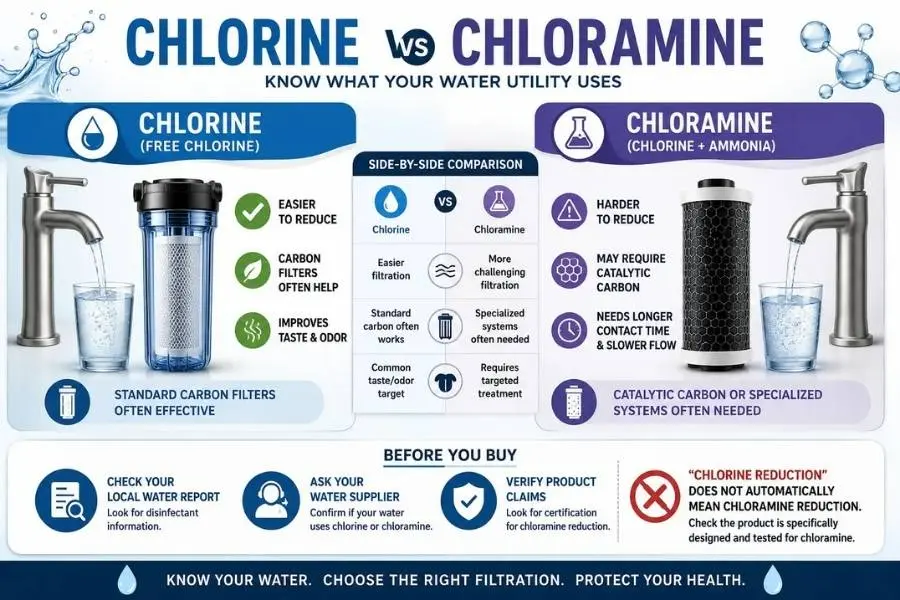
Some water systems use chlorine. Others use chloramine, which is chlorine combined with ammonia.
This matters because chloramine is generally harder to reduce than free chlorine.
A standard carbon filter may help with chlorine taste and odor, but chloramine often needs catalytic carbon, more media, slower flow, longer contact time, or a system specifically designed and tested for chloramine reduction.
Before buying a whole-house system, check your local water report or ask your water supplier whether your water is disinfected with chlorine or chloramine.
If the product page only says “chlorine reduction,” that does not automatically mean it is strong enough for chloramine.
For the best whole house water filter system that removes PFAS, chlorine, and microplastics, see Best Whole House Water Filter System.
Why Chlorine Matters Beyond Taste
Chlorine is not just a taste issue.
Hot showers can increase skin exposure and inhalation exposure to chlorine-related compounds, depending on your water chemistry, shower temperature, bathroom ventilation, and how long you shower.
This is why whole-house filtration may matter more than people think.
If you only filter drinking water, you may improve what goes into your glass, but you are not changing your shower water, bath water, laundry water, or water vapor exposure in the bathroom.
For some families, especially those with sensitive skin, strong chlorine odor, or a desire to reduce whole-home chemical exposure, whole-house carbon filtration can make sense.
Contaminant 3: Microplastics
Microplastics are tiny plastic particles that can come from packaging, synthetic textiles, tire wear, plastic breakdown, industrial sources, and water distribution pathways.
This is a growing concern, but the science is still developing.
WHO reviewed microplastics in drinking water and examined their occurrence, possible health impacts, and removal during drinking-water treatment. WHO also emphasized that the available evidence was limited and that microbial pathogens remain a major drinking-water safety priority.
For a practical home filter buyer, that means two things.
First, microplastics are worth considering.
Second, you should not ignore better-established risks such as bacteria, lead, nitrates, arsenic, PFAS, or disinfection byproducts if they are relevant to your water.
To protect your drinking water at the kitchen sink, check out Best Under-Sink Water Filter.
Can a Whole-House Filter Remove Microplastics?
It depends on particle size and filter design.
A sediment filter can reduce larger particles. Finer filters can reduce smaller particles. Membrane-based systems may go further, especially at the drinking-water point.
But a whole-house filter that says “sediment reduction” is not automatically a complete microplastic solution.
When comparing systems, look for:
- Micron rating
- Whether the rating is nominal or absolute
- Filter type
- Flow rate
- Independent testing
- Replacement schedule
- Whether the system is designed for whole-house use or drinking water only
A 5-micron sediment filter and a sub-micron drinking-water membrane are not doing the same job.
For families most concerned about microplastics in drinking water, a layered setup may make more sense:
Whole-house sediment filtration for broader particle reduction.
Under-sink ultrafiltration or reverse osmosis for drinking water.
Glass or stainless steel storage instead of thin plastic pitchers where practical.
If lead is a concern in your pipes, find the Best Water Filter for Lead Removal.
Contaminant 4: Lead
Lead is different from chlorine and sediment because it may enter water from the plumbing system itself.
That means even if water leaves the utility clean, it can pick up lead from service lines, older pipes, solder, brass fixtures, or faucets.
This is why lead can be tricky for whole-house filters.
A point-of-entry system may help with some incoming contaminants, but if lead is being introduced after that filter through pipes, fixtures, or faucets, you may still need certified lead reduction at the tap.
If lead is your concern, prioritize certified point-of-use filtration at the kitchen tap, especially for:
- Drinking water
- Cooking water
- Baby formula
- Coffee and tea
- Pet water
- Food prep
This is where an under-sink lead-removal filter often makes more sense than relying only on whole-house filtration.
For maximum contaminant removal across your entire home, explore Best Whole House Reverse Osmosis Systems.
Contaminant 5: Bacteria and Well Water Risks
If you are on city water, disinfection is usually handled by the water supplier.
If you are on private well water, the responsibility shifts heavily to you.
Well water may need a very different setup than city water. It may involve bacteria testing, nitrate testing, sediment filtration, UV treatment, iron or manganese treatment, arsenic testing in some regions, or reverse osmosis at the kitchen tap.
For well water, do not buy a whole-house filter based only on taste.
A carbon filter alone is not a universal well water safety system.
If bacteria are present, the solution is not just better taste. It may require disinfection, UV, shock chlorination, well repair, or another treatment plan based on testing.
Not sure which RO setup fits your needs? Compare Whole House RO vs Point-of-Use RO.
What a Whole-House Filter Should Actually Remove First
For most homes, a whole-house filter should start with the broad exposure problems:
- Sediment
- Rust
- Chlorine or chloramine
- Taste and odor
- Scale or hardness support if needed
- Protection for appliances and fixtures
Then, depending on your water test, it may need to address:
- PFAS
- VOCs
- Heavy metals
- Pesticides
- Well water contaminants
- Microbial risks
- Microplastics or fine particulates
The key is not to buy a system based on fear.
It is to match the filter to the water.
Before investing, read Do You Really Need Whole-House RO? to decide if it’s right for you.
The Layered Strategy: Why One Filter Is Often Not Enough
For most families, the safest setup is not always the most expensive whole-house system.
It is a smart combination.
A practical layered setup may look like this:
- Whole-house sediment filter
- Whole-house carbon or catalytic carbon filter
- Under-sink certified drinking-water filter
- Reverse osmosis if testing supports it
- UV or special treatment if well water testing requires it
Here is the simple version:
Whole-house filtration protects the home environment.
Under-sink filtration protects the water you drink and cook with.
That is often more realistic and more effective than trying to buy a single system that claims to do everything.
For maximum protection against multiple contaminants, learn about Layered Water Filtration.
Layer 1: Sediment Protection
Sediment protection helps reduce visible particles, rust, grit, and debris.
This protects:
- Plumbing
- Shower heads
- Appliances
- Faucets
- Downstream filter media
- Laundry and fixtures
Sediment filtration is not glamorous, but it is often the first practical layer.
Layer 2: Carbon or Catalytic Carbon
Carbon filtration is often used for chlorine, taste, odor, and certain chemical contaminants depending on the system.
For chloramine, catalytic carbon is usually more relevant than basic carbon.
This layer can make water feel better throughout the home, especially in showers, laundry, and everyday use.
Layer 3: Drinking-Water Filter
This is the kitchen-tap layer.
Depending on your water test, this may be:
- Under-sink carbon filter
- Reverse osmosis system
- PFAS-certified filter
- Lead-certified filter
- Countertop system for renters
- Gravity-fed system where installation is not possible
This is the layer I would prioritize first in a rental home, because it protects the water used for drinking, cooking, tea, coffee, baby formula, soups, smoothies, and pet bowls.
Layer 4: Special Treatment If Needed
This only applies if testing shows a specific issue.
Examples include:
- UV for bacteria
- Softener for hardness
- Iron filter for staining
- Nitrate treatment for well water
- Arsenic treatment where regionally relevant
- Whole-house PFAS treatment if contamination is significant
This is why testing matters. Without testing, you may overbuy in one area and under-protect in another.
To budget properly, check out Whole House Water Filter Installation Cost.
What About Reverse Osmosis?
Reverse osmosis can be a strong option for drinking water, especially when you are concerned about PFAS, dissolved solids, certain metals, or a broad range of contaminants.
But RO is usually a point-of-use system, often installed under the kitchen sink.
That matters because a point-of-use RO system focuses on the water you drink and cook with. It does not usually treat every shower, toilet, appliance, and laundry load in the home.
This is not a weakness. It is often the point.
For many families, under-sink RO gives the strongest protection where it matters most, while whole-house filtration handles sediment, chlorine, odor, and broader comfort.
A practical setup may be:
Whole-house carbon or sediment filtration.
Under-sink RO for drinking water if testing supports it.
Remineralization if taste or mineral balance is a concern.
Wondering if portable filters work? Read the Berkey Water Filter Review.
What About Water Softeners?
A water softener is not the same as a contaminant filter.
A softener is mainly designed to address hardness minerals such as calcium and magnesium that cause scale.
It may help with:
- Scale buildup
- Appliance life
- Soap performance
- Laundry feel
- Shower feel
- Fixture staining
But a softener does not automatically remove PFAS, chlorine, microplastics, lead, bacteria, or VOCs.
This is a common buying mistake.
A water softener can be part of a whole-home setup, but it is not a replacement for filtration.
If you have hard water and contaminant concerns, you may need both:
A softener or scale-control system for hardness.
A filter system for contaminants.
Before buying any filter, always How to Test Your Water Quality first.
The Material Side Most Buyers Miss
Water filtration is not only about what the filter removes.
It is also about what the water touches after it has been filtered.
This matters especially for Healthy Home Upgrade because the goal is not just cleaner water on paper. The goal is a lower-toxin home in real life.
When comparing whole-house filters, under-sink filters, pitchers, or countertop systems, look at:
- Filter housing material
- Internal plastic parts
- Tubing quality
- Faucet material
- Storage tank material
- Lead-free fittings
- BPA-free claims
- Certification for materials in contact with drinking water
This does not mean every plastic component is automatically unsafe. Many certified systems use plastic parts safely.
But if you are spending money to reduce PFAS, chlorine, and microplastics, it makes sense to avoid a low-quality plastic reservoir that leaves filtered water sitting in warm plastic for hours.
This is one reason I prefer to look for stainless steel, glass, lead-free faucets, high-quality certified plastics, and clear material disclosures where possible.
Pitchers, Plastic, and Standing Water
Pitcher filters can be useful, especially for renters, students, travel, backup, and tight budgets.
But they have two weaknesses people often overlook:
- Filter limitations
- Standing-water hygiene
With a pitcher, filtered water may sit in a reservoir for hours or even days. If the pitcher is not cleaned regularly, if the filter is overdue for replacement, or if the water is left warm on the counter, the system may become less hygienic than people realize.
This is not a reason to panic.
It is a reason to use pitcher filters properly.
If you use a pitcher filter:
- Keep it clean
- Change the filter on schedule
- Store it in the refrigerator when possible
- Do not leave filtered water sitting for too long
- Wash the reservoir regularly
- Replace cracked, cloudy, or old plastic parts
A pitcher can be a helpful first step, but it should not be confused with a full water strategy if your concerns include PFAS, lead, bacteria, or well water contamination.
What I Would Prioritize in a Rental Home
Because we are preparing to rent, I would not automatically begin with a permanent whole-house system.
My first priorities would be:
- Check the local water report
- Test the kitchen tap if needed
- Protect drinking and cooking water first
- Choose a removable or landlord-friendly system
- Avoid low-quality plastic storage where possible
- Consider whole-house options only if the rental situation allows it
For a rental home, a strong under-sink filter, countertop system, or gravity-fed stainless steel system may be more realistic than a full whole-house installation.
That does not mean I do not value whole-house filtration.
It means the best system is the one that fits the home you actually live in.
Red Flags When Shopping for Whole-House Filters
Be careful if a product page says:
- Removes all contaminants
- Filters everything
- PFAS protection without test data
- No maintenance ever
- Lifetime filter
- Medical-grade water without certification
- Removes microplastics without micron rating or testing
- Softens water when it only filters sediment
- NSF tested without saying which standard and which contaminant
- Eco-friendly with unclear replacement media or plastic-heavy design
A good filter company should be willing to show clear performance data.
Certification Claim Check
If a salesperson or product page says a filter removes almost everything, ask for the performance data sheet.
These are some of the most useful standards to understand:
| Standard | Why it matters |
| NSF/ANSI 42 | Aesthetic effects such as chlorine taste and odor |
| NSF/ANSI 53 | Health-related contaminant reduction claims, depending on product claim |
| NSF/ANSI 58 | Reverse osmosis systems |
| NSF/ANSI 401 | Certain emerging compounds and incidental contaminants |
| NSF/ANSI 372 | Lead content in plumbing materials |
| PFAS designation | Important when checking whether the filter has a PFAS reduction claim |
NSF explains that NSF/ANSI 42, 53, and 401 are common filtration standards, and its water filter FAQ notes that filters certified to NSF/ANSI 53 or NSF/ANSI 58 with a PFAS designation help filter PFAS.
The key is to check the actual claim.
A filter certified for chlorine taste and odor is not automatically certified for lead, PFAS, VOCs, bacteria, or microplastics.
Final Verdict: What Should Your Whole-House Filter Actually Remove?
A whole-house filter should first solve the broad water problems that affect your entire home:
- Sediment.
- Rust.
- Chlorine or chloramine.
- Odor.
- Hardness support if needed.
- General whole-home water quality.
But it should not give you false confidence.
If your concern is PFAS, lead, bacteria, nitrates, arsenic, VOCs, or drinking-water microplastics, you need a more targeted plan.
For many families, the smartest setup is not one giant filter.
It is a layered system:
- Whole-house filtration for whole-home comfort and exposure reduction.
- Under-sink or countertop filtration for drinking and cooking water.
- Testing before buying.
- Certifications before trusting claims.
- Better materials wherever water sits or flows after filtration.
That is the real lower-toxin water strategy.
Not the most expensive system.
Not the loudest marketing claim.
The right filter for the right contaminant, in the right place.

Anita is the founder and writer behind Healthy Home Upgrade, where she shares her passion for transforming living spaces into foundations for smart health and wellness. Driven by her personal health journey, her goal is to provide valuable, practical articles that empower readers to use technology and design to improve their quality of life.