An adjustable bed base can improve sleep quality when it solves a real sleep problem, such as pressure discomfort, reflux comfort, snoring comfort, back tension, poor reading posture, leg elevation, or difficulty getting in and out of bed.
A traditional bed frame is enough if you already sleep comfortably, do not need positional support, and prefer a simpler, lower cost setup.
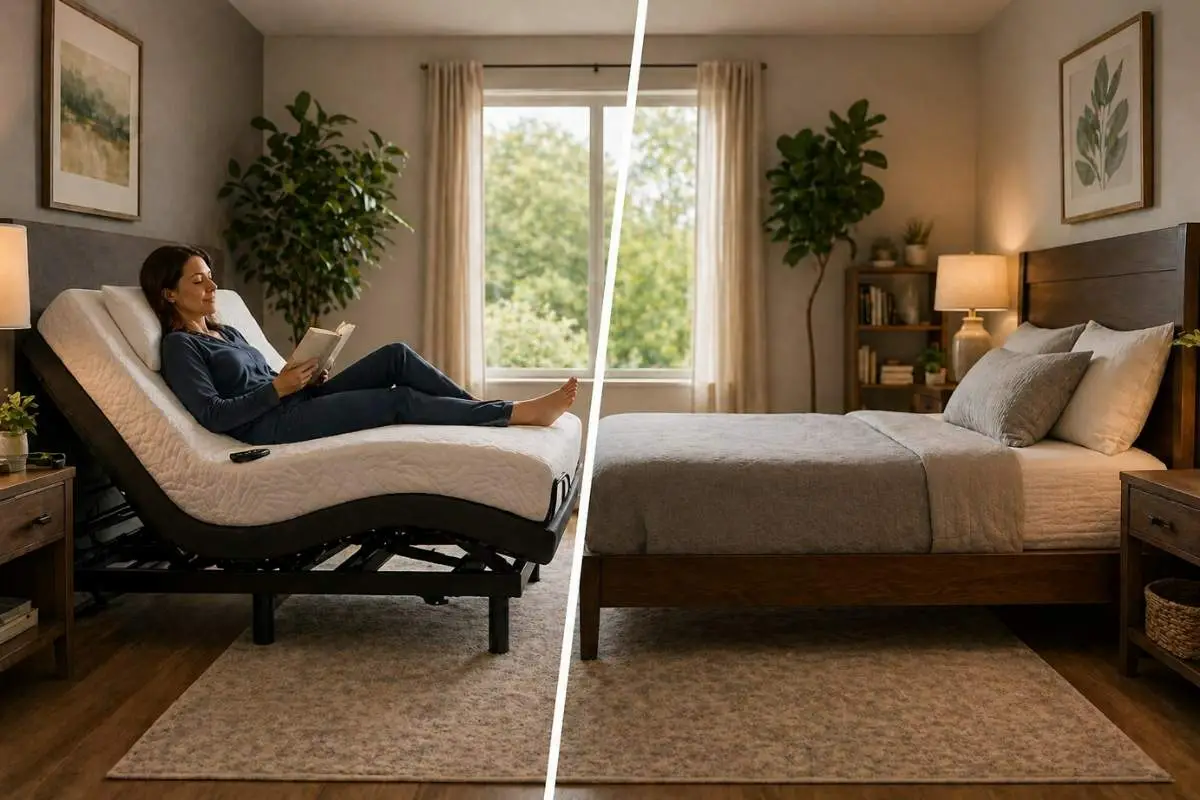
The biggest difference is this: a traditional frame holds your mattress flat, while an adjustable base changes your sleep position. That can make a meaningful difference for some people, but it is not automatically better for everyone.
From a healthy home perspective, the best choice depends on more than comfort. You also need to think about mattress compatibility, motor noise, materials, electronics, off-gassing, EMF exposure, durability, and whether the base will actually improve your daily sleep routine.
If you are comparing adjustable bases, my full buying guide to the best adjustable bed bases is here: Elevate Your Sleep: The 5 Best Adjustable Bed Bases
Also in This Article
Adjustable Base vs Traditional Frame: What Is the Real Difference?
A traditional bed frame is simple. It supports the mattress in a flat position, usually with slats, a platform, or a foundation. It does not move, lift, recline, massage, or change your sleep angle.
An adjustable base is different. It lets you raise the head, raise the feet, or create a customized sleeping or resting position. Some models also include massage, under-bed lighting, USB ports, app control, presets, or zero gravity positioning.
That sounds like a luxury feature, but the real question is not whether it feels impressive.
The real question is whether it solves something that is disturbing your sleep.
If you sleep well on a flat bed, a traditional frame may be all you need. If you often wake with pressure, discomfort, reflux discomfort, snoring, or poor positioning, an adjustable base may be more than a comfort upgrade. It may be a sleep quality tool.
Material matters more than motors: adjustable bed base materials 101 – avoid cheap particle board.
Quick Comparison
| Feature | Traditional Frame | Adjustable Base |
| Sleep position | Flat only | Head and foot elevation |
| Best for | Simple support and stable sleep | Position-sensitive comfort |
| Cost | Usually lower | Usually higher |
| Electronics | None | Motors, remotes, possible app control |
| Maintenance | Very low | More moving parts |
| Mattress needs | Works with most mattresses | Needs compatible flexible mattress |
| Best benefit | Simplicity | Custom positioning |
| Healthy home concern | Materials, slats, dust | Materials, motors, wiring, off-gassing |
| Who may benefit most | People who sleep well flat | People with pressure, reflux comfort, snoring comfort, or mobility needs |
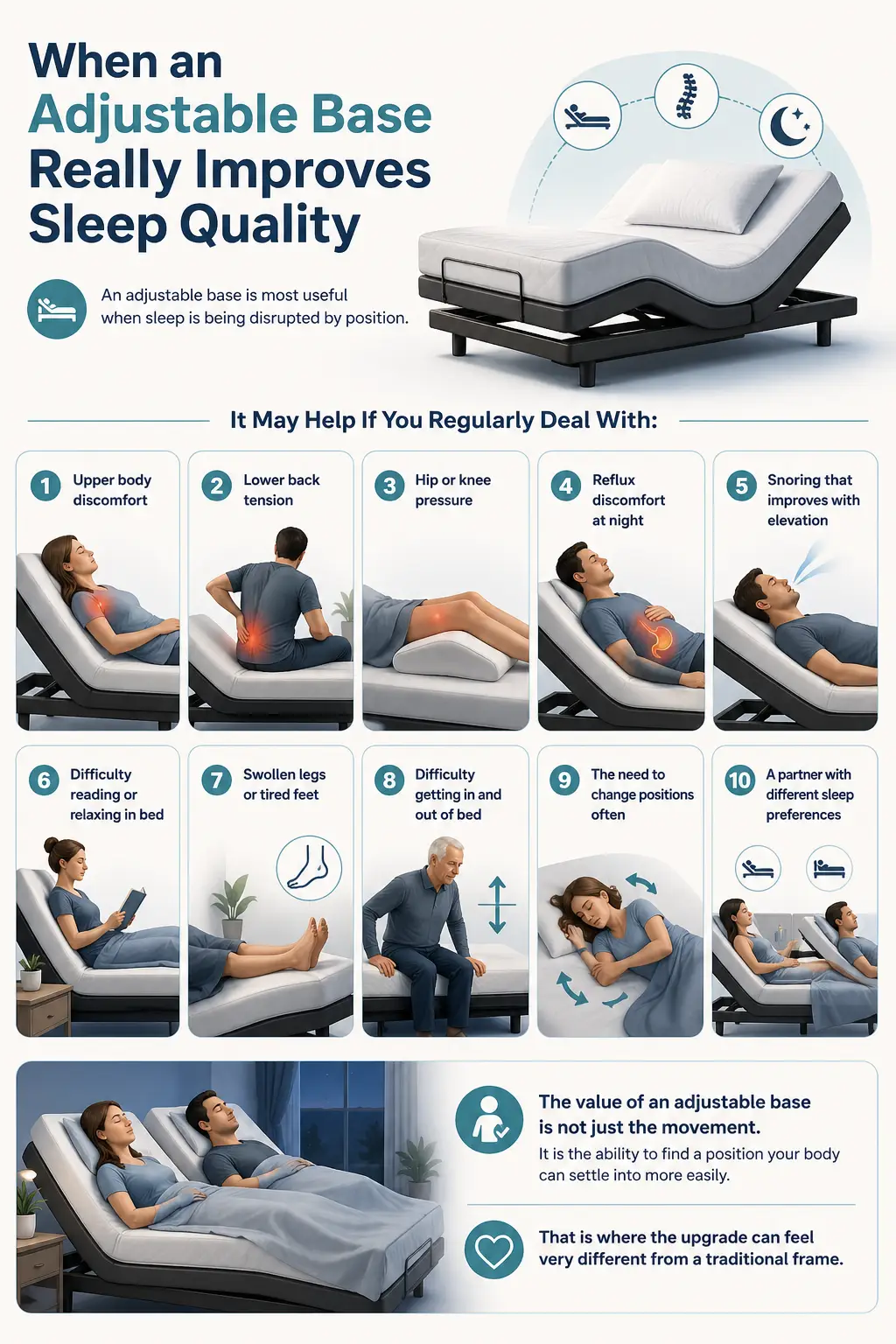
When an Adjustable Base Really Improves Sleep Quality
An adjustable base is most useful when sleep is being disrupted by position.
This is important because many people buy sleep products hoping they will magically improve sleep. But sleep quality usually improves when the product solves a specific friction point.
An adjustable base may help if you regularly deal with:
- Upper body discomfort
- Lower back tension
- Hip or knee pressure
- Reflux discomfort at night
- Snoring that improves with elevation
- Difficulty reading or relaxing in bed
- Swollen legs or tired feet
- Difficulty getting in and out of bed
- The need to change positions often
- A partner with different sleep preferences
In those situations, the value of an adjustable base is not just the movement. It is the ability to find a position your body can settle into more easily.
That is where the upgrade can feel very different from a traditional frame.
Real-world testing: Nectar adjustable base review (2026) – worth the hype?
When a Traditional Frame Is Enough
A traditional frame is still the better choice for many people.
If you sleep well, wake without discomfort, and do not need elevation, a simple frame may be all you need. It is less expensive, easier to maintain, and does not add electronics to the bedroom.
A good traditional frame can also support a non-toxic bedroom setup very well, especially if it is made from solid wood, low-VOC materials, or metal without unnecessary foam, glue, or chemical coatings.
A traditional frame may be enough if:
- You sleep comfortably on a flat mattress
- You do not need head or foot elevation
- You want the simplest setup possible
- You dislike electronics near the bed
- You are sensitive to motor noise or lights
- You already have a supportive mattress
- You want fewer parts that can break
- You are prioritizing budget
The cleanest sleep setup is not always the most expensive one. Sometimes it is the one with fewer moving parts.
Don’t forget compatibility: perfect mattress match for adjustable bases.
The Sleep Quality Question: What Problem Are You Solving?
Before buying an adjustable base, ask one question:
What exactly do I want this to improve?
That question matters because adjustable bases are often marketed like they are universally better. They are not. They are better when the problem is related to position, pressure, comfort, breathing comfort, or access.
If your mattress is too firm, too soft, too hot, or made from materials you do not like, an adjustable base may not solve the real problem. You may need a better mattress first.
If your sleep issue is caused by stress, caffeine, poor sleep timing, too much light, or a hot bedroom, an adjustable base may help you feel more comfortable, but it will not fix the root cause.
But if your sleep issue is positional, the upgrade can be meaningful.
Back Comfort and Pressure Relief
One of the most common reasons people consider an adjustable base is back comfort.
A flat bed is not always the most comfortable position for every spine, especially if the mattress is not distributing pressure well. Slight elevation of the head or legs can change how weight is distributed across the body.
Some people find that raising the knees slightly reduces tension in the lower back. Others prefer a gentle upper body incline because it makes the body feel less compressed.
The most famous setting is often called zero gravity. This position raises both the head and feet to create a reclined posture that may feel more evenly supported than lying flat.
This does not mean an adjustable base treats back pain. But it can help some people find a more comfortable resting position, especially when flat sleeping feels tense or unsupported.
Can an Adjustable Base Help With Snoring?
An adjustable base may help some people feel more comfortable if raising the upper body improves their nighttime breathing position.
Sleeping completely flat can make snoring worse for some people. A gentle incline may help the throat and airway feel less compressed. This is one reason some people use wedge pillows, but an adjustable base can make elevation more stable and easier to adjust.
The advantage over pillows is consistency. Pillows move, flatten, and create neck angles that are not always comfortable. A base lifts the mattress surface instead, which can feel smoother and more supportive.
However, snoring can have many causes. If snoring is loud, frequent, or linked with choking, gasping, or daytime sleepiness, it should be discussed with a qualified healthcare professional.
For a healthy home article, the honest answer is this: an adjustable base can help some people sleep more comfortably in an elevated position, but it is not a medical solution.
Can an Adjustable Base Help With Reflux?
An adjustable base can be useful for people who feel more comfortable sleeping with the upper body elevated.
Many people with nighttime reflux already use extra pillows or a wedge to avoid lying completely flat. An adjustable base can make that elevation easier, more stable, and more comfortable.
The key difference is that the whole upper mattress lifts. This can feel more natural than stacking pillows, which may bend the neck or upper back.
Again, this is not a treatment claim. It is a comfort and positioning benefit. If reflux is frequent or severe, it should be handled with proper medical guidance.
But as a practical sleep setup, head elevation is one of the clearest reasons an adjustable base can be worth considering.
Leg Elevation and Recovery Comfort
Raising the legs can feel good after long days, workouts, travel, or standing for hours.
A traditional frame does not give you this option unless you use pillows under your legs. Pillows can work, but they often shift during the night.
An adjustable base makes leg elevation more controlled. You can raise the foot section slightly, find a comfortable angle, and return it to flat when you want.
This can be especially useful for people who like to read, relax, or recover in bed without putting pressure on the lower back.
It is also one reason adjustable bases are popular in sleep and recovery tech. They turn the bed into a more flexible rest space, not just a flat sleeping surface.
Reading, Relaxing, and Screen Use in Bed
This is one of the most practical everyday differences.
If you read in bed, watch a show, use a laptop, or drink tea before sleep, a traditional frame often forces you into awkward pillow stacking. That can create neck strain, rounded shoulders, and poor posture.
An adjustable base lets you lift the upper body without building a wall of pillows behind you.
This may not sound like a sleep quality feature at first, but it matters. The position you spend time in before sleep can affect how relaxed your body feels when you finally lie down.
A more comfortable evening posture can make the bedroom feel calmer and more supportive.
Of course, screen use before bed is still worth keeping under control. A better base does not cancel out bright light or late-night scrolling. But it can make reading and quiet routines more comfortable.
Partner Sleep: When One Person Needs Elevation
Adjustable bases can be especially helpful when one partner wants elevation and the other does not.
With a traditional frame, both people share the same flat surface. With a split adjustable setup, each side can move independently if the mattress and base are designed for that.
This can be useful if one person snores, needs upper body elevation, likes to read, or prefers a different resting position.
The downside is that split setups can be more expensive and may create a gap between mattresses. They also require more planning around sheets, mattress protectors, and bedroom layout.
For couples, the best adjustable base is not always the one with the most features. It is the one that reduces sleep friction without making the bed feel complicated.
Zero Toxic Load Lens: What to Watch For
An adjustable base is not just a sleep product. It is also a large object that sits in your bedroom every night.
That means the materials matter.
From a zero toxic load perspective, look beyond the movement features and check what the base is made from. Many adjustable bases include metal frames, plywood, fabric covering, foam padding, adhesives, motors, wiring, and electronic components.
That does not make them automatically bad. But it does mean they deserve a closer look.
Things to consider:
- Does the base have a strong chemical smell when unpacked?
- Are the fabric and foam components low-VOC or certified?
- Does the brand provide material information?
- Are there unnecessary foam layers or padding?
- Is the base mostly metal and wood, or heavily upholstered?
- Does it use app control or WiFi features you do not need?
- Can lights and electronics be turned off fully at night?
- Is the motor quiet enough for sensitive sleepers?
A traditional frame usually wins on simplicity. An adjustable base wins on function. The best choice depends on how much you need the function.
EMF and Electronics Near the Bed
Some people prefer to keep electronics out of the bedroom as much as possible. That is a reasonable concern, especially for people who are building a low-stimulation sleep environment.
Adjustable bases use motors and electrical components. Some may also use wireless remotes, Bluetooth, app control, USB ports, or under-bed lighting.
If this matters to you, choose a simpler adjustable base with fewer smart features. You can also unplug the base when not in use if the design allows it and if that fits your routine.
For many people, this will not be a major concern. For sensitive sleepers, it may matter.
The key is not fear. The key is intentional design. Do not pay for electronics you do not actually want in your sleep environment.
Mattress Compatibility Matters
Not every mattress works well with an adjustable base.
A mattress needs to bend with the base without damaging its structure. Many foam, latex, and hybrid mattresses are compatible, but some innerspring mattresses may not be flexible enough.
Before buying an adjustable base, check:
- Whether your mattress is adjustable-base compatible
- Whether using a base affects the mattress warranty
- Whether the mattress is too thick to bend properly
- Whether the base works with your mattress size
- Whether you need a split mattress for independent partner control
This is one of the most important practical checks. A good adjustable base will not help if your mattress does not work with it.
Adjustable Base Features That Actually Matter
Adjustable bases can come with many features, but not all of them are equally useful.
The most important features are usually:
- Head elevation
- Foot elevation
- Quiet motor
- Stable frame
- Strong weight capacity
- Simple remote
- Flat preset
- Memory positions
- Mattress retainer bar or anti-slip design
- Good return policy
- Mattress compatibility
Nice-to-have features include:
- Zero gravity preset
- Under-bed lighting
- Massage function
- USB ports
- Wall-hugging design
- Split side control
- App control
For a low-toxin, low-stress bedroom, I would prioritize function over novelty. The best base is not the one with the most features. It is the one you will actually use every night without feeling like your bed has become a gadget.
Who Benefits Most From an Adjustable Base?
An adjustable base is most likely to be worth it for people who already know they sleep or rest better with elevation.
It may be a good fit if:
- You use extra pillows to prop yourself up
- You sleep better in a reclined position
- You often wake with back tension
- You like raising your legs after long days
- You read or relax in bed often
- You struggle to get comfortable lying flat
- Your partner needs a different sleep position
- You want a more flexible recovery space
- You are choosing a compatible mattress anyway
This is where the upgrade becomes practical rather than luxurious.
Who Should Skip the Upgrade?
Not everyone needs an adjustable base.
You may be better off with a traditional frame if:
- You already sleep well flat
- You want the lowest-maintenance option
- You are sensitive to electronics near the bed
- Your current mattress is not compatible
- You do not want motors or moving parts
- You are working with a limited budget
- You dislike complicated remotes or features
- You prefer a simple natural bedroom setup
A traditional frame can still be part of a beautiful, healthy sleep environment. In fact, for some people, it is the cleaner and calmer choice.
Traditional Frames Can Still Be Healthy and Supportive
Traditional frames should not be dismissed as basic or outdated.
A well-made frame can support your mattress properly, improve airflow, reduce floor dust exposure, and keep the bedroom simple.
For a healthier setup, look for:
- Solid wood or metal construction
- Low-VOC finishes
- Strong slats or platform support
- Good airflow under the mattress
- No strong chemical smell
- No unnecessary upholstery or foam
- Stable construction without squeaking
If you choose a traditional frame, the mattress becomes even more important. Since the frame will not change your position, the mattress must provide the pressure relief and support your body needs.
Adjustable Base vs Traditional Frame: Decision Guide
Use this simple guide.
Choose a traditional frame if you want:
- Simple support
- Lower cost
- No electronics
- Fewer moving parts
- A cleaner minimalist bedroom
- A flat sleep surface
- Maximum mattress flexibility
Choose an adjustable base if you want:
- Head elevation
- Leg elevation
- Custom sleep positions
- Better reading posture
- More recovery comfort
- Potential snoring comfort
- Potential reflux comfort
- Partner position flexibility
- A more functional sleep setup
The best choice is the one that solves your actual sleep problem.
My Honest Take
I do not think everyone needs an adjustable base.
If your sleep is already good and your bedroom feels calm, a traditional frame may be enough. I would rather see someone invest in a good mattress, clean bedding, breathable materials, and a dark, cool bedroom before buying technology they do not need.
But if you already know your body feels better slightly elevated, an adjustable base can be a meaningful upgrade. It can make the bed feel more supportive, more flexible, and easier to use for real life.
The best adjustable base is not about luxury. It is about reducing friction between your body and rest.
That is when the upgrade makes sense.
Final Thoughts
Adjustable bases and traditional frames both have a place in a healthy bedroom.
A traditional frame is simple, stable, and low-maintenance. It is often the best choice for people who sleep well on a flat mattress and want a cleaner, lower-tech setup.
An adjustable base is better when sleep quality is being limited by position. If elevation helps you breathe more comfortably, reduce pressure, relax your back, raise your legs, read in bed, or settle into sleep more easily, the upgrade may be worth it.
The right question is not, “Is an adjustable base better?”
The right question is, “Will changing my sleep position actually solve something for me?”
If the answer is yes, an adjustable base can be one of the few sleep tech upgrades that genuinely changes how your bed works.
If you are ready to compare options, see my full guide to the best adjustable bed bases here: Elevate Your Sleep: The 5 Best Adjustable Bed Bases

Anita is the founder and writer behind Healthy Home Upgrade, where she shares her passion for transforming living spaces into foundations for smart health and wellness. Driven by her personal health journey, her goal is to provide valuable, practical articles that empower readers to use technology and design to improve their quality of life.