Cutting boards see more daily action than almost any other tool in the kitchen, which makes your cleaning routine more important than most people realize. The good news is that keeping them safe does not require bleach or harsh chemical smells. A simple habit of hot, soapy water, thorough drying, and regular conditioning with food-safe mineral oil or beeswax is enough for most wood boards, with hydrogen peroxide or vinegar as occasional back-up for extra sanitizing. The goal is a surface that is genuinely clean and easy to maintain, not just perfumed. If you are still choosing which board deserves that care, this guide to the best non-toxic cutting boards walks through safer materials worth building a maintenance routine around.
Quick Answer
The best cutting board cleaning routine is simpler than most people think: wash the board promptly with hot, soapy water, dry it thoroughly, and condition wood boards regularly with food-safe mineral oil or beeswax. If you want an extra sanitizing step without bleach, University of Maine Extension says 3% hydrogen peroxide, undiluted white vinegar, or apple cider vinegar may be used on household cutting boards, with the note that hydrogen peroxide should be rinsed off and the board allowed to air-dry. USDA and CDC both make the bigger point clear: clean first, because sanitizing or disinfecting does not work properly on a dirty surface.
I run a healthy home website, so I pay attention to the quiet habits that shape a kitchen over time. Cutting boards are one of those things people stop seeing until the surface looks rough, stained, or tired. I do not want a routine built on strong chemical smells, but I also do not believe in soft, useless “natural” advice that sounds nice and does very little. The goal is a board that is actually clean, actually maintainable, and still aligned with a lower-toxin home.
If you are still deciding which board is worth maintaining in the first place, it helps to read this guide to cutting board materials before you build a cleaning routine around the wrong surface.
At a Glance
| Task | Best Low-Chemical Method | Why It Works | Avoid |
| Daily cleaning | Hot water, dish soap, and scrubbing | Removes food residue, grease, and most germs | Letting the board sit dirty or wet |
| Wood maintenance | Food-safe mineral oil or beeswax | Helps prevent drying and cracking | Olive oil or vegetable oil that can turn rancid |
| Extra sanitizing | 3% hydrogen peroxide or undiluted vinegar | Adds a gentler sanitizing step when needed | Assuming a quick wipe-down is enough |
| Raw meat workflow | Separate board, then clean first and sanitize if needed | Reduces cross-contamination risk | Using one board for everything |
| End of life | Replace when worn, cracked, or deeply grooved | Damaged surfaces become hard to clean well | Trying to “save” a ruined board |
Also in This Article
- Cutting board cleaning vs. sanitizing
- The right daily routine
- How to season wood boards properly
- What actually works without bleach
- Why lemon and salt are not enough
- When to replace a board
- Product recommendation
- FAQ
Cutting Board Cleaning vs. Sanitizing: Stop the Confusion
Most articles blur these words together, and that is part of the problem.
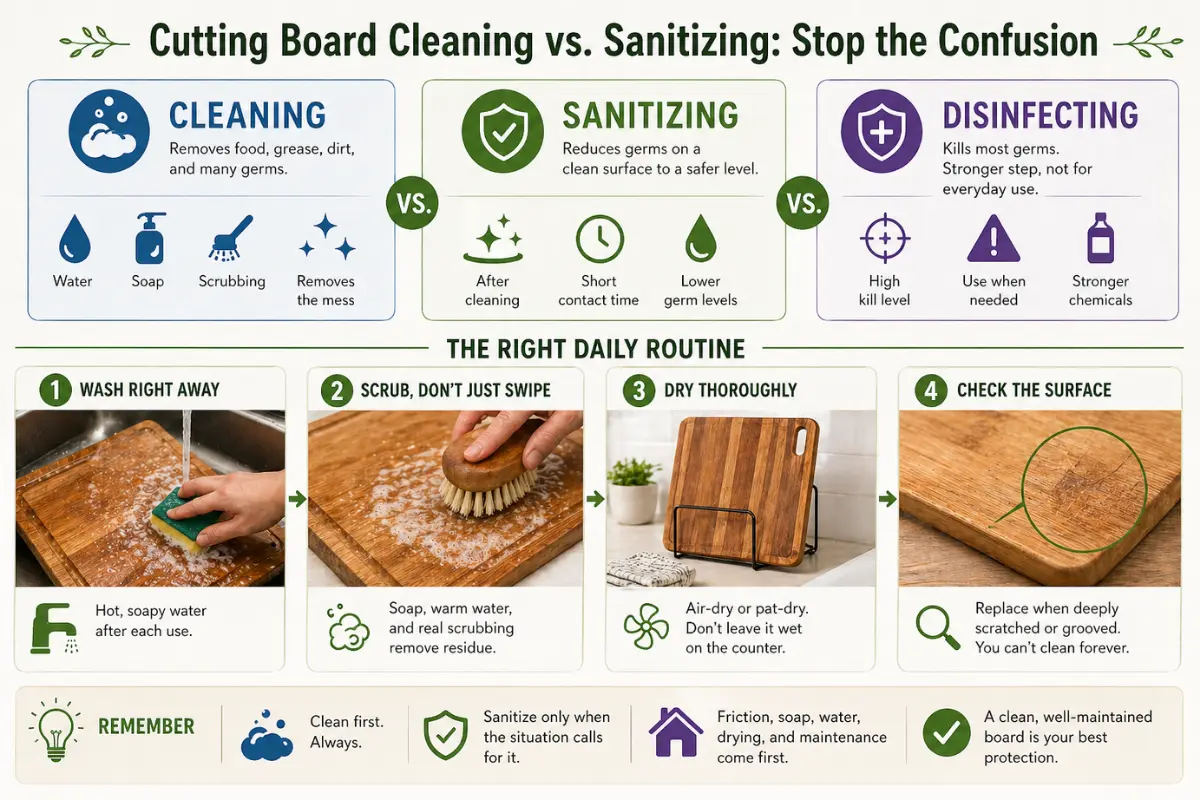
Cleaning removes food, grease, dirt, and many germs from the surface. Sanitizing reduces the germs left behind to a safer level. Disinfecting is a stronger kill step, but in a normal home kitchen it is not the default answer to everything. CDC says cleaning is done with water, soap, and scrubbing, and that surfaces should be cleaned before they are sanitized or disinfected because dirt can make it harder for those products to work.
That matters because a lot of people use chemicals like a shortcut for weak cleaning. In a Zero Toxic Load kitchen, the better principle is simple: use friction, soap, water, drying, and smart maintenance first. Reach for an extra sanitizing step when the situation actually calls for it, not because the internet made you feel guilty for washing a board normally. CDC also notes that cleaning alone removes germs and dirt from surfaces, which is exactly why it remains the foundation.
The Right Daily Routine
Forget miracle sprays. The real work is mechanical.
1. Wash the board right away
USDA recommends washing cutting boards with hot, soapy water after each use, then rinsing with clear water and air-drying or pat-drying. That is still the core routine because it removes the residue bacteria live in, not just the bacteria themselves.
2. Scrub, do not just swipe
A lazy wipe is not cleaning. Soap, warm water, and actual scrubbing remove oils, starches, juices, and debris that stay trapped on the board if you rush the job. CDC’s cleaning guidance is blunt here: cleaning is done with water, soap, and scrubbing.
3. Dry thoroughly
A wet board left flat on the counter or shoved into a drawer is asking for problems. Drying is part of the cleaning process, not an optional extra. USDA says to air-dry or pat-dry after washing, and CDC also stresses allowing cleaned surfaces to dry appropriately.
4. Pay attention to the surface itself
FDA says scratched and scored cutting surfaces can become difficult to clean and sanitize. USDA says to replace boards once they become excessively worn or develop grooves that are hard to clean. That is the part people ignore for too long. You cannot rescue a board forever just because you mean well.
Choose boards worth maintaining: cutting board materials ranked for toxin load and durability.
How to Season a Wood Cutting Board Properly
If your wood board looks gray, feels dry, or starts absorbing stains too easily, it is not “rustic.” It is drying out.
University of Maine Extension recommends conditioning wooden boards with food-safe mineral oil or beeswax about once a month, or more often if the board appears dry. That conditioning helps maintain the board’s integrity and reduce drying or cracking over time. The same source also says to avoid cooking oils such as olive or vegetable oil because they can become sticky and turn rancid.
The Healthy Home Upgrade method
- Make sure the board is clean and fully dry.
- Apply a generous layer of food-safe mineral oil or a beeswax-based board cream.
- Let it absorb for several hours or overnight.
- Wipe off the excess before using the board again.
That is the kind of maintenance that actually matters. It is not glamorous, but it keeps the board more stable, easier to clean, and less likely to crack.
What Actually Works Without Bleach or Harsh Chemicals
This is where a lot of “natural cleaning” content drifts into fluff.
If you want a gentler extra sanitizing step, University of Maine Extension specifically lists undiluted white vinegar, apple cider vinegar, and 3% hydrogen peroxide as food-safe household sanitizers that may help reduce microbial contamination on cutting boards. It also says that if you use hydrogen peroxide, you should rinse the board thoroughly with clean water and allow it to air-dry.
So the practical HH hierarchy looks like this:
- Daily use: hot soapy water, scrubbing, full drying
- Wood care: mineral oil or beeswax regularly
- Extra sanitizing without bleach: 3% hydrogen peroxide or undiluted vinegar when you want an additional step
- Higher-risk situations: separate board for raw meat, plus stricter cleanup discipline
That is far more useful than turning every ordinary kitchen task into a chemical event.
Complete your safe prep station: best non toxic kitchen tools.
What to Do After Raw Meat, Poultry, or Seafood
This is where people should be stricter, not more theatrical.
USDA recommends keeping separate cutting boards for raw meat, poultry, and seafood versus ready-to-eat foods like fruit, vegetables, or bread to reduce cross-contamination. USDA also notes that dishwasher-safe cutting boards can be cleaned and sanitized in the dishwasher.
So if you want the least stressful system, do this:
- use your good wood board for produce, bread, herbs, and general prep
- keep a separate board for raw meat
- clean it immediately after use
- sanitize when appropriate
- replace it sooner if it becomes deeply grooved or hard to clean
In a Zero Toxic Load kitchen, that is a smarter compromise than trying to force one beautiful board to do everything.
The Biggest Mistake: Trusting Lemon and Salt to Do a Serious Job
This is where I part ways with social-media cleaning advice.
Lemon and coarse salt can help with odor and surface residue. Salt gives mild abrasion. Lemon smells fresh. But that does not make the combo a serious sanitizing strategy. USDA, CDC, and University of Maine Extension do not present lemon-and-salt rubbing as the main answer for food-safe cutting board sanitizing. Their guidance centers on soap and water first, then appropriate sanitizers when needed. Based on that, it is fair to say lemon and salt may help cosmetically, but they should not be treated as the food-safety backbone of your routine.
Use lemon because you like the smell or want a little freshening. Do not confuse that with doing the real job.
Clean boards meet clean pans: safest cookware materials.
When to Give Up on a Board
You cannot clean your way out of physical damage.
If a plastic board is deeply scored and rough, if a bamboo board is cracking, or if a wood board has serious splits that no longer let it clean up properly, it is time to stop pretending and replace it. USDA says boards should be replaced when they become excessively worn or develop hard-to-clean grooves. FDA says scratched and scored surfaces may become difficult to clean and sanitize.
In a healthier home, this is a bigger rule than any homemade spray recipe: know when the surface itself is no longer trustworthy.
A Simple Product Recommendation
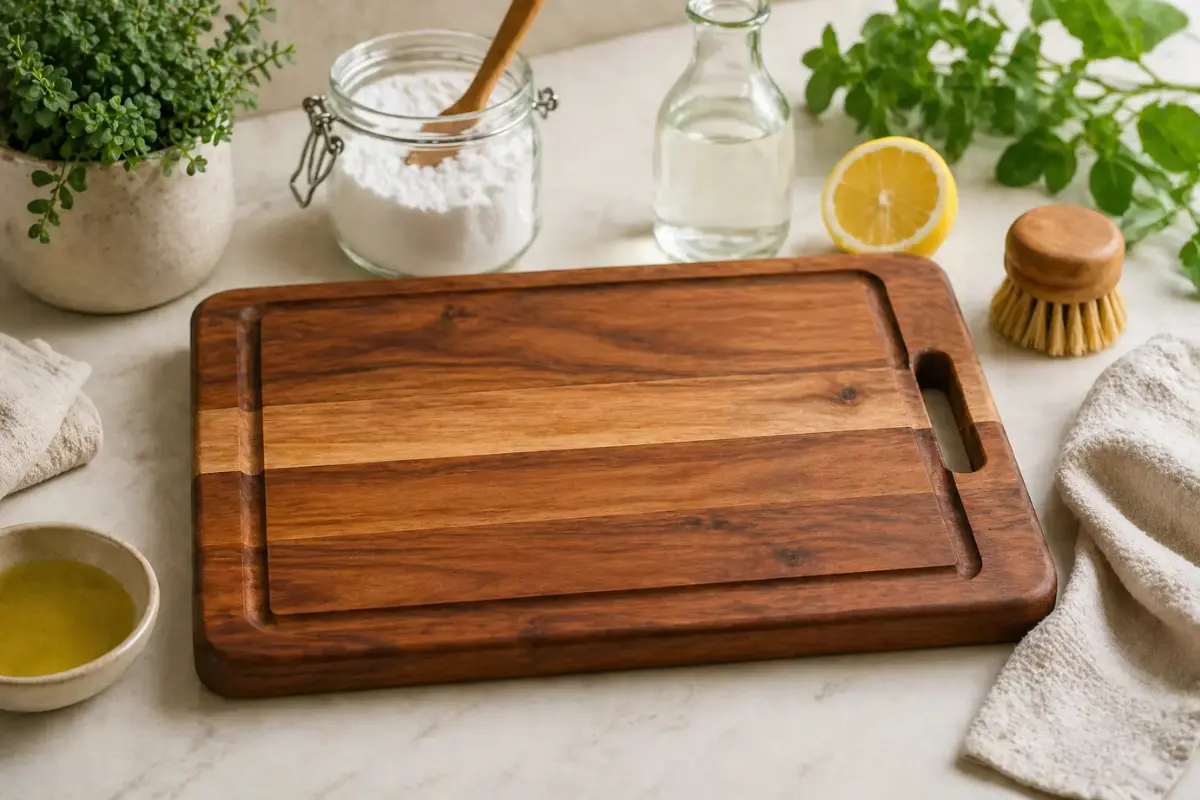
If you want to keep a wood cutting board in good condition, I would keep the routine very simple: one food-safe mineral oil for regular conditioning, and one beeswax board cream for a slightly richer finish when the surface feels dry or tired. Mineral oil is useful for deep, no-fuss maintenance, while a beeswax cream helps seal the surface and leaves the board feeling smoother and more protected. You do not need a huge collection of products for this. A basic, food-safe oil and a well-made board cream are enough for most kitchens. You can check a simple mineral oil option here and a beeswax board cream here.
Final Verdict
If you want the simplest answer, it is this:
Wash promptly with hot, soapy water. Dry thoroughly. Condition wood regularly. Use 3% hydrogen peroxide or undiluted vinegar as an extra step when needed. Replace boards when the surface is no longer truly cleanable.
For a kitchen built around Zero Toxic Load, that is a better long-term strategy than swinging between neglect and chemical overload. The point is not to sterilize your life. The point is to keep food-contact surfaces genuinely clean without building your routine around harsh chemicals or fake “natural” shortcuts.
FAQ
Can I disinfect a cutting board without bleach?
For an extra sanitizing step, University of Maine Extension says you may use 3% hydrogen peroxide, undiluted white vinegar, or apple cider vinegar on household cutting boards. For hydrogen peroxide, rinse thoroughly and let the board air-dry afterward.
Is hydrogen peroxide okay for food-contact surfaces?
University of Maine Extension specifically includes 3% hydrogen peroxide among food-safe household sanitizers for cutting boards, with the instruction to rinse thoroughly afterward. For commercial settings, it advises checking the product label for food-contact-surface suitability.
Should I use olive oil or vegetable oil on a wood cutting board?
No. University of Maine Extension recommends food-safe mineral oil or beeswax instead and specifically warns against cooking oils such as olive or vegetable oil because they can become sticky and turn rancid over time.
When should I replace my cutting board?
Replace it when it becomes excessively worn, cracked, split, or develops grooves that are hard to clean. USDA says that plainly, and FDA’s guidance points in the same direction.

Anita is the founder and writer behind Healthy Home Upgrade, where she shares her passion for transforming living spaces into foundations for smart health and wellness. Driven by her personal health journey, her goal is to provide valuable, practical articles that empower readers to use technology and design to improve their quality of life.