When people compare Berkey vs Reverse Osmosis vs Pitcher Filters, they often focus on aesthetics, convenience, or brand reputation first. That is usually the wrong order. The smarter place to start is your actual water, the contaminants you care about, and how much maintenance and material compromise you are willing to accept in daily life.
If you are leaning toward a gravity system and want a deeper dive into one of the most popular options, you can read the full Berkey Water Filter Review for pros, cons, and test-driven details. A lower-toxin kitchen is not about buying the biggest or most expensive filter; it is about choosing the lightest, simplest setup that still matches your actual water concerns and your low‑waste goals.
Quick Answer
For many city-water households, a certified pitcher or faucet filter is the easiest and most practical first step if the main issue is chlorine taste, odor, or a modest lead concern. Reverse osmosis is the stronger choice when the concern is more serious, such as PFAS, arsenic, nitrate, or high dissolved solids. A Berkey-style gravity system can still make sense for countertop-only, no-plumbing, or off-grid use, but it requires more buyer judgment because the certification story is less direct than with many certified RO or pitcher systems.
At a Glance
| Setup | Best for | Main strengths | Main tradeoffs | Overall take |
| Pitcher or faucet filter | Treated city water, renters, small kitchens | Easy, affordable, simple to use, often good for taste and chlorine | Small capacity, frequent cartridge changes, usually plastic-heavy | Best first step for many homes |
| Reverse osmosis | Known contaminant concerns, under-sink installs, high-TDS water | Broad reduction potential, strong certification pathway, useful for more serious water issues | Reject water, more parts, more upkeep | Strongest technical option when your water data justifies it |
| Berkey-style gravity filter | No-plumbing households, off-grid use, countertop filtration | Stainless body, no electricity, portable, simple concept | Slower flow, manual filling, less straightforward certification story | Niche but appealing option if portability matters |
Also in This Article
- What matters before you buy
- Berkey vs Reverse Osmosis vs Pitcher Filters: The real tradeoffs
- Materials, maintenance, and the low-toxin lens
- Anita’s perspective
- Which setup fits which home
- FAQ
What Matters Before You Buy
A filter is only useful if it solves the problem you actually have.
If your tap water mostly tastes like chlorine, that is a very different situation from lead in old plumbing, PFAS in local water supplies, or a private well with nitrate or arsenic concerns. Many people buy filters because they want water to taste better, but better taste is not the same thing as broader contaminant reduction.
Before choosing a system, ask:
- What does your local water report or home test show?
- Which contaminants are the real concern?
- Do you need a simple improvement, or a deeper treatment system?
That framing is far more useful than buying based on trend, fear, or kitchen aesthetics.
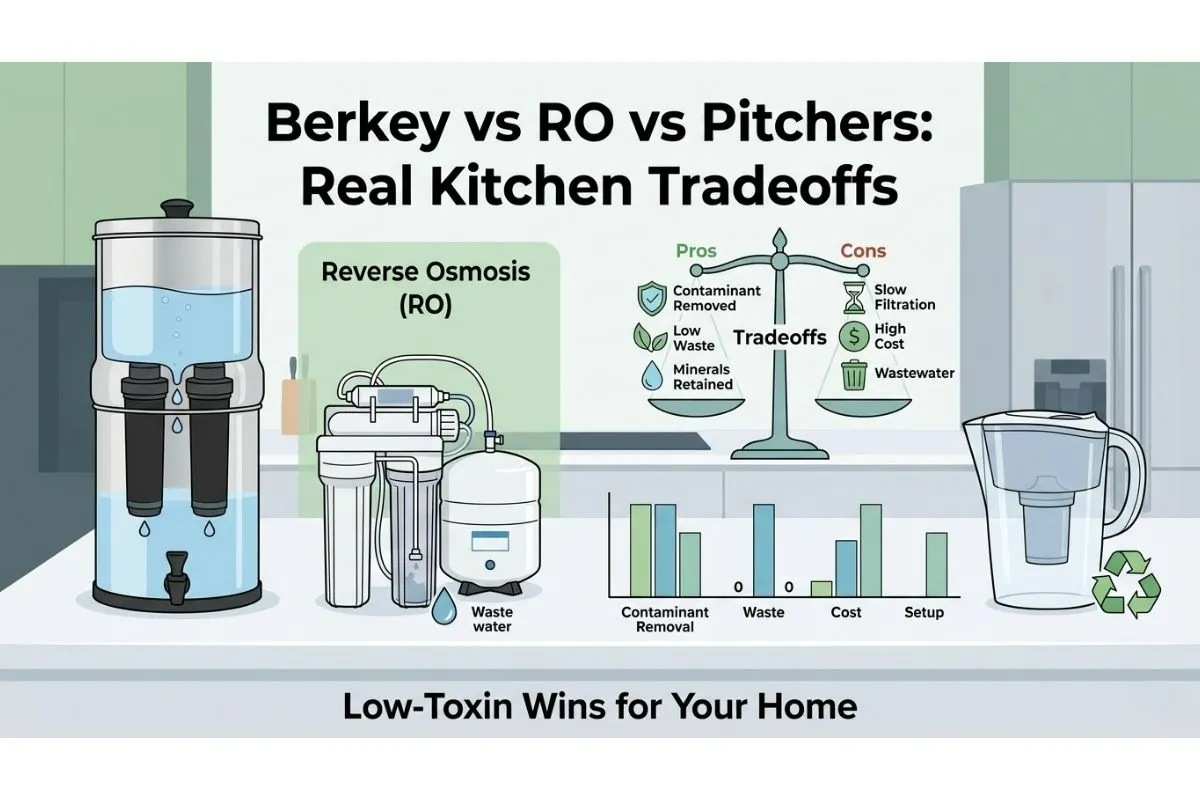
Berkey vs Reverse Osmosis vs Pitcher Filters: The Real Tradeoffs
Pitcher and faucet filters
For many homes, this is the most realistic category to start with. A good certified pitcher or faucet filter can make water taste better, reduce chlorine, and in some cases also target lead or other specific contaminants, depending on the exact model and certification.
This category works best when the water is already municipally treated and the goal is a lighter upgrade rather than full-scale purification.
Weakness: Most models have limited capacity, need regular cartridge changes, and rely heavily on plastic housings.
Who should avoid this: Households with known PFAS, arsenic, nitrate, or broader water-quality problems that require deeper reduction than a basic carbon-based system can usually provide.
Reverse osmosis
Reverse osmosis is the strongest technical option in this comparison when the water issue is real and specific. It is designed for deeper reduction and is often the most sensible step up when water data points to PFAS, arsenic, nitrate, or high dissolved solids.
It is also the category most likely to feel less simple in everyday life. There is usually an under-sink setup, more fittings, more maintenance, and some reject water as part of the process.
RO can also reduce beneficial minerals along with unwanted contaminants. Because of that, some households prefer a remineralization stage for taste and a more natural mineral profile. That does not make remineralization mandatory for everyone, but it can make sense depending on preference and system design.
Weakness: Reject water, more components, more maintenance, and usually more plastic in the system than people initially expect.
Who should avoid this: People whose only real issue is taste, or anyone likely to neglect maintenance because the setup feels too involved.
Berkey’s gravity-fed power crushes contaminants. Our full review → Berkey Water Filter Review
Berkey-style gravity filters
A Berkey-style gravity system is appealing for understandable reasons. It does not need plumbing, it does not require electricity, and the stainless steel body feels calmer and cleaner than the average plastic pitcher. It is also portable, which is useful for countertop living, travel, or more off-grid use cases.
The tradeoff is that the certification story is less straightforward. That does not automatically mean the system is ineffective. It means the buyer has to work harder to evaluate claims, replacement parts, and the difference between genuine components and lookalikes.
This is also a category where maintenance matters more than many people assume. Water sitting in a gravity system still needs a clean routine and properly managed filter changes.
Weakness: Less straightforward certification trail, slower flow, manual filling, and more room for buyer error.
Who should avoid this: Anyone who wants the clearest certification pathway, or households dealing with more serious contaminant concerns where a stronger verified reduction system would be easier to defend.
Quick-swap faucet filters that slash toxins without waste → Best Faucet Water Filter
Materials, Maintenance, and the Low-Toxin Lens
This is where a stricter standard matters.
Glass and stainless steel are still the cleanest material choices where they are genuinely available. That said, many pitchers, reverse osmosis tanks, housings, and cartridges still involve plastic. In this category, the goal is not fantasy-level purity. It is better material transparency, safer food-contact surfaces where possible, and fewer vague claims.
Maintenance matters just as much as materials. Any water filter is only as good as the routine behind it. If it needs regular cleaning, cartridge changes, or verified replacement parts, that is not a small side note. It is part of the product.
A filter that works well only when properly maintained should be judged with that reality in mind.
RO for the entire home: Low-maintenance purity everywhere → Whole House Reverse Osmosis System
Anita’s Perspective
At Healthy Home Upgrade, I do not judge a filter by how “clean” it looks on the counter. I look first at contaminant fit, certification clarity, maintenance reality, and material transparency.
A stainless gravity system can be appealing from a lower-plastic perspective, but that alone does not make it the smartest choice. If PFAS, arsenic, lead, nitrate, or high dissolved solids are the real issue, a certified reverse osmosis system usually has the stronger technical case. If your water is already fairly clean and the goal is a lighter everyday upgrade, a certified pitcher or faucet filter can be the calmer and more sensible move.
DIY water tests reveal kitchen toxins. Start here → How To Test Your Water Quality
Which Setup Fits Which Home
Best for renters with treated city water
Start with a certified pitcher or faucet filter. It is simple, low-commitment, and often enough if the real problem is chlorine taste, odor, or a modest lead concern.
Best for serious contaminant concerns
Choose reverse osmosis when your water data points to a deeper issue. This is usually the strongest category when the problem is more than taste and convenience.
Best for no-plumbing or off-grid use
A Berkey-style gravity system still has a place. It works best when portability, stainless construction, and sink-free use matter more than speed or a very straightforward certification trail.
Best for a low-waste kitchen that still values realism
Start with the least aggressive setup that actually matches your needs. Upgrade only if your water data gives you a clear reason to do so.
Shower filters that block chlorine for healthier skin → Best Shower Filter for Chlorine
FAQ
Is Berkey better than reverse osmosis?
Not as a blanket rule. Reverse osmosis usually has the stronger certification framework and deeper reduction potential for more serious contaminant concerns. A Berkey-style system is more attractive for portability and no-plumbing use, but it is not automatically the better technical choice.
Is reverse osmosis too much for normal city water?
Sometimes, yes. If the main issue is taste and chlorine, a good certified pitcher or faucet filter may be enough. Reverse osmosis makes more sense when your water data shows a stronger reason to step up.
Does reverse osmosis remove minerals?
Yes, it can reduce beneficial minerals along with unwanted contaminants. Some households like a remineralization stage for taste and mineral profile, while others do not see it as necessary.
Are all pitcher filters basically the same?
No. The exact model and its certification matter far more than the category name. Some are mainly for taste and chlorine. Others target additional contaminants.
Is maintenance really that important?
Yes. A filter that is not cleaned properly or does not get replacement parts on time cannot be judged only by the claim on the box.
Final Verdict
If you strip away the marketing noise, Berkey vs Reverse Osmosis vs Pitcher Filters comes down to one honest rule: use the lightest system that still matches your real water risk. A certified pitcher or faucet filter is often enough for treated city water and a simple daily upgrade. Reverse osmosis is the stronger move when the contaminant burden is real and you want the clearest technical case. A Berkey-style gravity system remains attractive for stainless, no-plumbing, lower-tech living, but it asks more of the buyer in terms of judgment, maintenance, and trust.
RO myths exposed: Safe, mineral-balanced water decoded → Is Reverse Osmosis Water Too Pure?
References
- CDC, About Choosing Home Water Filters
- CDC, About Home Water Treatment Systems
- CDC, Preventing Waterborne Germs at Home
- NSF, Standards for Water Treatment Systems
- NSF, NSF/ANSI 42, 53 and 401
- EPA, Point-of-Use Reverse Osmosis Systems
- EPA, Reducing PFAS in Your Drinking Water with a Home Filter
- EPA, Identifying Drinking Water Filters Certified to Reduce PFAS
- Berkey Knowledge Base, Are the Black Berkey Elements NSF certified?
- Berkey Water Systems, Counterfeits and Lookalikes