
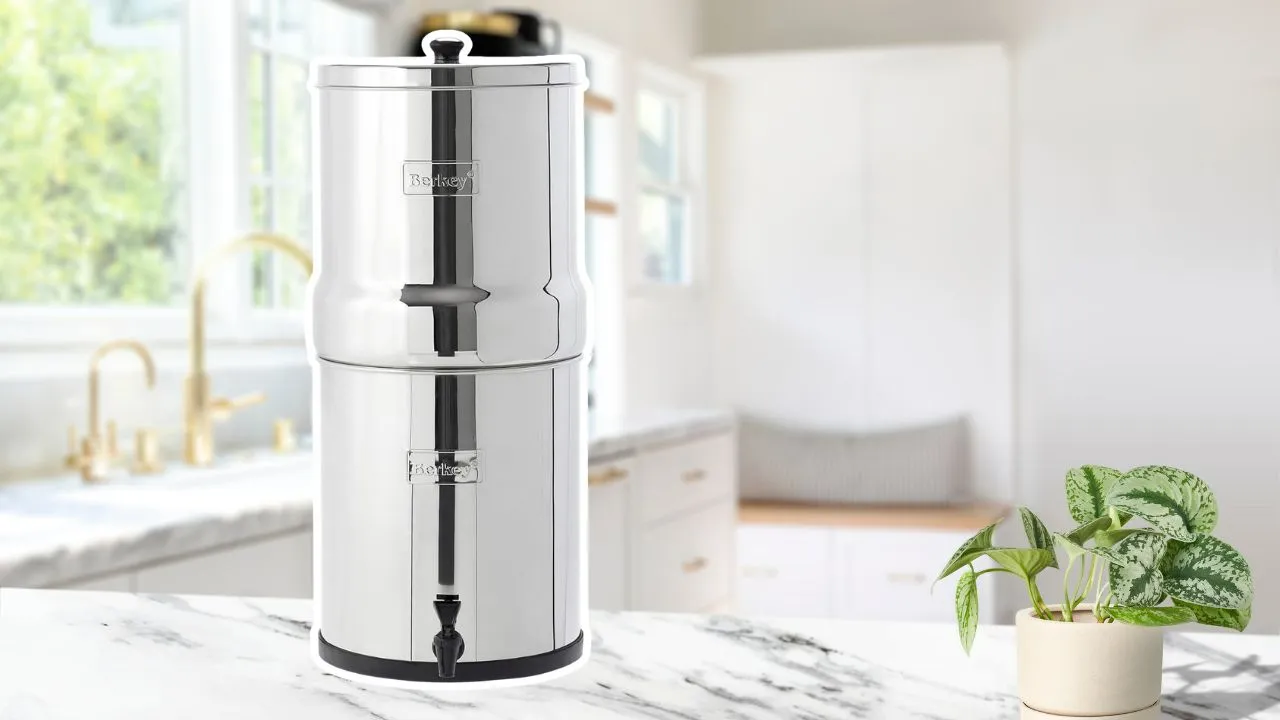
Berkey Water Filter Review 2026: Still Worth the Hype?
Is a Berkey water filter still worth it? This hands-on review looks at the stainless-steel system through the lens of purity, independence, and modern minimalist living.
Top Picks – Berkey Water Filter (2025–2026)
Best Overall Berkey System
Big Berkey 2.25-Gallon System
Best for families of 2–4 who want dependable daily drinking water with minimal refills.
Best for Larger Families
Royal Berkey 3.25-Gallon System
Ideal for households of 4–6 or anyone who wants extra capacity for cooking, coffee, and pets.
Best Compact / Travel Option
Travel Berkey 1.5-Gallon System
A space-saving choice for singles, couples, vans, and tiny kitchens.
Best Compatible Replacement Filter (Third-Party)
Boroux Foundation Filters (for Berkey-style systems)
Compatible with many gravity systems, long advertised lifespan per pair, and designed to target a broad range of common tap-water contaminants.
Best Budget-Compatible Option (Lower Coverage)
Super Sterasyl Ceramic Elements
Older ceramic technology with more basic contaminant coverage, but often more affordable and easier to find.
Our favorite setup in 2026: For most homes, the sweet spot is the Big Berkey 2.25-Gallon paired with high-performance elements (original Black Berkey or compatible cartridges) for drinking and cooking, plus a simple under-sink or reverse-osmosis system if you want extra protection for all faucets in the house.
Berkey Water Filter Review in 2026 — Is It Still Worth It?
Pure water has quietly become the new form of luxury. In 2026, the homes that value calm, health, and design no longer hide their water systems under the sink — they display them proudly on the counter. And among all the choices on the market, one name still echoes through wellness communities, minimalist kitchens, and off-grid cabins: Berkey.
In a world of smart purifiers, Wi‑Fi apps, and self-cleaning membranes, a stainless-steel gravity filter can feel almost nostalgic. The real question is simple: Is Berkey still worth it today?
The short answer: yes — if you value independence, mineral-rich water, low ongoing costs, and a quiet, analog ritual more than app dashboards and instant flow.
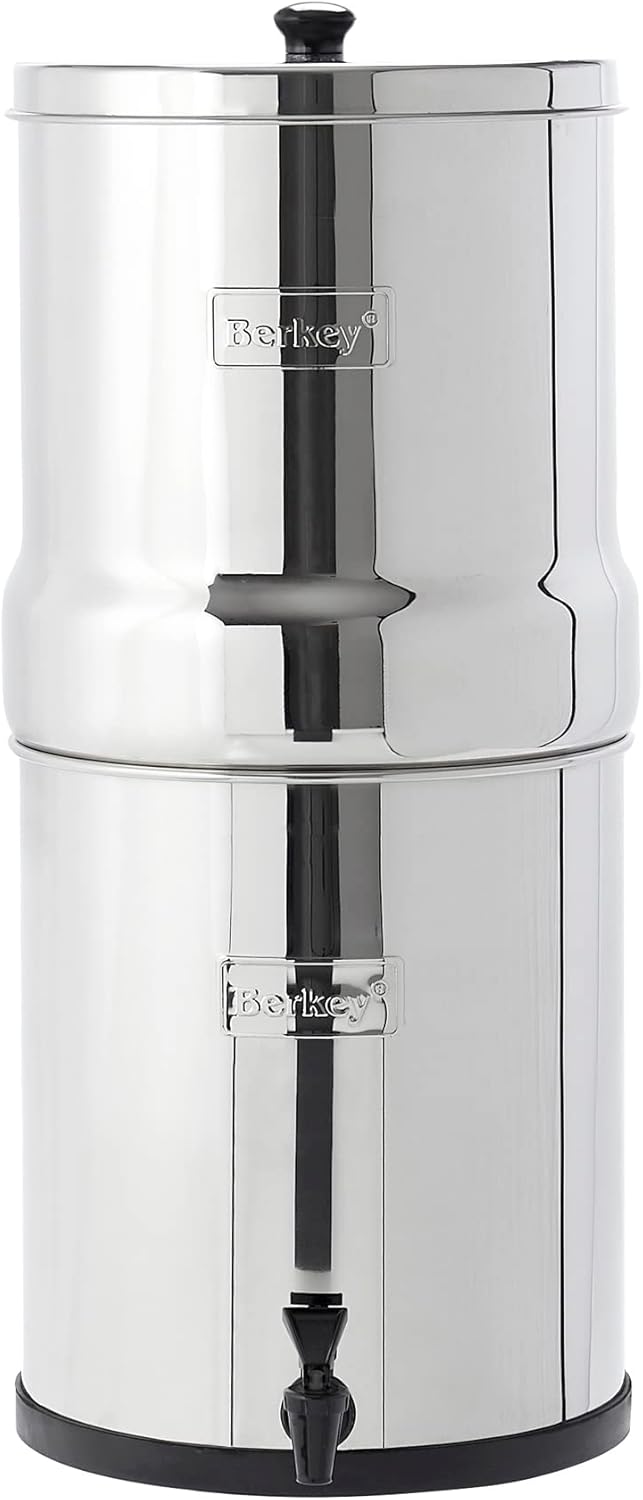
Models at a glance – editor’s review
Use this quick table to see which Berkey size fits your home.
| Model | Best for | Capacity (approx.) | Filtration type | Typical use pattern | Approx. system price* |
| Travel Berkey 1.5 Gal | Singles, couples, small counters, vans | 5.7 L | Gravity carbon + microfiltration elements | 1–2 refills per day for drinking only | ≈ $323 / €309 |
| Big Berkey 2.25 Gal | Most families (2–4 people) | 8.5 L | Same element set (2 or 4 filters) | Morning and evening refills for drinking + cooking | ≈ $387 / €369 |
| Royal Berkey 3.25 Gal | Families (4–6 people) or heavy water use | 12.3 L | Dual or quad elements for faster flow | 1–2 refills per day for heavy use, guests, pets | ≈ $436 / €419 |
*Prices vary by region and retailer; check current pricing before you buy.
If you’re just starting out, the Big Berkey is the safest “one-and-done” choice, while the Travel Berkey works well for smaller spaces or as a dedicated second unit in an office, cabin, or camper.
Design & build – stainless simplicity
Each Berkey looks more like a designer appliance than a survival tool. Two polished stainless cylinders nest together when empty, and the reflective finish blends easily into most kitchens.
There are no power cords or touch screens — just gravity pulling water through the elements. Inside, the Black Berkey-style elements combine carbon and microfiltration to target a wide range of contaminants such as bacteria, protozoa, many common heavy metals, chlorine, some PFAS, pesticides, and microplastics, while leaving beneficial minerals in place.
This slow, steady process is what gives Berkey water its “calm” taste — clean without being flat.
Want a deeper dive into contaminant types and how they behave in homes? See your guide to How to Test Your Water Quality for simple, at-home steps.
Flow rate & real‑world use
“How long does it take to filter a full tank?” With two fresh elements, a Big Berkey commonly produces around 4 litres per hour — roughly a litre every 15 minutes — though this can vary with water temperature, element age, and sediment level.
Most owners quickly fall into a rhythm:
- Fill the upper chamber in the morning (for daytime drinking, coffee, smoothies).
- Fill again in the evening (for next morning’s water and cooking).
Flow & noise comparison
| System type | Typical flow rate | Power needed | Noise level |
| Pitcher filter | ≈ 0.2 L/min (when full) | No | Silent |
| Berkey gravity system | ≈ 0.07 L/min | No | Gentle drip |
| Smart RO system | ≈ 1.8 L/min | Yes (plug-in) | Low hum |
After a few months, all gravity filters slow somewhat as fine particles accumulate in the outer pores. A quick scrub or “re-priming” under running water usually restores flow and keeps the drip consistent.
Who uses it & why
The Berkey has become a quiet favorite across several groups:
- Minimalist and wellness-focused households love that it sits on the counter as a visual reminder to hydrate.
- Endurance athletes and van dwellers use it in vans, cabins, and off-grid setups.
- Parents appreciate having one central source of drinking water for baby bottles, smoothies, and kids’ water bottles.
- Designers and home organizers like its timeless stainless look and the way it pairs with glass bottles and carafes.
For many people, it feels less like a gadget and more like part of a daily ritual: fill, pause, pour, repeat.
If you like this “everyday wellness” approach, you may also enjoy the guide to Best Reusable Water Bottles, which pairs perfectly with a Berkey on the counter.
From tap to river – adaptable purity
One of Berkey’s strengths is flexibility: it can handle many water sources, as long as you use common sense.
| Source type | How suitable it is | How people typically use it |
| Treated city tap (US/EU) | Ideal | Daily drinking, cooking, coffee, tea |
| Well or spring water | Excellent (if tested) | Rural homes; test periodically for minerals & metals |
| Rainwater | Good with a simple pre-filter cloth | Eco-homes and cabins; retains minerals |
| Lake / river water | For emergency situations | Use with a cloth pre-filter; avoid obviously polluted sources |
| Seawater | Not suitable | Gravity elements do not remove salt effectively |
The key principle is simple: the clearer your source water, the easier it is for the elements to do their job and the longer they last.
For a whole-home solution that treats every tap and shower, you can pair a Berkey with a whole house water filter or whole-house reverse osmosis system and reserve the Berkey for drinking and cooking.
Independent performance & filter options (2025–2026)
Recent third-party lab testing (commissioned by Berkey and by compatible-filter brands) continues to show strong performance for gravity elements in this category against typical tap-water contaminants such as chlorine, many heavy metals, and certain PFAS compounds, while retaining healthy minerals.
Filter options for Berkey-style systems
If you already own a Berkey or another stainless gravity system, you have several element types to choose from:
- Black Berkey-style elements
- High-capacity carbon and microfiltration elements designed for wide contaminant coverage and long life.
- Popular for households that want “set it and forget it” simplicity with occasional cleaning.
- Boroux Foundation filters (compatible)
- Third-party cartridges designed to fit many gravity systems, with published lab reports aligned to NSF standards.
- Advertised to filter thousands of gallons per pair, making them a strong long-term option for heavy water users.
- Super Sterasyl ceramic elements
- Classic white ceramic filters with a more basic contaminant profile than the latest carbon composites.
- A workable option when you want simpler filtration and prefer ceramic technology.
When choosing elements, focus on three questions:
- Which contaminants matter most in your water?
- How many litres per day do you realistically use?
- How often are you willing to clean or replace filters?
For help answering the first question, your step-by-step guide to testing your water quality is a useful starting point.
Taste & mineral balance
Unlike many reverse-osmosis systems that strip everything — including beneficial minerals — Berkey-style gravity filters are designed to keep calcium and magnesium intact while reducing unwanted contaminants.
In daily life, that means:
- Water tastes naturally sweet, not “flat.”
- Coffee and tea often have a cleaner aroma and less bitterness.
- Many people notice plants and pets seem to prefer Berkey water over straight tap.
If you’re curious about how “pure” water should be, you can explore Is Reverse Osmosis Water Too Pure? for a nuanced, science-forward comparison.
Sustainability & cost efficiency
Every pair of long-life gravity elements replaces thousands of single-use bottles. There is no electricity usage, and the stainless-steel housing can last for decades with basic care.
Annual costs and energy use
| System type | Approx. annual filter cost | Typical element lifespan | Energy use |
| Berkey (Big) | ≈ $45 / €42 (averaged) | 8–10 years (up to ~22 000 L, depending on use) | None |
| Smart RO system | ≈ $120 / €110 | 2–3 years | Medium (pump + waste-water) |
| Pitcher filter | ≈ $80 / €75 | 1 year (with frequent cartridge changes) | None |
10-year cost & ROI (illustrative)
| System | 10-year estimated cost | Litres filtered (approx.) | Cost per litre |
| Berkey | ≈ $450 | 22 000 L | ≈ $0.02 |
| RO system | ≈ $1 200 | 15 000 L | ≈ $0.08 |
| Pitcher filter | ≈ $800 | 5 000 L | ≈ $0.16 |
These are ballpark figures, but they show why many families see Berkey-style systems as a long-term investment in both health and sustainability.
Daily living – the ritual of gravity
Each morning starts the same way: fill the upper chamber, put the kettle on, then come back to a lower chamber quietly filled with clear water. It is a small ritual that turns waiting into intention.
There is a rhythm to it:
- Fill when you wake up.
- Pour through the day.
- Top up again in the evening.
Families often describe the gentle drip as part of the soundscape of their home — a soft reminder that clean water is something you participate in, not just a lever you flip.
If you love pairing mindful rituals together, consider matching your Berkey with a stainless steel ice cube tray or best glass food storage containers so your clean water stays away from questionable plastics in the freezer and fridge.
For families, babies, and pets
Parents often want to know whether Berkey water is gentle enough for baby formula and everyday kid hydration. In practice, many families use Berkey-filtered water for:
- Mixing formula (after consulting their pediatrician, especially for infants with special needs).
- Filling kids’ water bottles and lunch flasks.
- Making smoothies, soups, and broths.
Because gravity filters retain minerals while reducing common tap-water contaminants, the resulting water tends to be well tolerated by most adults, children, and pets.
Owners also commonly notice:
- Fewer digestive upsets in sensitive pets once chlorinated tap water is replaced.
- Better acceptance from picky water drinkers who dislike the taste of heavily chlorinated city water.
Maintenance made simple
One of Berkey’s biggest advantages is how simple it is to maintain without tools or apps.
- Monthly
- Wipe the chambers, lid, and spigot with mild, fragrance-free soap and rinse well.
- Every 3–6 months
- Remove the elements, gently scrub the outer surface with a non-abrasive pad, and re-prime under running water.
- Annually
- Inspect rubber gaskets, stainless seams, and spigot fittings.
- Every 8–10 years (approx.)
- Replace the main gravity elements, or sooner if your water has high sediment or if performance noticeably changes.
Many systems include a simple red-dye test or similar “proof of performance” method: if colored water passes through unchanged, it is time to replace the elements. Seeing the difference with your own eyes builds trust in a way that app dashboards often cannot.
FAQ – Berkey water filter, answered simply
Is a Berkey water filter still worth it in 2026?
Yes, if you value mineral-rich drinking water, independence from electricity, and low long-term costs more than instant high flow. For many homes, a Berkey on the counter plus a basic whole-house solution offers an excellent balance.
Which Berkey size should I choose?
Most families are happiest with the Big Berkey (2.25 gallons), while larger households or heavy water users often prefer the Royal Berkey (3.25 gallons). The Travel Berkey suits singles, couples, and tiny spaces.
Does Berkey water still contain minerals?
Gravity systems like Berkey are designed to retain beneficial minerals such as calcium and magnesium while reducing many unwanted contaminants, so the water tastes “alive” rather than flat.
How often do I need to replace the filters?
With typical household use on city water, main elements can last several years and up to around 8–10 years in ideal conditions, though high sediment or heavy daily use will shorten that timeline.
What’s better for health: Berkey or reverse osmosis?
Reverse osmosis removes almost everything (including minerals) and is ideal when you need very low TDS at every tap. Berkey is ideal when you want to keep minerals while improving taste and reducing common contaminants at your drinking and cooking station; many households combine both.
Can I use Berkey water for babies and pets?
In many homes, yes: people use Berkey water for baby bottles, kids’ cups, and pet bowls. If your child has specific medical needs or your tap water has unusual chemistry, check with a healthcare provider and consider a detailed water test first.