Last Updated: May 2026
Quick Answer
A sleep score is not just a number. Used the right way, it can become a practical guide to what your bedroom and evening routine may need next.
If your tracker shows repeated wake-ups, poor sleep efficiency, higher resting heart rate, low HRV, long sleep latency, or fragmented REM sleep, the answer is not always a supplement, a new device, or a new mattress.
Sometimes the first changes are much simpler:
- Stop eating heavy meals too late
- Dim the lights earlier
- Make the room darker
- Cool the bedroom
- Reduce screen stimulation
- Improve air quality
- Drink calming tea earlier, not right before bed
- Test simple foods like kiwi, tart cherry, or a few pistachios without turning food into another obsession
I use my Oura Ring 4 to look for patterns in my own sleep and recovery. Not to obsess over one bad night, but to ask better questions.
Is my room too warm?
Did I get too much light at night?
Did I eat too late?
Did I drink too much too close to bed?
Is my mattress helping me recover or keeping my body tense?
Is the air in the bedroom clean enough for deep sleep?
Am I using technology in a way that supports my nervous system or stresses it?
The goal is not to let your tracker control your life. The goal is to use sleep data as a gentle signal that helps you upgrade your habits and bedroom in a smarter, more personal way.
Consumer sleep trackers can be helpful trend tools, but they are not medical sleep studies. The American Academy of Sleep Medicine has stated that consumer sleep technologies should not be used to diagnose or treat sleep disorders when they lack proper validation and FDA clearance.
Also in This Article
- How to use sleep scores without becoming anxious
- What your tracker may reveal about your bedroom
- Why late eating and late drinking can affect sleep
- Simple sleep supportive foods to test gently
- How darkness, eye masks, and blackout curtains can help
- How mattress comfort and temperature show up in sleep data
- How light affects latency and recovery
- How air quality may influence nighttime disruption
- How I use Oura Ring 4 as a bedroom feedback tool
- A simple 7 night bedroom upgrade test
- When not to blame the bedroom
- Which HH guides to read next
Why Your Sleep Score Should Not Be the Final Judge
A sleep tracker can tell you when your sleep looked restless, short, fragmented, or less restorative than usual.
But it cannot always tell you why.
That is where many people go wrong. They see a lower sleep score and immediately think their body is failing. Or they start changing everything at once: supplements, bedtime, workouts, food, caffeine, apps, temperature, pillows, lighting, air purifiers, and morning routines.
That creates confusion.
A better approach is to treat your sleep tracker like a pattern detector.
The useful question is not:
“Why was my score bad?”
The useful question is:
“What was different in my bedroom, body, or routine?”
That is where the data becomes practical.
My Real Life Experience With Oura Ring 4
I use my Oura Ring 4 because I wanted a calmer way to understand my sleep and recovery without wearing a bright screen on my wrist at night.
For me, the most useful part is not one single sleep score. It is the pattern.
When my HRV is lower, resting heart rate is higher, or my sleep looks more fragmented, I ask what changed.
Was the room too warm?
Did I scroll too late?
Did I eat too late?
Was I emotionally stressed?
Was the air in the bedroom stuffy?
Did I sleep on a mattress or pillow setup that made my body tense?
Did I ignore my wind down routine?
Did I drink something too close to bed and wake up to use the bathroom?
That is how sleep data becomes useful. It helps me connect what I feel in my body with what is happening in my bedroom and evening routine.
Oura Ring 4 uses Smart Sensing, and Oura describes the ring as using sensors and algorithms that adapt to the finger to collect continuous data day and night. Oura states that red and infrared LEDs measure blood oxygen during sleep, while green and infrared PPG sensors are used for heart rate, HRV, and respiration rate during sleep.
But even with better sensors, I still treat the data as a trend layer, not as a perfect verdict.
Check Oura Ring 4 price on Amazon
The Healthy Home Upgrade View: Your Bedroom Is Part of Your Recovery System
At Healthy Home Upgrade, a bedroom is not just a place to sleep.
It is a recovery environment.
Your mattress, light exposure, air quality, temperature, bedding, noise, electronics, food timing, and wearable habits all influence how safe and settled your body feels at night.
The CDC recommends a sleep environment that is very dark, quiet, cool, and comfortable, including opaque window coverings or an eye mask when needed, a comfortable mattress and pillow, and reducing phone disturbance. The CDC also recommends avoiding heavy or spicy meals before bed and limiting liquids several hours before sleep to reduce bathroom wake-ups.
That fits exactly with the HH approach.
We are not chasing perfect sleep gadgets.
We are building a bedroom and evening routine that help the nervous system downshift.
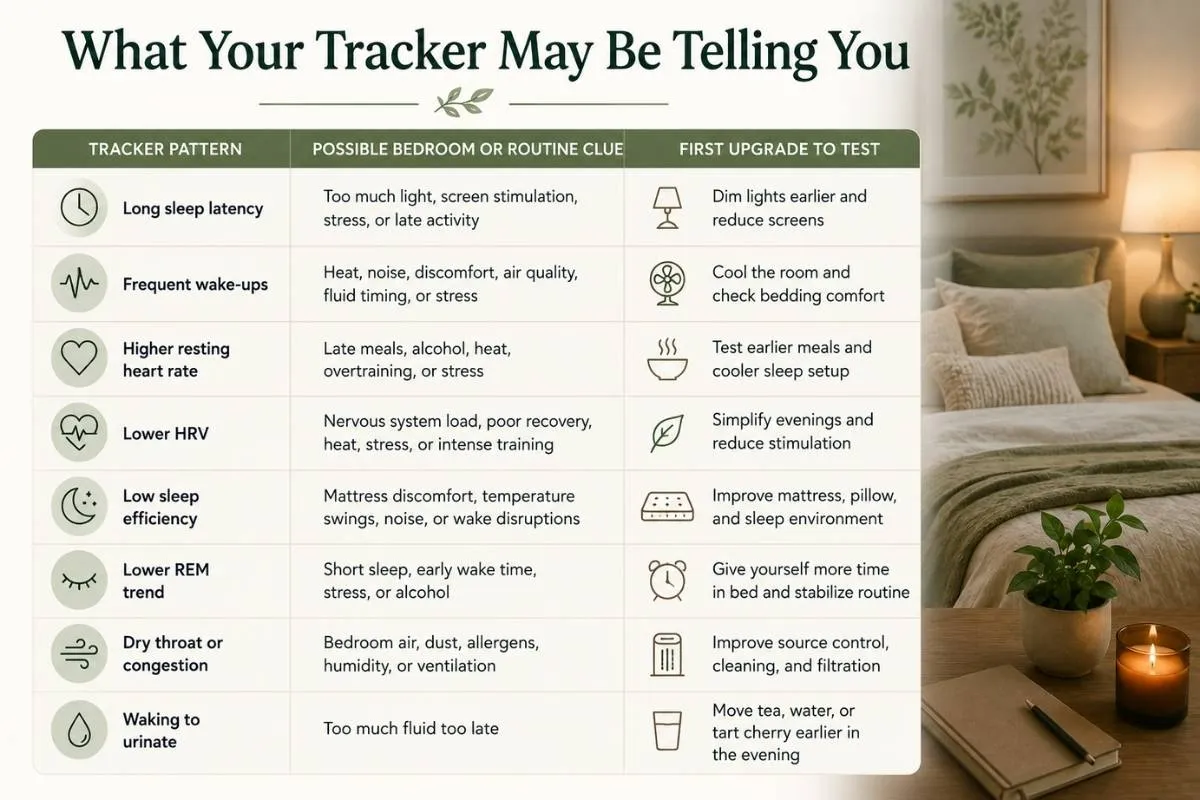
At a Glance: What Your Tracker May Be Telling You
| Tracker Pattern | Possible Bedroom or Routine Clue | First Upgrade to Test |
| Long sleep latency | Too much light, screen stimulation, stress, or late activity | Dim lights earlier and reduce screens |
| Frequent wake-ups | Heat, noise, discomfort, air quality, fluid timing, or stress | Cool the room and check bedding comfort |
| Higher resting heart rate | Late meals, alcohol, heat, overtraining, or stress | Test earlier meals and cooler sleep setup |
| Lower HRV | Nervous system load, poor recovery, heat, stress, or intense training | Simplify evenings and reduce stimulation |
| Low sleep efficiency | Mattress discomfort, temperature swings, noise, or wake disruptions | Improve mattress, pillow, and sleep environment |
| Lower REM trend | Short sleep, early wake time, stress, or alcohol | Give yourself more time in bed and stabilize routine |
| Dry throat or congestion | Bedroom air, dust, allergens, humidity, or ventilation | Improve source control, cleaning, and filtration |
| Waking to urinate | Too much fluid too late | Move tea, water, or tart cherry earlier in the evening |
Still choosing a device? Start with our Best Sleep Tracker guide.
Step 1: Use Your Sleep Score as a Clue, Not a Command
The sleep score is usually a summary of several signals. Depending on the tracker, it may include sleep duration, efficiency, timing, restfulness, sleep stages, heart rate, HRV, and other body signals.
That can be useful.
But a score can also make people overreact.
One lower score does not mean your mattress is bad, your air is toxic, or your body is broken.
A pattern is different.
If the same issue repeats for one to two weeks, then it becomes worth investigating.
For example:
If your sleep latency is long almost every night, your evening light and stimulation may need attention.
If you wake hot and restless several nights in a row, your mattress, bedding, room temperature, or airflow may be part of the problem.
If your sleep looks fragmented and you also wake with congestion, dryness, or irritation, the air environment may be worth checking.
If you wake up to pee after drinking a large cup of tea right before bed, the problem may not be your mattress or sleep tracker at all.
The tracker gives you a signal.
Your job is to connect it with real life.
Before You Upgrade the Bedroom, Test the Simple Evening Inputs
Before blaming your mattress, air quality, or bedroom setup, it can help to look at the simple evening inputs first.
Sometimes a lower sleep score is not caused by the bed itself.
It may be connected to what happened in the last few hours before sleep.
That includes:
- Eating too late
- Drinking too much liquid close to bed
- Bright light in the evening
- Screens and emotional stimulation
- A room that is not dark enough
- Caffeine or alcohol
- A bedroom that feels too warm, too dry, or too stimulating
This is where a sleep tracker can be helpful.
Not because it gives you a perfect answer, but because it can show you whether a simple change makes your body respond differently over several nights.
Evening Food Timing: Start With Not Eating Too Late
One of the simplest sleep experiments is to stop eating heavy meals too close to bedtime.
Late eating may affect digestion, reflux, body temperature, glucose regulation, and the body’s ability to fully downshift into sleep. The CDC recommends avoiding heavy or spicy meals several hours before bedtime, which makes food timing one of the simplest first things to test before buying anything.
For 7 nights, test this:
- Finish your last heavy meal earlier
- Avoid large late snacks
- Avoid high sugar foods right before bed
- Notice whether resting heart rate, HRV, sleep latency, or wake-ups change
This is not about being strict.
It is about seeing whether your body sleeps better when digestion is not competing with recovery.
Gentle Sleep Supportive Foods to Test
Some foods may support sleep more gently than supplements, especially when used as part of a calm evening routine.
The key is not to turn food into another obsession.
The key is to test one simple thing at a time.
Kiwi
Kiwifruit has some human research behind it. A study in adults with self-reported sleep disturbances found that eating two kiwifruit one hour before bedtime for four weeks was associated with improvements in sleep onset, duration, and efficiency.
A simple test could be:
- 1 to 2 kiwis earlier in the evening
- Not right before lying down
- Track sleep latency, wake-ups, and how you feel in the morning
This does not mean kiwi is a cure for sleep problems.
It means it may be a simple food based experiment worth testing.
Tart Cherry
Tart cherry juice has been studied for sleep, including in adults with insomnia. A pilot study found potential sleep benefits, but also noted that the melatonin intake from the cherry juice was far lower than common supplemental melatonin doses, so the effect may not be explained by melatonin alone.
A gentle HH style approach would be:
- Use tart cherry as a food based experiment
- Keep the amount moderate
- Avoid drinking it too close to bed if nighttime urination is an issue
- Watch whether sleep duration, wake-ups, or recovery trends change
The timing matters.
A sleep supportive drink can still disturb sleep if it makes you wake up to pee.
Pistachios
Pistachios naturally contain melatonin, but reported levels vary across studies and cultivars. Published analyses have found melatonin in pistachios, but I would not treat a few pistachios like a measured melatonin supplement.
Still, a few pistachios in the evening can be a simple, low effort option for some people.
The honest way to use them is:
- Treat them as a small food based sleep support habit
- Do not expect a dramatic sedative effect
- Avoid large portions too late at night
- Track your own response
I would not claim that 2 to 4 pistachios are a proven melatonin dose.
I would say this instead:
A few pistachios may be a gentle evening snack to test, partly because pistachios naturally contain melatonin, but the exact amount can vary and the effect is not the same as taking a measured supplement.
Chamomile Tea
Chamomile is another gentle option. A 2024 systematic review and meta-analysis found that chamomile improved some sleep outcomes, especially awakenings after sleep onset and staying asleep, although it did not clearly improve total sleep duration.
The practical detail matters:
Do not drink a large cup too close to bed if it makes you wake up to urinate.
Try it earlier in the evening as part of a wind down ritual.
Do Not Let Healthy Drinks Wake You Up at Night
This is a small thing, but it matters.
Even healthy drinks can disturb sleep if they make you get up to pee.
So if you use chamomile tea, tart cherry juice, magnesium drinks, lemon water, or any other evening drink, test the timing.
The CDC recommends limiting liquids several hours before sleep to avoid waking up to use the bathroom.
Sometimes the best change is not the drink itself.
It is drinking it earlier.
This is where a tracker can help. If your wake-ups decrease after moving fluids earlier, that is useful real life feedback.
Darkness Is a Bedroom Upgrade Too
Darkness is one of the simplest sleep upgrades.
Harvard Health explains that light exposure at night suppresses melatonin production and changes sleep patterns. It also notes that sleeping next to a night light has been linked with shallower sleep and more frequent arousals.
A tracker may show light disruption as:
- Longer sleep latency
- More wake-ups
- Lower sleep efficiency
- Worse recovery after screen heavy evenings
- Better sleep when the room is darker
Simple upgrades to test:
- An eye mask
- Blackout curtains
- Covering small LED lights
- Turning the alarm clock away
- Charging the phone outside the bed area
- Dimming lights earlier in the evening
- Keeping the room dark enough that your body understands it is night
This is one of the best examples of a low cost bedroom upgrade.
You do not always need a new device.
Sometimes you need a darker room.
Step 2: When Sleep Data Points Toward Your Mattress
A mattress can influence sleep in two major ways:
comfort and temperature.
If your body feels unsupported, tense, or pressured, your sleep may become more restless.
If your mattress traps heat, you may wake more often or struggle to stay asleep.
A tracker cannot tell you, “your mattress is wrong.”
But it can show patterns that make you look closer.
Mattress Clues in Your Sleep Tracker
Look for repeated patterns like:
- More wake-ups than usual
- Lower sleep efficiency
- Restless sleep
- Higher body temperature trends
- Higher resting heart rate
- Lower HRV after hot nights
- Waking with stiffness or pressure
- Feeling tired despite enough time in bed
If these patterns appear together with physical discomfort, your mattress or bedding may be part of the story.
What to Test Before Buying a New Mattress
Do not buy a new mattress because of one bad score.
Test the simple things first:
- Lower the room temperature
- Switch to lighter bedding
- Try a breathable mattress protector
- Rotate the mattress if appropriate
- Test a different pillow height
- Remove heavy synthetic layers that trap heat
- Wash bedding to reduce dust and irritants
- Track whether wake-ups change over 7 nights
If the tracker improves and your body feels better, you may not need a new mattress yet.
If the same problems continue, then it may be time to look at a better sleep surface.
Healthy Home Upgrade Mattress Filter
For HH, mattress decisions are not only about softness.
They are about recovery, breathability, material quality, and lower toxic load.
When choosing a mattress or sleep surface, I would look for:
- Good spinal support
- Pressure relief without sinking too much
- Breathable materials
- Low odor
- Strong third party certifications when possible
- No unnecessary chemical smell
- No fiberglass concern
- Materials that do not make you overheat
- Return policy or sleep trial
This is where sleep data helps.
It gives you a way to test whether your bedroom upgrade actually supports your body.
If heat and comfort are your main issues, read our guide to the Best Cooling Memory Foam Mattress.
Step 3: When Sleep Data Points Toward Light
Light is one of the strongest environmental signals for sleep timing.
Morning light helps set the body’s rhythm.
Evening light can delay the wind down process, especially if the light is bright, close to the face, or emotionally stimulating.
Harvard Health notes that light of any kind can suppress melatonin, and blue light at night can do so more powerfully.
This does not mean every screen ruins sleep.
It means light is worth testing if your tracker repeatedly shows long sleep latency, late sleep timing, or poor recovery after screen heavy evenings.
Light Clues in Your Sleep Tracker
Your bedroom light setup may need attention if you often see:
- Long sleep latency
- Late bedtime drift
- Lower sleep efficiency
- More restlessness after screens
- Lower readiness after late work or scrolling
- Difficulty waking naturally
- Better sleep on nights with less screen time
This is where sleep tracker data can be very helpful.
You can test your light routine without buying anything.
A Simple Light Test
For 7 nights, try this:
- Dim overhead lights earlier
- Use warmer, softer lighting in the evening
- Stop bright screen use earlier
- Avoid emotionally intense content close to bed
- Charge the phone away from the bed
- Use blackout curtains or an eye mask if outside light enters the room
- Get outdoor light earlier in the day
Then compare your sleep latency, bedtime consistency, HRV, resting heart rate, and how you feel in the morning.
If sleep latency improves, light was probably part of the problem.
The HH Light Rule
For sleep, the best bedroom light strategy is not complicated.
Bright during the day.
Soft in the evening.
Dark at night.
That is the foundation.
No sleep tracker can replace that.
Step 4: When Sleep Data Points Toward Air Quality
Air quality is harder to read from a sleep tracker because your ring or watch cannot directly measure dust, VOCs, mold, pollen, CO2, humidity, or ventilation.
But it can show patterns that make you look at the room more carefully.
If you wake with congestion, dry throat, headaches, coughing, or heavy morning fatigue, and your tracker also shows more wake-ups or poorer recovery, bedroom air may be worth investigating.
EPA explains that the three basic strategies for improving indoor air quality are source control, improved ventilation, and air cleaners or filtration. EPA also notes that source control is usually the most effective way to improve indoor air quality.
That is the right framework for a bedroom too.
Source control first.
Ventilation second.
Filtration as support.
Air Clues in Your Sleep Tracker
Your bedroom air may deserve attention if you notice:
- More wake-ups during allergy seasons
- Dry throat or congestion on waking
- Higher resting heart rate after stuffy nights
- Lower HRV when the room feels stale
- Worse sleep after new furniture, paint, candles, fragrance, or cleaning products
- Better sleep when windows were open or the room was freshly aired
Again, the tracker does not diagnose air quality.
It only helps you notice patterns.
A Simple Bedroom Air Test
For 7 nights, test:
- Remove scented candles, fragrance, and strong cleaners
- Wash bedding in a low fragrance detergent
- Vacuum and dust the bedroom
- Keep pets out of the bed if allergies are possible
- Air out the room when outdoor conditions are safe
- Use a HEPA air purifier if you already have one
- Keep humidity comfortable
- Avoid new off gassing products close to the bed
Then compare your wake-ups, breathing comfort, resting heart rate, HRV trend, and morning energy.
If you feel clearer and the tracker looks calmer, air quality may have been part of the puzzle.
The HH Air Rule
Do not use an air purifier as a cover-up for a polluted bedroom.
First remove what you can.
Then ventilate when appropriate.
Then filter.
EPA notes that portable air cleaners and HVAC filters can reduce indoor air pollution, but they cannot remove all pollutants from the air.
That is much more aligned with a lower toxic load approach than trying to purify around unnecessary chemicals, fragrance, dust, or clutter.
If air quality seems connected to your sleep, read our bedroom air and lower exposure guides before buying another device.
Step 5: Use Oura Ring 4 Without Turning the Bedroom Into a Tech Lab
This is important.
Sleep tracking should not make your bedroom feel like a control room.
For sensitive sleepers, the best setup is often the simplest one:
- One wearable
- No constant phone checking
- No bright smartwatch screen
- No alerts overnight
- No obsessive score checking
- No panic over one bad night
I like using Oura Ring 4 because it gives me data without a screen on my wrist.
I also like that Oura offers Airplane Mode. Oura states that Airplane Mode disables all radio transmission from the ring, including the Bluetooth connection between the ring and app, while the ring continues to collect and store data. The data syncs when Airplane Mode is disabled.
In my own routine, I prefer the idea of collecting data overnight and syncing away from the bed later.
This is not about fear.
It is about making the bedroom calmer, darker, and less stimulating.
That is the point of a healthy sleep environment.
Check Oura Ring 4 price on Amazon
Why the Oura Ring 4 Material Profile Matters to Me
Because I wear my Oura Ring 4 directly against my skin for many hours, material contact matters to me.
I do not only think about the data. I also think about what is touching my body overnight.
Oura describes Oura Ring 4 as having a fully titanium design and a non-allergenic titanium inner shell. Oura also states that the inner surface is medical grade and BPA free.
That fits better with my Healthy Home Upgrade approach than a wearable that feels irritating, bulky, or too plastic heavy against the skin.
This is not about chasing a perfect product.
It is about choosing tools that feel aligned with a lower toxic load, lower stress lifestyle.
Prefer a lower distraction wearable? Read our Best Sleep Tracking Ring guide.
Step 6: The 7 Night Bedroom Upgrade Method
Do not change everything at once.
If you change your mattress topper, light routine, bedding, air purifier, bedtime, supplements, workout timing, phone use, and evening snacks in the same week, you will not know what helped.
Use this instead.
Night 1 and 2: Observe
Do not change anything yet.
Record:
- Sleep score
- Sleep latency
- Wake-ups
- HRV
- Resting heart rate
- Temperature trend if available
- REM trend
- How you actually feel
Also note:
- Room temperature
- Evening screen use
- Late meals
- Fluid timing
- Bedroom air
- Mattress comfort
- Stress level
- Whether the room was truly dark
Night 3 and 4: Test Light and Darkness
Change only light.
Dim lights earlier.
Reduce screen stimulation.
Make the room darker with an eye mask, blackout curtains, or by covering small LED lights.
Watch sleep latency and sleep timing.
Night 5: Test Food and Fluid Timing
Change only your evening intake.
Finish heavy food earlier.
Move chamomile tea, tart cherry, or other drinks earlier.
If you test kiwi or a few pistachios, keep it simple and do not add several new foods at once.
Watch wake-ups, resting heart rate, HRV, sleep latency, and morning energy.
Night 6: Test Temperature and Bedding
Change only temperature and bedding.
Use lighter bedding, improve airflow, or cool the room slightly.
Sleep Foundation lists 65 to 68 degrees Fahrenheit as an ideal temperature range for many people, although individual comfort and climate matter.
Watch wake-ups, resting heart rate, and comfort.
Night 7: Test Air
Change only air.
Remove fragrance, clean dust, ventilate if conditions are good, or run a purifier if you already have one.
Watch breathing comfort, wake-ups, and morning energy.
This is not a perfect scientific trial.
But it is much better than guessing.
What Not to Upgrade Based on One Bad Sleep Score
Do not buy a new mattress because of one poor night.
Do not buy an air purifier because your REM was low once.
Do not buy blackout curtains because your HRV dipped after a stressful day.
Do not assume the room is the problem if you had alcohol, illness, travel, emotional stress, pain, or hard training.
One night is noise.
A pattern is information.
That is the rule.
When the Bedroom Is Not the Main Problem
Sometimes your bedroom is fine, but your body is carrying too much load.
Sleep data can be affected by:
- Illness
- Pain
- Hormones
- Menopause or perimenopause
- Medications
- Alcohol
- Caffeine
- Grief or emotional stress
- Intense exercise
- Overtraining
- Late meals
- Sleep apnea or other sleep disorders
If you see repeated oxygen drops, loud snoring, severe daytime sleepiness, long term insomnia, irregular heart alerts, or unrefreshing sleep despite enough time in bed, speak with a qualified professional.
A tracker can support the conversation.
It should not replace medical evaluation.
Best Internal Next Reads
If you are still choosing a device, start with our Best Sleep Tracker guide.
If you prefer a lower distraction wearable, read our Best Sleep Tracking Ring guide.
If you are comparing recovery wearables, see WHOOP vs Oura.
If you already use Oura or are considering it, check our Oura Ring Coupon Code page.
If sleep data makes you anxious, read Best Sleep Tracker Settings for Sensitive Nervous Systems.
If your sleep environment feels too warm, explore our Best Cooling Memory Foam Mattress guide.
If your sleep position or reflux symptoms matter, read our Best Adjustable Bed Base guide.
If you are trying to create a calmer, lower exposure bedroom, read EMF, Motors, and Remote Controls, especially if you use an adjustable bed, smart bed, or remote controlled sleep setup.
If you want a fuller sleep environment stack, read Adjustable Bases, Cooling Mattresses and Sleep Trackers, which connects mattress comfort, recovery tech, and bedroom setup.
FAQ
Can a sleep tracker tell me if I need a new mattress?
No. A sleep tracker cannot diagnose mattress problems. But repeated patterns such as frequent wake-ups, low sleep efficiency, discomfort, overheating, and waking tired may help you decide whether your mattress or bedding deserves a closer look.
Can sleep score show if my bedroom is too hot?
It may give clues. If you repeatedly wake up more often, have higher resting heart rate, or feel overheated, temperature may be part of the issue. Bedroom temperature is an important part of the sleep environment, and a cooler room often supports better sleep.
Can light at night affect sleep tracker data?
Yes, it can. Evening light and screen stimulation can delay sleep timing and make it harder to fall asleep for some people. If your tracker repeatedly shows long sleep latency, your light routine is worth testing.
Can an eye mask help if my room is not dark enough?
It may help some people. Harvard Health notes that light exposure at night suppresses melatonin and can change sleep patterns. If outside light, street lamps, small LEDs, or early morning light disturb your sleep, an eye mask or blackout curtains may be worth testing.
Can an air purifier improve my sleep score?
Maybe, but not always. An air purifier can support better air quality, especially when used alongside source control and ventilation. EPA notes that filtration can help reduce indoor air pollution, but it should not replace removing pollutant sources when possible.
Should I eat kiwi before bed?
Kiwi may be worth testing gently. One study found that eating two kiwifruit one hour before bed for four weeks was associated with better sleep onset, duration, and efficiency in adults with self-reported sleep disturbances. But it should still be treated as a simple food experiment, not a cure.
Do pistachios really help with melatonin?
Pistachios naturally contain melatonin, but reported levels vary across studies and cultivars. I would not treat a few pistachios like a measured melatonin supplement. They are better viewed as a small, gentle evening snack to test if they suit your body.
Is chamomile tea good before bed?
Chamomile may support sleep for some people. A 2024 review found improvements in some sleep outcomes, especially waking after sleep onset and staying asleep. The practical issue is timing. If tea makes you wake up to urinate, drink it earlier.
Should I use Oura Ring 4 in Airplane Mode?
That depends on your preference. Oura states that Airplane Mode disables radio transmission while the ring continues to collect and store data. For a calmer bedroom setup, some people may prefer to collect data overnight and sync later.
What bedroom upgrade should I try first?
Start with the lowest cost change. Dim lights earlier, make the room darker, cool the room, move fluids earlier, simplify bedding, reduce fragrance, clean dust, and move the phone away from the bed. Only consider bigger purchases after you see a repeating pattern.
Should I trust my sleep score more than how I feel?
No. Your sleep score is useful, but it should not replace body awareness. Always ask how you feel before letting the score define your day.
Final Thoughts
A sleep tracker is most powerful when it helps you make better real life decisions.
Not when it makes you chase a perfect score.
Your sleep score can guide you toward smarter bedroom upgrades, but only if you read it with context.
Long sleep latency may point toward light and stimulation.
Frequent wake-ups may point toward heat, comfort, air, noise, late fluids, or stress.
Lower HRV may point toward recovery load.
Poor sleep efficiency may suggest your bedroom needs to feel calmer, cooler, darker, cleaner, or more supportive.
My own Oura Ring 4 helps me ask better questions about my bedroom and my body.
That is the real value.
The tracker does not create better sleep by itself.
The upgrade happens when you use the data gently, make one change at a time, and build a bedroom and evening routine that support recovery in the real world.