Travel can disrupt recovery faster than a hard workout.
A late flight, airport stress, dehydration, time zone changes, hotel room air, unfamiliar noise, restaurant meals, competition nerves, and poor light timing can all show up in your sleep tracker the next morning.
For athletes, executives, and health-focused travelers, this matters because sleep is not just rest. It affects coordination, reaction time, mood, appetite, training quality, immune resilience, and decision-making.
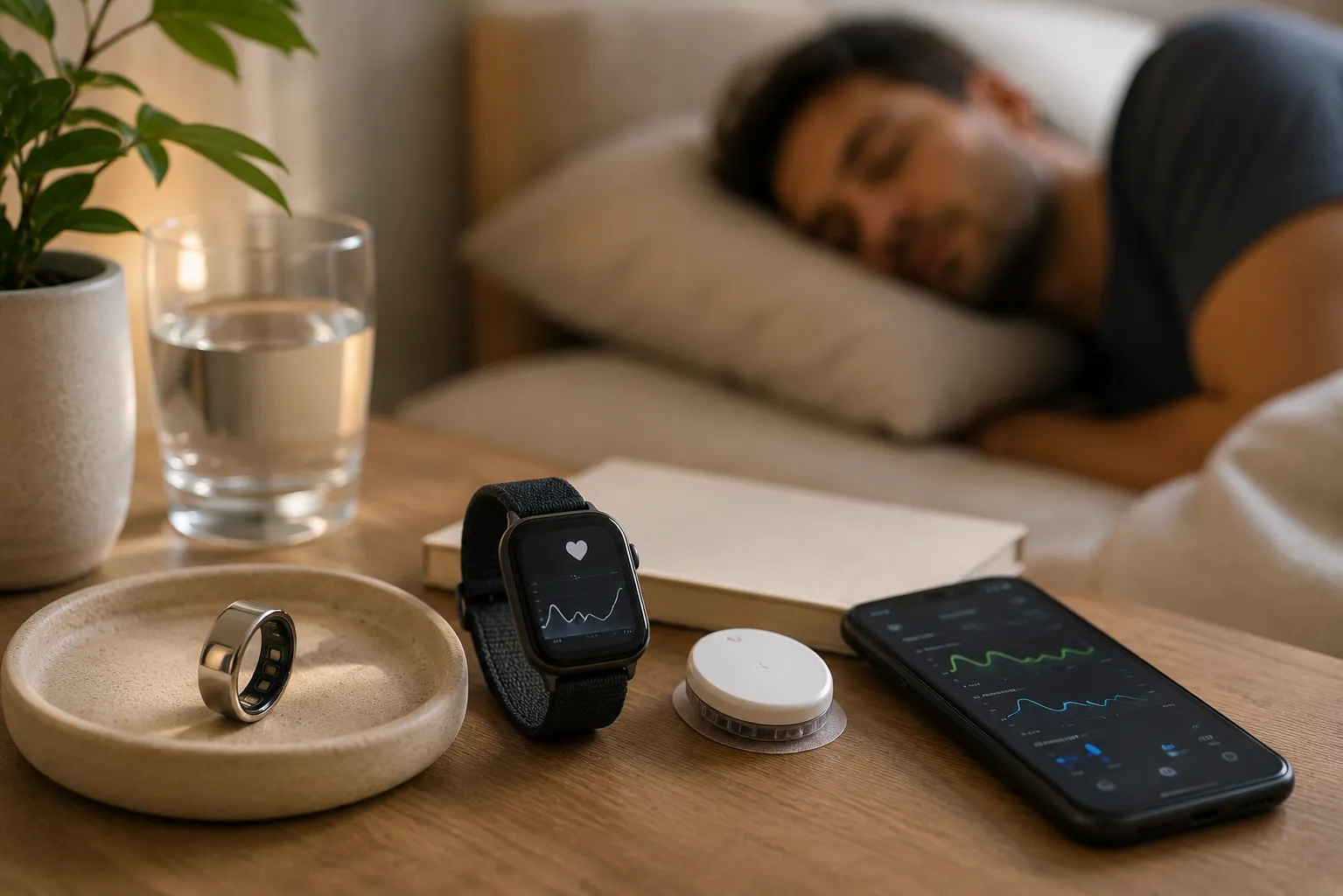
Wearables like Oura, WHOOP, Apple Watch, Garmin, and Polar can help you protect sleep on the road, but only if you use the data correctly.
The goal is not to chase perfect scores while traveling.
The goal is to arrive with enough recovery to perform, think clearly, and come home without crashing.
Quick Answer
The best way to use a wearable for travel, jet lag, and competition is to know your baseline before you leave, then track sleep, HRV, resting heart rate, recovery, temperature trends, and strain during and after travel. Use the data as a compass, not as a reason to panic.
For longer trips, shift sleep and meals before departure when possible, use light exposure strategically after arrival, protect the first night, and reduce training intensity if recovery markers worsen. For short competition or business trips of one or two days, it may be better to stay closer to your home time zone instead of forcing full adaptation. WHOOP describes this as time zone maintenance for short trips, where sleep, meals, and workouts stay closer to home time to avoid an adaptation and readaptation cycle.
At a Glance: The Travel Sleep Framework
| Travel Issue | Wearable Signal | The HH Move | What to Avoid |
| First Night Effect | More wake time, lighter sleep, lower sleep score | Accept it, then optimize darkness, coolness, and calm | Overchecking the app at 3 a.m. |
| Jet lag eastward | Late sleep onset, low HRV, morning grogginess | Use early destination light and earlier meals | Late caffeine and bright screens |
| Jet lag westward | Early waking or evening fatigue | Use afternoon or early evening light | Going to bed too early |
| Travel fluid load | Elevated resting heart rate, heavy legs, lower recovery | Hydrate, walk, use gentle movement | HIIT after a long flight |
| Hotel room stress | Restless sleep, higher wake time | Cool, dark, quiet, ventilated room | Ignoring the sleep environment |
| Competition nerves | Lower sleep efficiency, higher heart rate | Breathwork, familiar routine, calm evening | New supplements or gadgets |
| Short trip | Circadian disruption risk | Consider home time strategy | Forcing full adaptation too late |
Also in This Article
- Light timing for jet lag
- The First Night Effect
- Hotel room micro-environment
- Travel fluid load and swollen legs
- Short trips and time zone maintenance
- Competition sleep strategy
- Wearable travel dashboard
- Post-travel recovery protocol
What Jet Lag Actually Does
Jet lag happens when your internal circadian rhythm is misaligned with the local time at your destination. It can affect sleep timing, alertness, digestion, mood, and performance.
The CDC explains that light exposure timing is one of the main tools for shifting circadian rhythm. Morning bright light after the body’s circadian low tends to shift the clock earlier, while evening light tends to shift it later. The best timing depends on travel direction and number of time zones crossed.
This is why travel recovery is not only about sleeping more.
It is about using the right cues at the right time.
Light Timing: Your Biological Remote Control
Your body follows light more than the clock on the wall.
Traveling East
Eastward travel usually requires your body clock to shift earlier. This is often harder because many people find it easier to stay up later than to fall asleep earlier.
Helpful cues may include:
- Earlier bedtime before travel
- Morning light after arrival
- Avoiding late-night bright light
- Earlier meals
- Protecting the first two nights
Traveling West
Westward travel usually requires your body clock to shift later.
Helpful cues may include:
- Slightly later bedtime before travel
- Afternoon or early evening light after arrival
- Avoiding very early morning light if it shifts you too early
- Staying awake until a reasonable local bedtime
The details depend on your route, but the principle is simple: light is a timing signal. Use it deliberately.
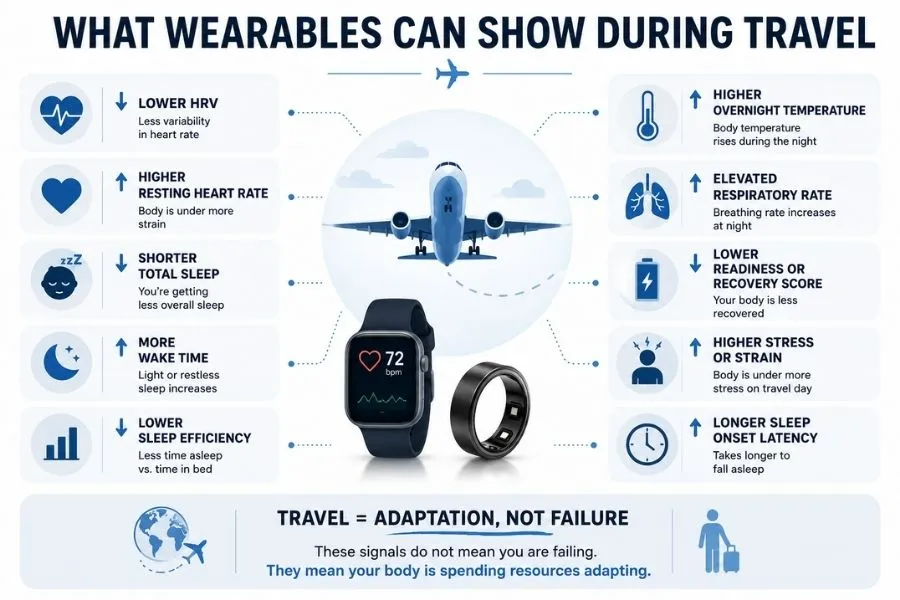
What Wearables Can Show During Travel
Your wearable cannot fix jet lag, but it can show how your body is responding.
Watch for:
- Lower HRV
- Higher resting heart rate
- Shorter total sleep
- More wake time
- Lower sleep efficiency
- Higher overnight temperature
- Elevated respiratory rate
- Lower readiness or recovery score
- Higher stress or strain on travel day
- Longer sleep onset latency
These signals do not mean you are failing. They mean your body is spending resources adapting.
The First Night Effect: Why Hotel Sleep Often Looks Worse
Many people sleep worse the first night in a new place, even in a good hotel.
This is not only psychological. Research on the First Night Effect found that one brain hemisphere can remain more vigilant in an unfamiliar sleep environment, almost like a night watch system.
Your wearable may show:
- More wake time
- Lighter sleep
- Lower sleep efficiency
- Less deep sleep
- More restlessness
- A lower sleep score
This does not automatically mean something is wrong.
It may simply mean your nervous system is scanning a new environment.
The practical lesson is powerful: do not panic over the first hotel night. Expect it, reduce unnecessary stimulation, and focus on improving the second night.
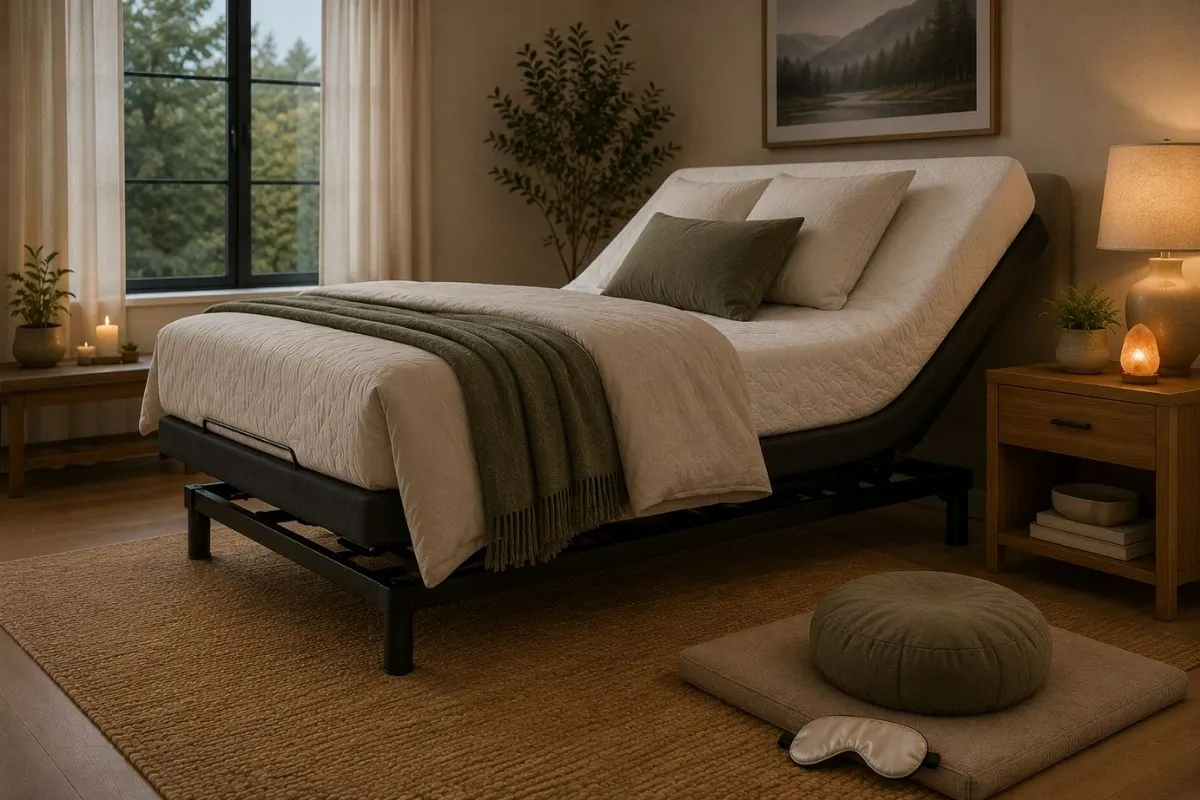
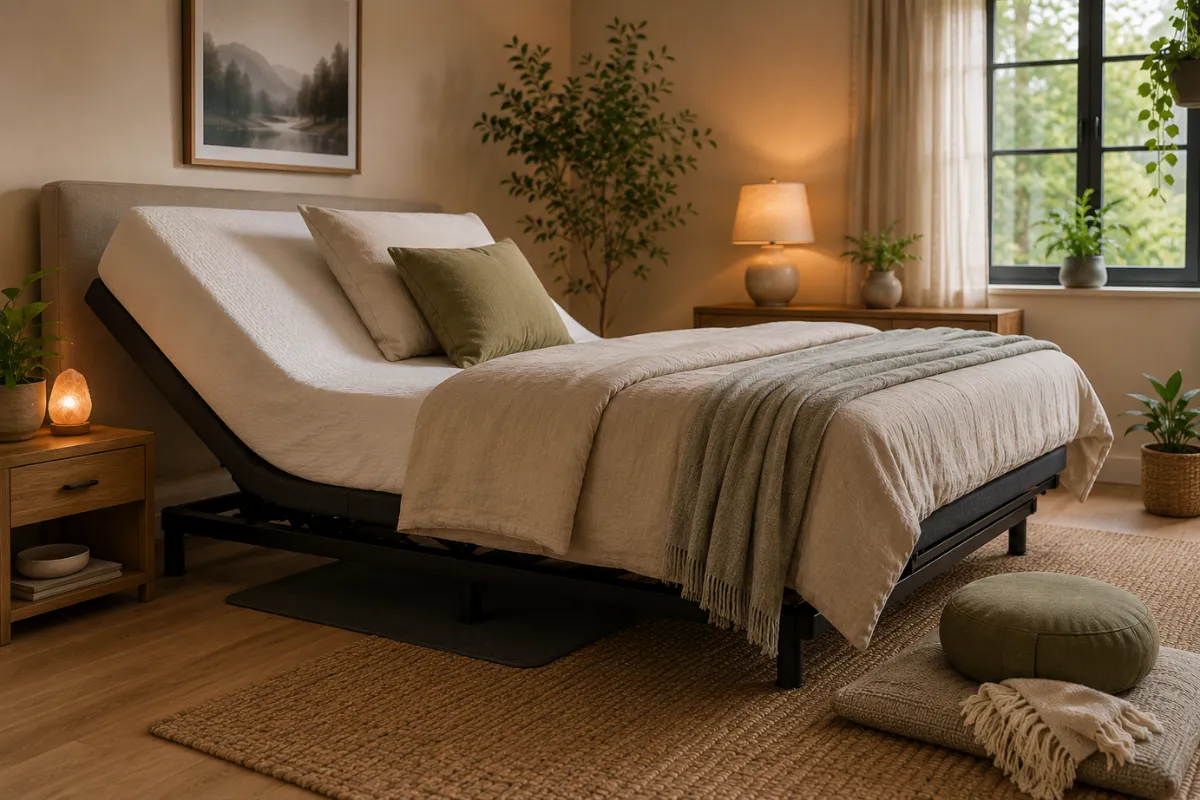
Hotel Room Micro-Environment: The HH Travel Layer
Most travel guides focus only on time zones.
At Healthy Home Upgrade, the sleep environment matters too.
A hotel room can add hidden load through:
- Warm temperature
- Dry air
- Poor ventilation
- High CO2 in a closed room
- Cleaning fragrance or VOC-like smells
- Hallway noise
- Light from standby buttons
- Street light leaking through curtains
- Notifications and device lights
- A mattress or pillow your body does not know
Bedroom ventilation and CO2 may matter for sleep quality. A Danish field study measured bedroom CO2, temperature, humidity, and sleep quality in real bedrooms, and broader bedroom ventilation research suggests that inadequate ventilation can disturb sleep quality.
A simple hotel sleep setup:
- Set the room cool if possible
- Crack a window briefly if safe and practical
- Block standby lights
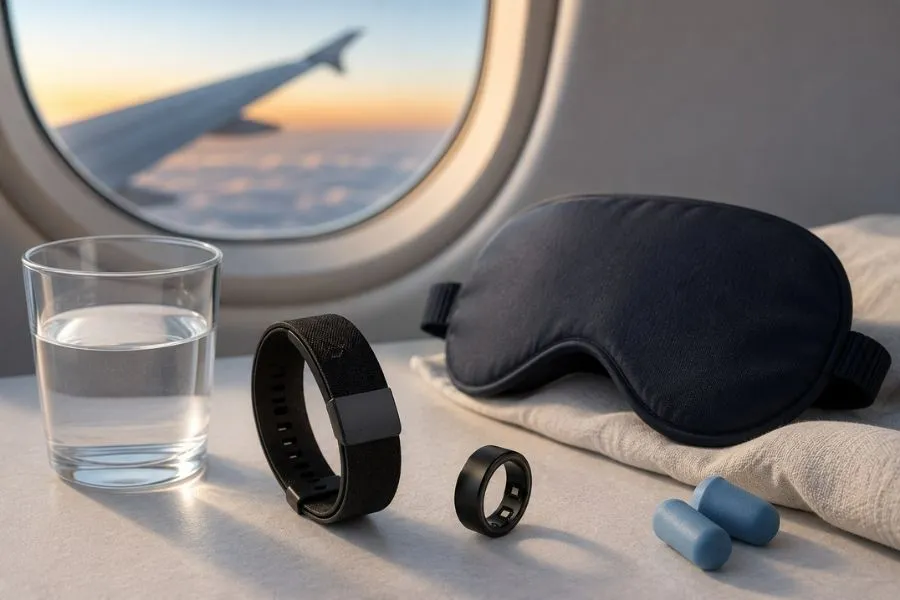
- Use an eye mask
- Use earplugs or white noise if needed
- Charge devices away from the bed
- Turn off nonessential notifications
- Avoid heavy fragrance if you can choose the room
- Keep your bedtime routine familiar
Your wearable can help you notice patterns. If your sleep improves in cooler, darker, better-ventilated rooms, that is useful information.
The Travel Fluid Load
Long travel is not just circadian stress. It is also sitting stress.
Long flights and long car journeys can cause fluid to pool in the legs and feet. Mayo Clinic explains that foot and leg swelling during air travel is common and is usually related to sitting for a long time, which causes blood to pool in the leg veins and fluid to move into surrounding tissues.
A long-haul flight study also found significant fluid accumulation in the lower extremities during long-haul travel.
Your wearable may not directly measure lymph flow or swelling, but you may see indirect signs of travel stress:
- Higher resting heart rate
- Lower HRV
- Heavier legs
- Poorer sleep
- Higher perceived strain
- More fatigue after arrival
The answer is not to punish the body with intense training immediately after landing.
The answer is to restore circulation gently.
Post-Travel Recovery Protocol
After a long flight or long drive, keep the first recovery block simple.
Use:
- Water and minerals
- Gentle walking
- Easy mobility
- Calf raises or light leg movement
- Normal meals with protein
- Daylight exposure at the right time
- A calm first evening
- Earlier bedtime if local timing allows
- Compression socks during long flights if appropriate for you
Avoid:
- HIIT immediately after landing
- Heavy alcohol
- Very salty meals
- Long sauna if dehydrated
- Late-night screens
- New supplements before competition
- Panic-checking the app all evening
Your tracker can help you see how quickly resting heart rate and HRV return toward baseline after travel.
That is more useful than judging yourself for one bad travel day.
Before You Travel: Use the Wearable as a Baseline
Your wearable is most useful before travel if you already know your normal baseline.
Look at the week before departure:
- Average sleep duration
- Normal bedtime and wake time
- Resting heart rate baseline
- HRV baseline
- Usual readiness or recovery score
- Training load
- Recent illness or stress signs
If you start travel already under-recovered, you need a more conservative plan.
A poor recovery score before departure is not a reason to panic. It is a reason to reduce unnecessary stress before the trip.
Adjust Before You Leave
Oura recommends preparing before international travel by gradually adjusting bedtime by 15 to 30 minutes, earlier when traveling east and later when traveling west. Oura also suggests shifting meal times toward the destination schedule and switching to the destination time after arrival.
A simple plan:
Three to four days before travel
Shift bedtime and wake time slightly toward destination time if possible.
Two days before travel
Avoid overtraining. Protect sleep. Reduce alcohol and late meals.
Day before travel
Pack early, hydrate, and keep the evening calm.
Travel day
Use the wearable as information, not judgment. Travel days often look messy in the data.
Sleep Foundation also recommends building a buffer into the first days of a trip and arriving ahead of an important event when possible.
Short Trip or Competition Weekend: Do Not Always Adapt Fully
If you are traveling for only one or two days, full adaptation may not be realistic.
For athletes and business travelers, this is especially important.
WHOOP describes time zone maintenance as a strategy for short trips lasting only a day or two, where you keep sleep, meals, and workouts closer to your home time zone to reduce the disruption of adapting and then quickly readapting when you return.
This can make sense when:
- The trip is short
- The competition or meeting is soon after arrival
- You return home quickly
- The time zone difference is manageable
- Full adaptation would create more disruption than benefit
For longer trips, especially across many time zones, gradually adapting to the destination is usually more useful.
Competition Travel: The Goal Is Stable Enough, Not Perfect
Competition sleep is rarely perfect.
Athletes often sleep worse before an event because of nerves, schedule changes, hotel rooms, travel stress, and excitement.
Do not let a poor sleep score destroy confidence.
Instead, check:
- Did I get some deep rest?
- Is my resting heart rate unusually high?
- Is HRV far below normal?
- Do I feel sick or just nervous?
- Does my warm-up feel normal?
- Is this one bad night or a pattern?
- Did I protect sleep the week before?
One bad night before competition does not erase fitness.
The bigger problem is stacking multiple nights of poor sleep, bad fueling, dehydration, travel stress, and overchecking the app.
The Wearable Travel Dashboard
During travel, focus on a few key metrics.
| Metric | Why It Matters | How to Use It |
| Sleep duration | Shows total sleep opportunity | Protect extra sleep after travel |
| Sleep timing | Shows circadian disruption | Shift gradually if needed |
| HRV | Reflects stress and recovery trends | Compare with your baseline |
| Resting heart rate | Often rises with stress, illness, dehydration, or load | Use as a recovery warning |
| Temperature trend | Can signal illness, cycle changes, or stress | Do not ignore unusual spikes |
| Recovery or readiness | Useful summary signal | Interpret with body feel |
| Strain or activity load | Shows travel and training burden | Reduce intensity if load is high |
| Restfulness or wake time | Shows sleep fragmentation | Improve room setup and wind-down |
Use the tracker to simplify decisions, not create more anxiety.
A Simple Travel Sleep Plan
Before the trip
- Check your recovery baseline
- Avoid arriving already depleted
- Shift sleep and meals slightly if crossing time zones
- Reduce intense training close to departure
- Pack sleep tools early
During the flight
- Hydrate
- Avoid excess alcohol
- Move when possible
- Use eye mask and earplugs
- Set your watch to destination time when useful
- Sleep only if it supports the destination schedule
After arrival
- Use light strategically
- Eat on local schedule if adapting
- Walk outside
- Avoid long late naps
- Protect the first night
- Keep training lighter if recovery data is poor
Before competition
- Do not obsess over one sleep score
- Use a familiar warm-up
- Check body feel and readiness
- Avoid new recovery experiments
- Trust preparation, not one night of data
What About Melatonin?
Melatonin can help some people with jet lag, but timing matters.
The CDC explains that correctly timed melatonin can help shift the circadian clock and that the timing effect depends on the body’s internal clock phase.
A Cochrane review found melatonin can be effective for preventing or reducing jet lag and that occasional short-term use appears safe, especially for adults crossing five or more time zones, particularly eastward.
For HH, the practical rule is:
Do not use melatonin randomly.
Use light first.
Use timing carefully.
Ask a qualified clinician if you take medication, have a medical condition, are pregnant, or are unsure.
What Not to Do on the Road
Avoid these common mistakes:
- Checking your app before noticing your body
- Training hard after a red-eye flight
- Using sauna when dehydrated
- Trying new supplements before competition
- Taking melatonin at random times
- Napping too long late in the day
- Staying under bright light at the wrong time
- Drinking alcohol to relax before sleep
- Obsessing over one bad recovery score
- Changing too many variables at once
- Ignoring hotel room light, noise, air, and temperature
Travel already stresses the system. Do not add unnecessary experiments.
The Zero Toxic Load View: Travel Edition
At Healthy Home Upgrade, travel recovery is part of the Zero Toxic Load framework.
Travel can add:
- Physical load
- Mental load
- Digital load
- Light disruption
- Food disruption
- Dehydration
- Circulation stress
- Hotel room air stress
- Nervous system vigilance
A wearable should reduce that load, not add to it.
Use one main recovery dashboard. Turn off unnecessary notifications. Do not let every metric become a command. Choose the simplest actions first: light, sleep, hydration, food, movement, calm, and a better sleep environment.
The best travel recovery system is not the most complicated one.
It is the one that helps your body feel safe enough to sleep.
Best Internal Links to Read Next
If you use wearables for sleep, travel, and performance, read these next:
- Best Sleep Tracking Ring
- Best Sleep Tracker
- WHOOP vs Oura
- How Athletes Should Interpret HRV and Recovery Scores
- Recovery Stack Framework
- Best Sleep Tracker Settings for Sensitive Nervous Systems
- Ring Sizing, Metals, and Allergies
- Apollo Neuro Review
These guides help you use recovery data, smart rings, and calming tools without letting technology take over your body awareness.
Final Thoughts
Travel recovery is not about perfect numbers.
It is about protecting the conditions that let your body adapt.
Use your wearable to notice patterns.
Use light to guide your body clock.
Use sleep and hydration as the foundation.
Use room setup to reduce hidden load.
Use gentle movement after long sitting.
Use training adjustments when recovery data and body feel both point down.
Use calm routines before competition.
The goal is not to beat jet lag with willpower.
The goal is to arrive with enough recovery to perform, think clearly, sleep better, and return home without crashing.
References and Further Reading
- CDC Yellow Book: Jet Lag Disorder, light timing, and melatonin timing.
- First Night Effect and increased vigilance in one brain hemisphere during sleep in unfamiliar environments.
- WHOOP: time zone maintenance for short trips.
- Oura and travel sleep adjustment guidance.
- Bedroom ventilation, CO2, and sleep quality research.
- Mayo Clinic: foot and leg swelling during air travel.
- Long-haul flight fluid shifts and lower-extremity edema.
- Cochrane review on melatonin for jet lag.