Last Updated: May 2026
Quick Answer
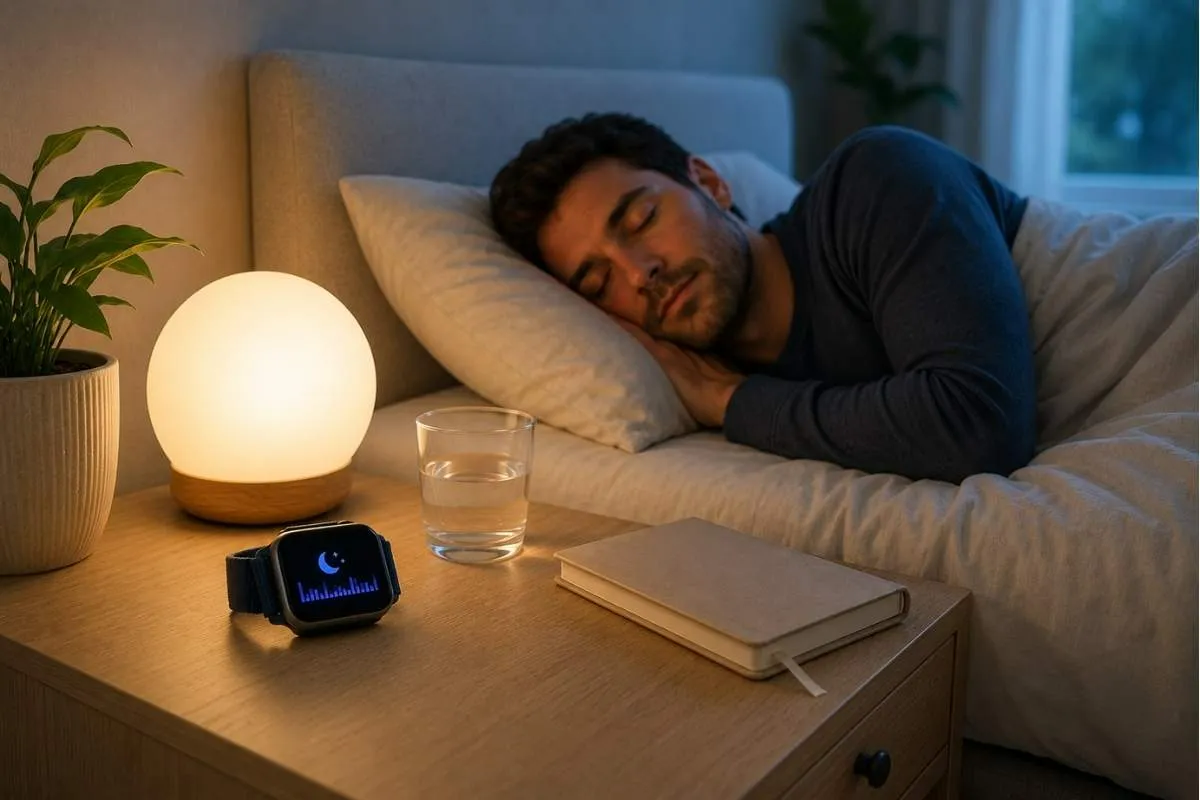
Sleep tracker data becomes useful when you stop treating it like a nightly grade and start using it as a pattern tool.
The three sleep metrics that matter most for real-life habit change are HRV trends, sleep latency, and REM sleep patterns.
HRV can help you notice how your nervous system responds to stress, training, late meals, alcohol, illness, travel, and recovery. Sleep latency shows how easily your body transitions from daytime alertness into sleep. REM trends can help you understand whether your sleep timing, stress load, or early wake-ups may be affecting recovery.
The goal is not to “win” your sleep tracker. The goal is to notice patterns, change one habit at a time, and build a sleep routine your body can trust.
I personally use my Oura Ring 4 to track my HRV, sleep timing, and recovery trends. Not because I want a perfect sleep score every morning, but because it helps me see what my body is trying to tell me over time. That distinction matters. The tracker is not the authority over your body. It is a feedback tool.
Consumer sleep trackers can be helpful for trends, but they are not the same as a medical sleep study. The American Academy of Sleep Medicine has stated that consumer sleep technology should not replace validated diagnostic evaluation when sleep disorders are suspected.
Also in This Article
-
- What sleep tracker data can and cannot tell you
- How I use my Oura Ring 4 without becoming obsessed
- Why HRV is a nervous system trend, not a personal score
- What sleep latency can reveal about your evening routine
- Why REM trends matter more over a week than one bad night
- How to change habits based on tracker data
- How to avoid sleep-score anxiety
- What I would not use Oura Ring 4 for
- When to speak with a professional
Why Sleep Tracker Data Can Feel So Overwhelming
Modern sleep trackers can give you an enormous amount of information: total sleep time, sleep score, readiness, HRV, resting heart rate, sleep latency, REM sleep, deep sleep, oxygen levels, skin temperature, breathing rate, wake-ups, activity recovery, and stress signals.
That can be helpful.
But it can also become too much.
For some people, sleep data creates motivation. For others, especially people with sensitive nervous systems, it can create pressure. You wake up, check the score, and suddenly your entire day feels judged before it has even started.
That is the wrong relationship with sleep data.
Sleep is not a performance sport. It is a recovery state.
The better question is not:
“Why was my sleep score bad?”
The better question is:
“What changed yesterday, and is there a pattern?”
That one shift turns your tracker from a stress trigger into a useful tool.
My Real-Life Experience With Oura Ring 4
I use my Oura Ring 4 because I wanted a calmer way to understand my recovery without wearing a bright screen on my wrist at night.
For me, the most useful part has not been one single sleep score. It has been watching how my HRV, resting heart rate, sleep latency, sleep timing, and recovery trends respond to real life.
I can see patterns after:
- a stressful day
- late meals
- hard training
- poor wind-down routines
- travel or irregular timing
- emotional overload
- better breathing, meditation, and calmer evenings
- less screen time before bed
- going to bed earlier and giving my body more recovery time
That is where wearable data becomes valuable. Not as a judgment, but as a mirror.
Oura Ring 4 uses sensors for heart rate, heart rate variability, respiration rate during sleep, blood oxygen during sleep, temperature trends, movement, and activity. Oura describes the ring as being built around Smart Sensing, a sensing platform that adapts to the finger to deliver continuous data day and night.
This is also why I prefer using the Oura data gently. I do not want sleep tracking to become another form of pressure. I want it to help me understand my body better.
Why the Oura Ring 4 Material Profile Matters to Me
Because I wear my Oura Ring 4 directly against my skin for many hours, material contact matters to me.
I do not only think about the data. I also think about what is touching my body overnight.
Oura describes Oura Ring 4 as having a fully titanium design and a non-allergenic titanium inner shell. Oura also states that the inner surface is medical grade and BPA-free. The Oura store lists non-allergenic titanium on the inner and outer surfaces.
That fits better with my Healthy Home Upgrade approach than a wearable that feels irritating, bulky, or too plastic-heavy against the skin.
This is not about chasing a perfect product. It is about choosing tools that feel aligned with a lower-tox, lower-stress lifestyle.
The Healthy Home Upgrade Approach to Sleep Data
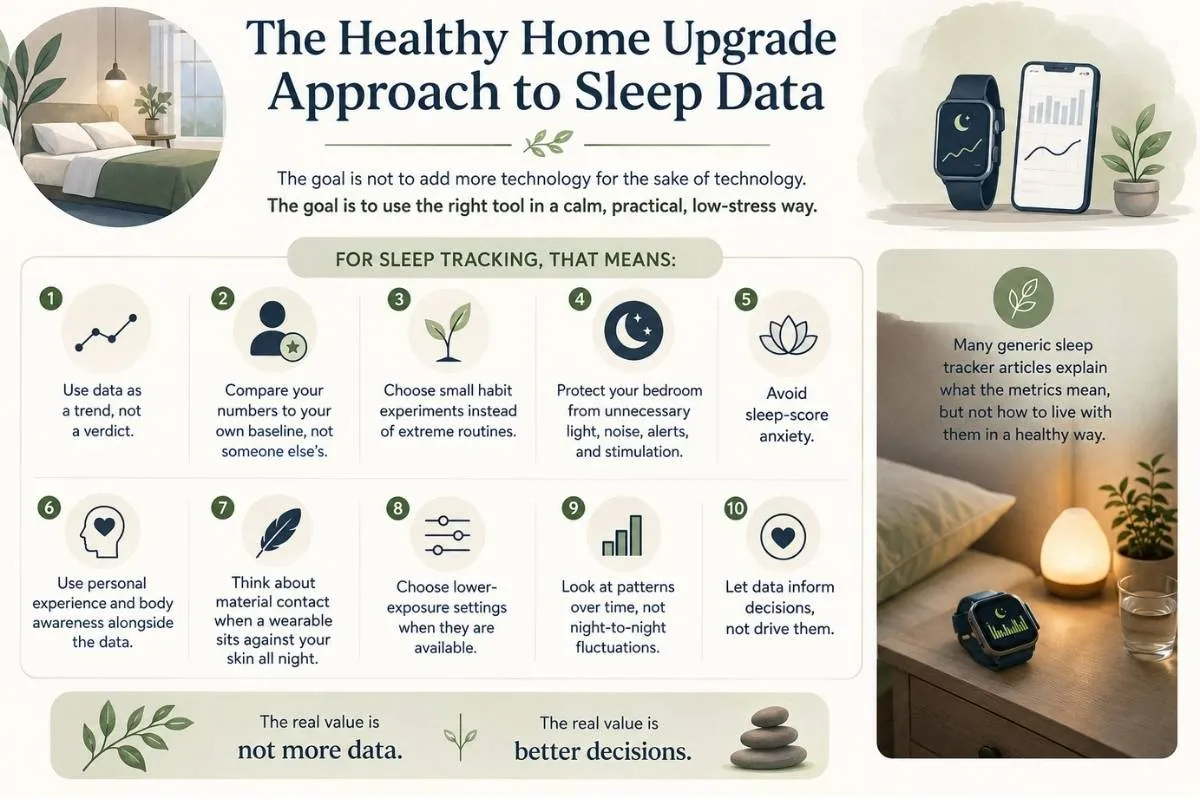
At Healthy Home Upgrade, the goal is not to add more technology for the sake of technology.
The goal is to use the right tool in a calm, practical, low-stress way.
For sleep tracking, that means:
- using data as a trend, not a verdict
- comparing your numbers to your own baseline, not someone else’s
- choosing small habit experiments instead of extreme routines
- protecting your bedroom from unnecessary light, noise, alerts, and stimulation
- avoiding sleep-score anxiety
- using personal experience and body awareness alongside the data
- thinking about material contact when a wearable sits against your skin all night
- choosing lower-exposure settings when they are available
This is where many generic sleep tracker articles fall short. They explain what the metrics mean, but they do not always explain how to live with them in a healthy way.
The real value is not more data.
The real value is better decisions.
At-a-Glance: The Three Sleep Metrics That Matter Most
| Metric | What It Can Suggest | Best Way to Use It | What Not to Do |
| HRV | Recovery, stress load, nervous system balance | Watch your own 7 to 14 day trend | Compare your HRV to other people |
| Sleep latency | How long it takes to fall asleep | Notice patterns after caffeine, stress, screens, meals, and training | Panic over one long night |
| REM trends | Sleep timing, stress, alcohol, late nights, early wake-ups | Watch weekly patterns | Treat one low REM reading as a crisis |
CTA box:
Still choosing a device? Start with our Best Sleep Tracker guide.
Metric 1: HRV: Your Recovery Trend, Not Your Worth
HRV stands for heart rate variability. It measures tiny changes in timing between heartbeats.
Harvard Health describes HRV as a reflection of the autonomic nervous system, which helps regulate involuntary functions such as heart rate, breathing, digestion, stress response, and relaxation. Harvard also notes that people should focus on their own HRV baseline instead of comparing their number with someone else’s.
That is exactly how I use it.
A higher HRV is often associated with better recovery and adaptability, but that does not mean higher is always better every single night.
HRV is personal.
Your baseline matters much more than someone else’s number.
Two people can both be healthy and have very different HRV ranges. Age, fitness, hormones, illness, stress, alcohol, sleep debt, training load, medications, and measurement timing can all influence HRV.
So the real question is not:
“Is my HRV high enough?”
The better question is:
“Is my HRV moving up, down, or staying stable compared with my own normal?”
How I Use HRV in Real Life
When my Oura Ring 4 shows a lower HRV, I do not automatically see it as a failure.
I ask:
- Did I train harder than usual?
- Did I eat too late?
- Did I sleep less?
- Did I feel emotionally stressed?
- Did I have too much stimulation in the evening?
- Did I ignore my need for recovery?
- Was my room too warm?
- Did I spend too much time on screens?
- Did I feel different before I checked the data?
That last question is important.
Before I let the data affect my mood, I try to check in with my body first.
Do I feel calm? Heavy? Wired? Rested? Inflamed? Clear? Tired?
This keeps the tracker in the right place. It supports my body awareness instead of replacing it.
Real-Life HRV Habit Tests
| HRV Pattern | Possible Meaning | Habit to Test |
| Lower HRV after intense exercise | Your body may need more recovery | Replace one hard session with walking, mobility, or zone 2 |
| Lower HRV after late dinner | Digestion may be affecting sleep quality | Finish dinner earlier for 3 to 5 nights |
| Lower HRV after alcohol | Alcohol may be fragmenting recovery | Remove alcohol and compare your trend |
| Lower HRV during emotional stress | Nervous system load may be high | Add breathwork, journaling, meditation, or evening light reduction |
| HRV improves with consistency | Your routine may be working | Keep bedtime, wake time, meals, and training rhythm stable |
Metric 2: Sleep Latency: How Easily Your Body Downshifts
Sleep latency means how long it takes to fall asleep after you are ready for sleep.
Sleep Foundation describes sleep latency as the time it takes to fall asleep after turning out the lights. It notes that a normal sleep latency often falls around 10 to 20 minutes, although individual variation matters.
This metric is useful because it reflects your transition from daytime activation into nighttime rest.
If your sleep latency is often very long, your body may not be getting a clear enough signal that the day is over.
If your sleep latency is extremely short every night, it may sometimes mean you are sleep deprived rather than perfectly relaxed.
Again, the pattern matters more than one night.
What Long Sleep Latency Can Suggest
Long sleep latency can be connected to:
- too much bright light at night
- late screen exposure
- caffeine too late in the day
- stress or rumination
- late intense exercise
- eating too close to bed
- an inconsistent sleep schedule
- a bedroom that feels too warm, noisy, or stimulating
- checking sleep data too often and becoming anxious about sleep
This is one reason I do not think sleep trackers should be used aggressively.
If the tracker itself makes you anxious, the tool may be interfering with the thing you are trying to improve.
Real-Life Sleep Latency Habit Tests
| Pattern | What to Try |
| Takes 45+ minutes to fall asleep after screen use | Reduce bright screens and emotionally stimulating content |
| Takes longer after late caffeine | Move caffeine earlier or reduce the amount |
| Takes longer after late workouts | Move intense training earlier and keep evenings calmer |
| Takes longer after emotional stress | Add a 5-minute worry list, breathwork, or meditation |
| Falls asleep faster in a cooler room | Lower bedroom temperature or use lighter bedding |
| Sleep latency worsens after checking data repeatedly | Stop checking sleep metrics before bed or first thing in the morning |
Metric 3: REM Trends: Look at the Week, Not the Night
REM sleep is one of the major sleep phases.
The National Heart, Lung, and Blood Institute explains that sleep cycles through REM and non-REM phases, and that the cycle restarts about every 80 to 100 minutes. NHLBI also notes that you usually have more REM sleep later in the night.
This matters because REM sleep often becomes more prominent later in the night.
So if you cut your sleep short, wake very early, or have fragmented early-morning sleep, your tracker may show lower REM.
But REM is also one of the sleep-stage metrics that consumer trackers may estimate imperfectly.
That does not make the number useless.
It means you should use it as a trend, not as an absolute truth.
A practical way to use REM data is to ask:
- Did I give myself enough time in bed?
- Did I wake too early?
- Did I drink alcohol?
- Did I eat late?
- Was I stressed?
- Did I have a consistent wake time?
- Did I get morning light?
- Did my body feel recovered even if the tracker score was not perfect?
What Low REM Trends Can Suggest
If your REM is low for several nights, look at:
- short total sleep time
- very early wake-ups
- alcohol close to bedtime
- late heavy meals
- stress
- irregular sleep schedule
- too much sleep-score anxiety
- overtraining or poor recovery
You do not need a special REM hack.
Most REM-supportive habits are simple:
- keep a consistent wake time
- give yourself enough time in bed
- avoid cutting sleep short
- reduce alcohol
- reduce late heavy meals
- create a calmer evening routine
- get daylight earlier in the day
- avoid checking your sleep score immediately if it increases stress
Oura Ring 4 and Smart Sensing: Why I Still Watch Trends
Oura Ring 4 uses Smart Sensing, which Oura describes as a platform that adapts to the user’s finger and selects signal paths dynamically. Oura also says the Ring 4 sensors include red and infrared LEDs for blood oxygen during sleep, green and infrared LEDs for heart rate and HRV, a digital temperature sensor, and an accelerometer for movement and activity.
That is impressive.
But I still do not treat the data as a perfect medical measurement.
I treat it as a useful trend layer.
That is an important difference.
The more advanced the tracker becomes, the more tempting it is to believe every number without question. But your body is not a spreadsheet. Your lived experience still matters.
For me, the strongest use of Oura Ring 4 is this:
It helps me notice what my body may already be trying to tell me.
The Real-Life Rule: Change One Habit at a Time
The biggest mistake people make with sleep tracker data is changing too many things at once.
They see a bad score and suddenly they:
- change bedtime
- change supplements
- change exercise
- change dinner
- change screens
- change bedroom temperature
- change their whole morning routine
Then they have no idea what actually helped.
A better system is:
- Notice the pattern
- Choose one habit
- Test it for three to seven nights
- Compare your trend
- Keep it only if it genuinely helps
This is how your tracker becomes useful.
My Simple Oura-Based Sleep Reflection
When I use my Oura Ring 4, I try to look at the data like this:
First, I ask how I feel
Before opening the app, I notice my body.
Do I feel rested, calm, heavy, tense, clear, or wired?
Then I check the trend
I look at HRV, resting heart rate, sleep latency, and sleep timing.
Not just the score.
Then I ask what changed
Was it training? Stress? Late food? Screen time? Travel? Temperature? Emotional load?
Then I choose one small adjustment
Not ten.
One.
That is what makes sleep tracker data useful in real life.
A 7-Day Sleep Tracker Reset
Day 1: Observe Without Changing Anything
Do not fix anything yet.
Look at your normal baseline for HRV, latency, REM, total sleep, wake-ups, resting heart rate, and how you actually feel.
Day 2: Move Light Earlier
Get outdoor light earlier in the day and reduce bright light in the evening.
Day 3: Stop Eating Earlier
Finish your last heavy meal earlier and see whether sleep latency, resting heart rate, or HRV shifts.
Day 4: Reduce Screen Stimulation
Do not only dim the screen.
Reduce emotional stimulation too: stressful news, work messages, online arguments, intense content, and late-night scrolling.
Day 5: Adjust Exercise Timing
If your tracker shows lower HRV after hard evening workouts, test a calmer evening and move intensity earlier.
Day 6: Protect the Last Hour
Create a repeatable wind-down signal: dim light, warm shower, stretching, breathwork, reading, or calm music.
Day 7: Compare Trends, Not Perfection
Look for direction, not perfection.
Did sleep latency improve? Did HRV stabilize? Did REM look better when total sleep was longer?
That is useful data.
Low-Exposure Sleep Tracking: A Healthy Home Upgrade Perspective
A sleep tracker should not make your bedroom feel like a mini command center.
For sensitive sleepers, a calmer setup may mean:
- choosing a ring instead of a bright-screen watch
- using Airplane Mode when possible
- syncing data away from the bed
- avoiding constant nighttime notifications
- turning off unnecessary alerts
- keeping the bedroom dark, cool, calm, and simple
- using the tracker for trends, not emotional reassurance
Oura states that Airplane Mode disables radio transmission from the ring, including Bluetooth connection between the ring and app, while the ring continues to collect and store data. Oura also states that the ring data syncs with the app when Airplane Mode is disabled.
In my own routine, I like the option of collecting sleep data overnight and syncing it away from the bed later. For me, that supports a calmer bedroom setup.
This is not about fear.
It is about making the sleep environment feel quieter, cleaner, and less stimulating.
This is one reason the Oura Ring 4 fits my personal sleep routine better than a screen-based wearable at night. It gives me useful recovery data without adding another glowing display to the bedroom.
That does not mean Oura is right for everyone.
It means the best sleep tracker is the one you can use calmly and consistently.
CTA box:
Prefer a lower-distraction wearable? Read our Best Sleep Tracking Ring guide.
What I Would Not Use Oura Ring 4 For
I like using my Oura Ring 4 as a trend tool, but I would not use it as a medical diagnosis tool or as the final authority on how I feel.
A few limitations matter.
It can estimate sleep stages, but it is not a sleep lab.
It may not always know the difference between very still wakefulness, meditation, and sleep.
It can become stressful for people who already feel anxious about health data.
It is most useful when you look at trends, not single-night scores.
Who should be careful with sleep tracking?
People who become obsessive, anxious, or emotionally affected by health scores may need to use sleep trackers more gently, check data less often, or avoid sleep tracking altogether for a period.
A sleep tracker should make you calmer and more informed.
It should not make you more afraid of your own body.
How to Avoid Sleep Score Anxiety
Sleep trackers should support your health, not make you afraid of your own night.
A simple rule:
Do not check your sleep score until after you have noticed how you actually feel.
Ask yourself first:
- Do I feel rested?
- Is my mood stable?
- Do I have energy?
- Do I feel calm or wired?
- Did I wake up naturally or struggle?
- Does the data match my lived experience?
Then check the data.
This protects your body awareness.
Your tracker is one input, not the final judge.
When Sleep Tracker Data May Be a Red Flag
A tracker cannot diagnose you.
But it can help you notice patterns worth discussing with a professional.
Consider medical guidance if you repeatedly see or experience:
- very low oxygen readings
- loud snoring plus daytime sleepiness
- frequent awakenings
- unrefreshing sleep despite enough time in bed
- long-term insomnia
- very irregular heart rhythm alerts
- extreme fatigue
- sudden major changes in sleep or recovery data
This is especially important if symptoms match the data.
Do not rely on the device alone.
Best Internal Next Reads
If you are still choosing a device, start with our guide to the Best Sleep Tracker.
If you prefer a lower-distraction wearable, read our guide to the Best Sleep Tracking Ring.
If you are comparing recovery-focused wearables, see WHOOP vs Oura.
If your sleep problems feel more nervous-system related than data-related, read the Apollo Neuro Review.
If you already know Oura is the right fit, check our Oura Ring Coupon Code page before buying.
You may also like: Best Sleep Tracker Settings for Sensitive Nervous Systems, especially if sleep data sometimes makes you anxious instead of calmer.
FAQ
What sleep tracker data should I focus on first?
Start with HRV, sleep latency, total sleep time, wake-ups, and REM trends. Do not try to interpret every number at once. HRV and latency are especially useful because they often respond clearly to stress, training, caffeine, late meals, and evening routines.
Is HRV more important than sleep score?
For many people, HRV trends are more useful than a single sleep score because HRV can reflect how the body is responding to stress, recovery, and lifestyle patterns. But HRV should still be compared to your own baseline, not to someone else’s number.
Is REM sleep on a tracker accurate?
Consumer trackers estimate REM using sensors and algorithms, but they are not the same as a sleep lab. Use REM as a trend over time, not as a perfect nightly measurement.
What does low HRV after sleep mean?
Low HRV can reflect stress, poor recovery, intense exercise, alcohol, illness, poor sleep, dehydration, or other factors. One low night is usually not meaningful. A repeated drop compared with your own baseline is more useful.
How long should it take to fall asleep?
Many healthy adults fall asleep within roughly 10 to 20 minutes, but individual nights vary. If you regularly take much longer to fall asleep and feel tired during the day, it may be worth improving sleep habits or speaking with a professional.
Should I check my sleep score every morning?
Not immediately if it affects your mood. First notice how you feel, then check the data. This helps you avoid sleep-score anxiety and keeps the tracker in its proper place.
Can Oura Ring 4 track HRV?
Yes. Oura states that Oura Ring 4 uses green and infrared PPG sensors to measure heart rate, heart rate variability, and respiration rate during sleep.
Does Oura Ring 4 have Airplane Mode?
Yes. Oura states that Airplane Mode disables radio transmission, including Bluetooth connection between the ring and app, while the ring continues collecting and storing data. The data syncs when Airplane Mode is disabled.
Can sleep tracker data imp