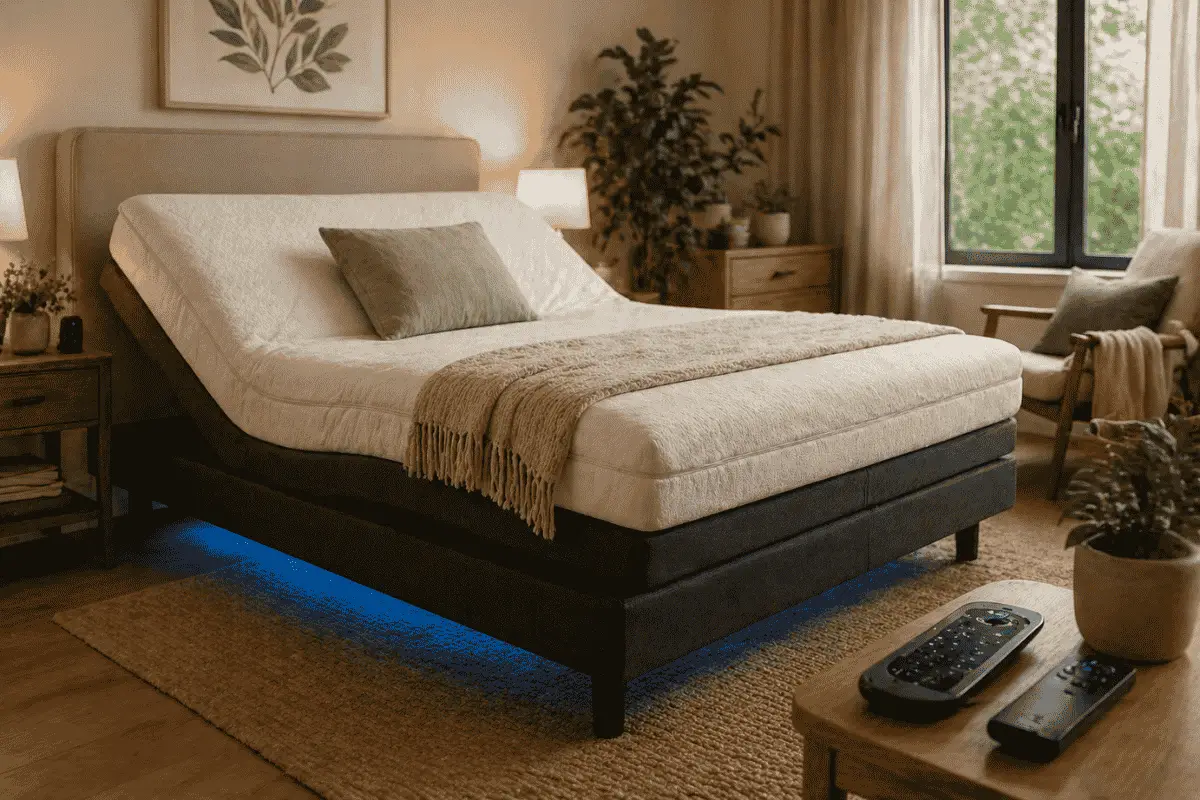
Smart beds and adjustable bed bases can fit into a low-exposure bedroom, but only if you choose them intentionally. The goal is not to fear every motor, wire, remote, or smart feature. The goal is to avoid unnecessary electronics in the place where your body is supposed to recover deeply.
An adjustable base usually contains motors, wiring, a power supply, a remote control, and sometimes Bluetooth, WiFi, USB ports, under-bed lighting, massage settings, or app control. Some of these features can be useful. Others are simply extra electronics near the bed that many people never use.
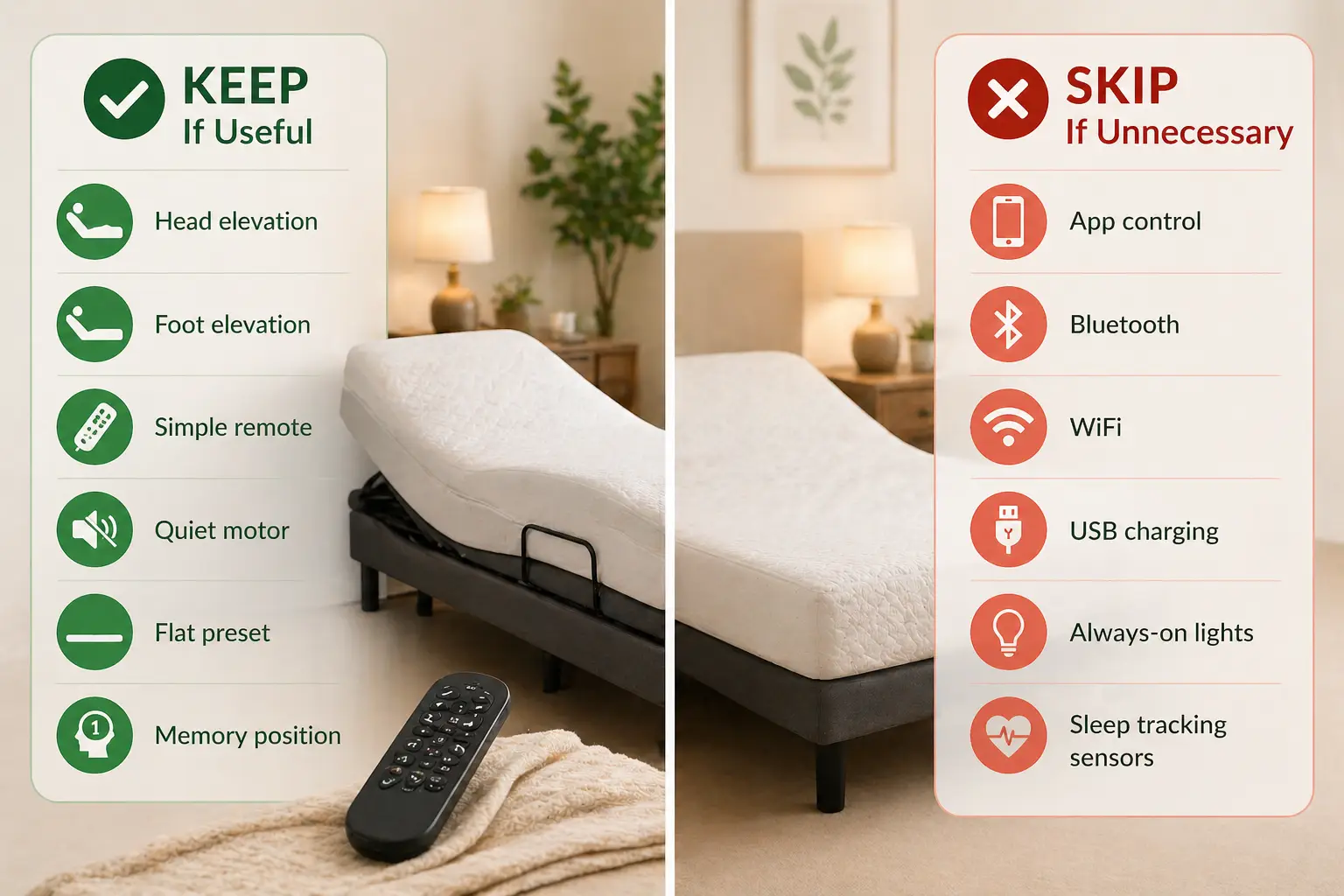
From a Zero Toxic Load perspective, the best smart bed is not always the most advanced one. It is the one that gives you the function you actually need, such as head elevation, foot elevation, or zero gravity positioning, without adding unnecessary wireless features, lights, chemical smells, motor noise, or complicated controls.
If you are comparing adjustable bases, my full buying guide to the best adjustable bed bases is here: Elevate Your Sleep: The 5 Best Adjustable Bed Bases
Also in This Article
- What makes a bed smart
- Where EMF can come from in adjustable bases
- Motors, wiring, remotes, Bluetooth, and app control
- Which features matter and which ones are unnecessary
- How to reduce exposure without becoming obsessive
- When a simple adjustable base is better than a smart bed
- What to look for in a low-exposure bedroom
- Final decision guide
What Makes a Bed Smart?
The word smart can mean many things in sleep products.
Sometimes it simply means the base has a remote control and adjustable positions. Sometimes it means the bed connects to an app, tracks sleep, includes sensors, responds to voice control, offers massage settings, or has USB charging and under-bed lighting.
That is a big difference.
A basic adjustable base with a wired motor and simple remote is not the same as a fully connected smart bed with wireless tracking and app control. Both may be marketed as modern sleep technology, but they do not create the same bedroom environment.
This is where buyers need to slow down.
The real question is not, “Is this bed smart?”
The better question is, “Which smart features will I actually use, and which ones will just sit next to me every night?”
Quick Comparison
| Feature | Useful for Some Sleepers | Low-Exposure Consideration |
| Head elevation | Reflux comfort, reading, snoring comfort | Usually one of the most practical features |
| Foot elevation | Leg comfort, recovery, pressure relief | Useful if you actually use it |
| Zero gravity preset | Relaxation and pressure comfort | Helpful but not essential for everyone |
| Wireless remote | Easy control | Usually fine, but avoid extra features you do not need |
| App control | Convenience and presets | Not necessary for many people |
| Bluetooth or WiFi | Tracking or app features | Skip if you prefer fewer wireless signals near the bed |
| USB ports | Charging devices | Can encourage phone use near sleep |
| Under-bed lighting | Night visibility | Choose lights that can turn fully off |
| Massage motors | Relaxation | Adds more motor use, vibration, and noise |
| Sleep tracking sensors | Data and patterns | Useful for some, stressful for others |
Where EMF Comes From in Smart Beds
EMF stands for electromagnetic fields. In a bedroom, EMF can come from many sources, including lamps, power cords, chargers, WiFi routers, phones, tablets, electric blankets, smart watches, and powered furniture.
In a smart bed or adjustable base, possible sources include:
- Motors
- Power supply
- Control box
- Power cords
- Wireless remote
- Bluetooth or WiFi connection
- USB charging ports
- Under-bed lights
- Massage motors
- Sleep tracking sensors
- App-connected features
This does not mean every adjustable base is a problem. It simply means the bed is no longer just wood, metal, and fabric. It becomes an electrical object inside the sleep environment.
For many people, that will not matter much. For sensitive sleepers, highly intentional buyers, or anyone building a calmer bedroom, it is worth considering.
The Balanced View: Function First, Fear Last
A low-exposure bedroom should not be built from fear.
It should be built from clarity.
If an adjustable base helps you sleep better because you need head elevation, leg elevation, or better resting posture, that benefit may matter. Poor sleep has its own cost. A simple, well-chosen adjustable base can be a good tool.
But if the bed is full of features you never use, that is different.
There is no need to add Bluetooth, app control, USB charging, glowing lights, tracking sensors, and massage functions if all you really need is a quiet base that raises the head and feet.
The goal is not to reject technology. The goal is to choose technology that earns its place in the bedroom.
My Own Approach to the Bedroom
When I started thinking more seriously about what goes into a healthy home, the bedroom was one of the first places I looked.
Sleep is not just about the mattress. It is also about what surrounds you at night: light, noise, cords, screens, air quality, materials, and the small electronics that slowly become normal beside the bed.
I do not have a fully technology-free bedroom, and I am not trying to. But I do try to make deliberate choices. My phone does not need to charge beside my pillow. I do not want app control or sleep tracking unless it truly helps. And if I choose an adjustable base, I would rather have a simple remote that does what I need, instead of a bed that turns into another smart device.
That is what Zero Toxic Load means to me in a sleep space. Not perfection. Just fewer things that do not need to be there.
EMF showdown: compare adjustable bed bases – which motors run cleanest?
Motors: What Actually Matters
Motors are the part of an adjustable base that make the bed move. They lift the head section, foot section, or both.
From a practical sleep quality perspective, the motor should be:
- Quiet
- Smooth
- Strong enough for the mattress and sleeper weight
- Reliable
- Easy to control
- Not used constantly through the night
Most people adjust the bed before sleep, while reading, or when waking. The motor is usually not running all night. That matters because the motor is active mainly during movement, not during normal still sleep.
For a low-exposure setup, the bigger questions are simple:
- Is the motor quiet enough not to disturb sleep?
- Can the bed return to flat easily?
- Can lights and extra features turn off completely?
- Can the base be unplugged when not in use, if that fits your routine?
- Is the power cord placed away from your head area?
A motor is not automatically a reason to avoid an adjustable base. But it is a reason to avoid poorly made products, noisy movement, unnecessary massage features, and cluttered wiring.
Smart buying decoded: adjustable bed base buying guide – exposure ratings included
Remote Controls: Simple Is Usually Better
A remote control can be helpful. It makes the bed easy to adjust without getting up.
The problem is when a simple remote becomes part of a larger smart system you do not need.
A good remote should be easy to use in the dark and not overloaded with confusing buttons. The most useful controls are usually:
- Head up
- Head down
- Foot up
- Foot down
- Flat preset
- One or two memory positions
- Zero gravity preset, if included
Many people do not need app control if the remote already works well.
For a calmer bedroom, simple is often better. You want the base to support sleep, not turn your bed into another device you have to manage.
Bluetooth, WiFi, and App Control
Bluetooth and WiFi features can be convenient, but they are not essential for most adjustable bases.
App control may be useful if you want saved positions, sleep tracking, partner settings, or smart home integration. But it can also encourage more phone use in bed, more notifications, more troubleshooting, and more technology in a room that should help your nervous system slow down.
If you are trying to create a low-exposure bedroom, ask:
- Can the base work without the app?
- Can wireless features be disabled?
- Does the remote work independently?
- Are Bluetooth or WiFi required for basic movement?
- Will the app make sleep better, or just add another screen?
If the bed cannot function properly without the app, that is a downside for anyone who wants a simpler setup.
A low-exposure bedroom does not have to be anti-technology. But it should be selective.
Sleep quality meets low exposure: best adjustable bed bases for sleep quality
USB Ports and Charging Near the Bed
USB ports sound convenient, but they are one of the features I question most in a sleep environment.
Charging your phone directly from the bed can make it easier to keep the phone close to your head, check it late at night, or start the morning with scrolling.
From a sleep quality perspective, that may matter more than the port itself.
If you want a calmer bedroom, consider charging your phone across the room or outside the bedroom. A simple charging station away from the bed can support better boundaries around sleep.
If an adjustable base includes USB ports, you do not have to use them. But I would not make USB charging a priority feature unless you truly need it.
Under-Bed Lighting
Under-bed lighting can be useful if you get up at night and do not want to turn on bright overhead lights.
The problem is when the lighting cannot be fully turned off, feels too bright, or creates unnecessary visual stimulation.
For a low-exposure bedroom, look for:
- Lights that can turn fully off
- Warm, soft lighting rather than harsh light
- No glowing control panels near your face
- No always-on indicator lights if they bother you
- Easy controls that do not require an app
Bedroom light should be gentle and intentional. If a bed adds more glow, blinking, or visual clutter, it may work against the calm feeling you are trying to create.
Massage Features: Helpful or Just Extra?
Massage features can feel relaxing, but they are not essential for everyone.
In an adjustable base, massage usually means vibration. Some people love it. Others find it noisy, stimulating, or unnecessary.
Before paying more for massage, ask yourself:
- Will I actually use it?
- Does it help me relax, or does it feel like a gimmick?
- Is the motor quiet enough?
- Can the feature be fully turned off?
- Does it add complexity I do not need?
For some people, a massage function is a nice wind-down tool. For others, it is one more feature that sounds good in the store but rarely gets used.
From a low-exposure and low-stimulation perspective, I would not choose a bed for massage alone.
Sleep Tracking Sensors
Some smart beds include sleep tracking. They may track movement, breathing patterns, heart rate patterns, sleep stages, or time in bed.
This can be useful for people who love data and want to understand their sleep routine more clearly.
But sleep tracking can also become stressful.
If you wake up and immediately check a score, you may start judging your sleep before you even feel your body. For some people, that creates more anxiety, not better recovery.
A low-exposure bedroom is not only about EMF. It is also about mental load.
Ask yourself:
- Does sleep data help me make better choices?
- Do I feel calmer with tracking, or more worried?
- Can I use the bed without tracking?
- Can the sensors be disabled?
- Do I already track sleep with another device?
If you already use a wearable or sleep app, a tracking bed may be unnecessary.
Can You Have a Smart Bed in a Low-Exposure Bedroom?
Yes, you can have a smart bed in a low-exposure bedroom if the bed is chosen carefully.
The key is to separate useful function from unnecessary technology.
A low-exposure smart bed setup might look like this:
- A simple adjustable base
- Head and foot elevation
- Quiet motor
- Simple remote
- No required app
- No always-on lights
- No unnecessary Bluetooth or WiFi
- No USB charging used near the head
- Power cords managed away from the pillow area
- Bedroom phone charging kept away from the bed
That setup gives you the benefit of adjustable positioning without turning the bedroom into a tech zone.
Can You Unplug an Adjustable Bed at Night?
In many cases, you can unplug an adjustable bed when it is not in use, but it depends on the model and your routine.
Some people adjust the bed before sleep, then unplug the base after it is in position. Others prefer to keep it plugged in so they can change position during the night or return it to flat easily.
Before making this a habit, check the manufacturer’s instructions. Some bases may have memory settings, backup batteries, or reset procedures that matter.
A practical approach is:
- Adjust the bed to your sleep position
- Turn off lights and extra features
- Keep the remote nearby
- Unplug only if it is safe and convenient
- Do not create a routine that becomes stressful
The best low-exposure routine is one you can actually maintain.
Are Adjustable Bed Bases High EMF?
There is no single answer because adjustable bed bases vary widely.
A simple adjustable base with motors and a remote is very different from a connected smart bed with app control, sensors, wireless tracking, lighting, USB ports, and multiple electronic features.
This is why it is better to evaluate the specific bed rather than the category.
Ask:
- Does it require WiFi?
- Does it use Bluetooth?
- Does it include sleep tracking sensors?
- Are there USB ports?
- Does it have always-on lighting?
- Can wireless features be turned off?
- Can the bed function with a simple remote?
The more electronic features a bed has, the more intentional you should be about whether they are worth it.
For most people, the practical goal is not to measure every signal. It is to avoid unnecessary electronics near the bed, choose a simple design when possible, and keep the bedroom calm.
Low-Exposure Bedroom Checklist
A low-exposure bedroom is not only about the bed. It is about the whole sleep environment.
Consider:
- Move phone charging away from the bed
- Keep WiFi router out of the bedroom if possible
- Avoid sleeping next to power strips
- Choose lamps with simple switches
- Turn off unnecessary lights
- Avoid bright screens before bed
- Keep cords away from the pillow area
- Choose low-VOC bedding and furniture
- Air out new furniture before sleeping near it
- Avoid unnecessary smart devices in the room
This matters because focusing only on the bed can miss the bigger picture.
If your phone, router, tablet, smart watch charger, lamp cords, and laptop are all next to your pillow, changing the bed base alone will not create a low-exposure bedroom.
Zero Toxic Load Lens: Materials Still Matter
EMF is only one part of the smart bed conversation.
Materials matter too.
An adjustable base may include metal, wood, plywood, fabric, foam padding, adhesives, plastic components, wiring, and finishes. Some bases have more upholstery and padding than others.
From a Zero Toxic Load lens, look for:
- Low-VOC materials
- Minimal chemical smell
- Clear material information
- Strong metal or wood structure
- Less unnecessary foam and padding
- Certifications where available
- Good ventilation before use
- No strong odor after unpacking
- A return policy if the smell is overwhelming
A smart bed should not only feel comfortable in the showroom. It should also feel acceptable in the air you breathe every night.
What to Look For in a Low-Exposure Adjustable Base
If you want an adjustable base but prefer a calmer bedroom, prioritize:
- Head and foot elevation
- Quiet motors
- Simple remote
- No required app
- No required WiFi
- Ability to turn lights off completely
- Minimal upholstery
- Low-VOC material information
- Strong frame construction
- Good mattress compatibility
- Clear warranty
- Good return policy
Features I would treat as optional:
- Massage
- USB ports
- App control
- Bluetooth
- Sleep tracking
- Voice control
- Under-bed lighting
- Smart home integration
The more sensitive you are to bedroom electronics, the more you should lean toward a simple adjustable base rather than a fully connected smart bed.
When Smart Features Are Actually Worth It
Some smart features can be useful.
A memory preset may be worth it if you use the same elevated position every night. A zero gravity button may be helpful if you use that position often. Under-bed lighting may be useful if you get up at night and want soft light.
For couples, split control can be very valuable if one person needs elevation and the other does not.
Smart features are worth it when they solve a real problem.
They are not worth it when they simply make the product sound more advanced.
When to Choose a Traditional Frame Instead
A traditional frame may be the better choice if your top priority is simplicity.
Choose a traditional frame if:
- You sleep well flat
- You dislike electronics near the bed
- You do not need elevation
- You want fewer parts that can break
- You are sensitive to lights or motor noise
- You want a lower cost setup
- You prefer solid wood or metal furniture
- Your mattress is not adjustable-base compatible
A traditional frame can be a very healthy choice. It may be the cleanest option for people who want a quiet, simple, low-tech bedroom.
When an Adjustable Base Still Makes Sense
An adjustable base may still make sense if the positional benefits are meaningful for you.
Choose an adjustable base if:
- You sleep better with your head raised
- You use pillows to prop yourself up
- You need leg elevation
- You read or relax in bed often
- You want zero gravity positioning
- You share a bed with someone who has different needs
- You want more recovery comfort
- Your mattress is compatible
- You can choose a simple low-feature model
This is the best middle ground: useful movement without unnecessary smart overload.
Decision Guide: Smart Bed, Simple Adjustable Base, or Traditional Frame?
Choose a traditional frame if you want:
- No motors
- No wiring
- No remotes
- No app
- Lower cost
- Simple materials
- A low-tech sleep space
Choose a simple adjustable base if you want:
- Head elevation
- Foot elevation
- Comfort positions
- A basic remote
- Fewer smart features
- Less tech complexity
- Good support for sleep posture
Choose a full smart bed if you want:
- Sleep tracking
- App control
- Sensors
- Personalized settings
- Partner data
- Smart home features
- Advanced comfort technology
The most expensive option is not automatically the healthiest option.
The best option is the one that improves your sleep without adding stress, clutter, or features you do not need.
My Honest Take
I like the idea of adjustable beds when they solve a real problem.
I am much less impressed by smart beds that add technology simply because they can.
A bed should help the body settle. It should not feel like another device, another app, another score, another light, or another source of stimulation.
If head elevation, foot elevation, or zero gravity positioning helps you rest better, an adjustable base can be a smart and practical upgrade. But I would choose the simplest version that does the job well.
For a low-exposure bedroom, less is often better.
Not less comfort.
Not less support.
Less unnecessary technology.
Final Thoughts
Smart beds can fit into a low-exposure bedroom, but only when the technology is chosen with care.
The goal is not to avoid every wire, motor, or remote. The goal is to avoid unnecessary features that do not improve sleep.
A simple adjustable base with quiet motors, a basic remote, no required app, no always-on lights, and good material quality may be a very reasonable choice. A fully connected smart bed with wireless tracking, app control, USB charging, bright lights, and extra sensors may be more than many people need.
Before buying, ask one simple question:
Does this feature help me sleep better, or does it just make the bed sound smarter?
That question will protect your budget, your bedroom, and your sleep environment.
If you are ready to compare adjustable bases, see my full guide to the best adjustable bed bases here: Insert internal link to Elevate Your Sleep: The 5 Best Adjustable Bed Bases